
Hiring the wrong person costs a small business far more than a bad quarter. Research from the U.S. Department of Labor puts the direct cost of a mis-hire at roughly 30% of that employee’s first-year salary, before counting lost productivity or team disruption. Resumes and gut-feel interviews rarely catch that risk early enough.
Talent assessment software gives small firms and startups a faster, fairer way to screen candidates before an offer goes out. The right platform reveals cognitive ability, behavioral fit, and real job skills long before a candidate sits down for a final interview.
This guide breaks down the 15 best talent assessment software for small firms in 2026, based on pricing accessibility, ease of setup, and how well each tool actually fits a small hiring team’s budget and workflow, so you can pick the right one with confidence.
What Is Talent Assessment Software?
Talent assessment software is a digital tool that measures a candidate’s skills, cognitive ability, personality, or job-specific behavior before they get hired. Instead of relying only on a resume and an interview, a hiring manager sends candidates a structured test and gets back a scored, comparable report.
For small businesses specifically, the best talent assessment tools tend to combine a few things well: fast setup, honest pricing for low hiring volume, and tests that actually predict how someone performs on the job, not just how they answer a personality quiz.
A good assessment platform typically covers one or more of these categories: cognitive ability, personality and behavioral fit, technical or role-specific skills, and situational judgment. Most small firms get the best results by combining two of these rather than relying on just one.
Top 15 Talent Assessment Software for Small Firms
Each tool below was evaluated on real user feedback, feature depth, pricing accessibility for small teams, and how well it holds up against the gaps found in typical competitor round-ups, thin descriptions, vendor bias, and missing buying guidance chief among them.
1. TestGorilla
TestGorilla – Best Overall Talent Assessment Software for Small Firms
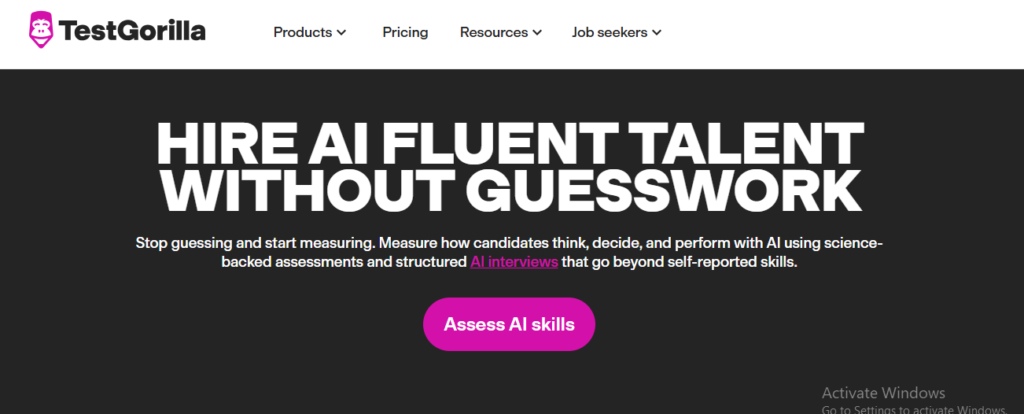
TestGorilla built its reputation on one simple idea: give small companies the same testing depth that big enterprises pay a fortune for, without the enterprise price tag. The platform hosts a library of hundreds of validated tests covering cognitive ability, personality, coding, language, and job-specific skills, and a small firm can mix and match up to five tests into a single assessment.
It ranks highly here because a five-person HR team can build a professional screening process in an afternoon, without a psychology degree or a big software budget. Candidates never need to create an account, which keeps completion rates high, and built-in webcam checks and full-screen monitoring cut down on cheating during remote testing.
The real differentiator is flexibility on price. A forever-free plan lets a founder test the waters with five tests and unlimited candidates before committing to a paid tier, something most competitors in this space simply do not offer.
✅ Key Features
- 400+ ready-made tests spanning cognitive ability, personality, coding, and role-specific skills, so a small team can build a full assessment without writing a single question.
- Custom question types including essay, video response, and file upload, letting hiring managers add a company-specific task on top of the standard library.
- Anti-cheating safeguards such as webcam snapshots, full-screen lockdown, and tab-switch alerts that protect assessment integrity during unsupervised remote testing.
- No candidate account required, which removes a common drop-off point and keeps completion rates higher than platforms that force a signup step.
- Automated candidate ranking that scores and sorts applicants the moment they finish, so a hiring manager can open a shortlist instead of a spreadsheet.
- A free-forever plan with five tests and unlimited candidates, giving small firms room to trial the platform before paying anything.
✅ Pros
- Free tier makes it realistic for a bootstrapped small business to start testing candidates immediately.
- Massive test library covers nearly every entry-level and mid-level role a growing company hires for.
- Fast setup means a non-technical HR generalist can launch an assessment in under an hour.
- Strong anti-cheating tools for remote and distributed hiring teams.
- Clear, side-by-side candidate scoring that speeds up shortlisting decisions.
❌ Cons
- Annual billing is required once a team grows past 15 full-time employees, which can catch a scaling startup off guard.
- TestGorilla branding shows up on the candidate-facing screens for lower-tier plans.
- Deep customization for niche technical roles is more limited than a specialist coding platform.
- Some assessments cannot be edited once published, which means a typo in a custom question sticks around.
Best For: Small businesses and early-stage startups that want a wide test library and a genuine free tier before committing budget to a paid plan.
2. Vervoe
Vervoe – Best for Skills-Based Job Simulations
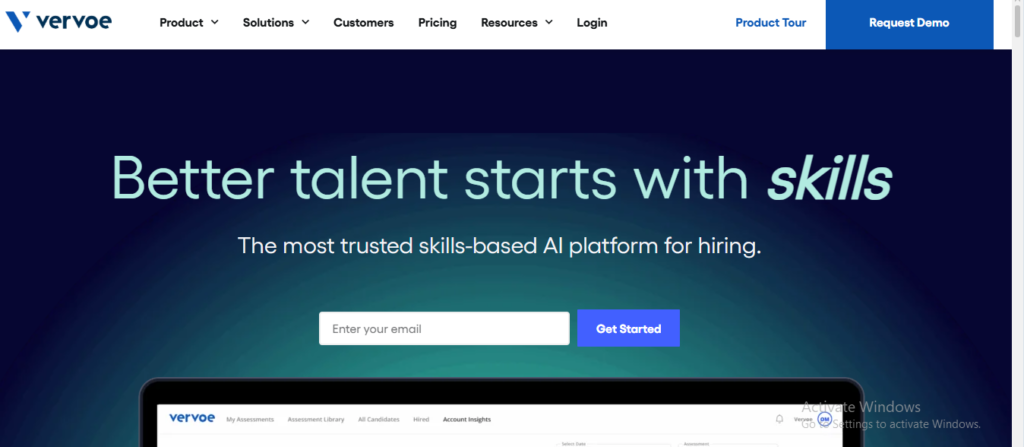
Vervoe takes a different angle on assessment than most tools on this list. Instead of leaning on personality quizzes or abstract cognitive puzzles, it asks candidates to actually do the job, using realistic simulations for sales calls, customer support tickets, writing samples, and technical tasks.
That approach makes it a favorite with small firms hiring for non-technical, customer-facing roles where a resume tells you almost nothing useful. An AI grading engine reviews open-ended responses and ranks candidates automatically, so a hiring manager sees a leaderboard instead of a pile of ungraded submissions.
Its key differentiator is the realism of the task library, including a dedicated customer service simulator that mirrors what an actual support queue looks like, giving small teams a genuine preview of how a candidate performs under real conditions before an offer ever goes out.
✅ Key Features
- 300+ prebuilt assessment templates designed with input from industrial-organizational psychologists, covering sales, support, marketing, and retail roles.
- AI-based grading and ranking that scores open-ended answers, video responses, and writing samples without manual review.
- A customer service simulator that recreates real support scenarios so hiring managers can watch how candidates actually handle a frustrated customer.
- Coding challenges available in eight common programming languages for teams that also need light technical screening.
- A branded candidate welcome video option that introduces the company before testing begins, improving completion rates.
- Side-by-side candidate comparison dashboards with trophies and badges that flag top performers automatically.
✅ Pros
- Realistic job simulations give a far better signal for non-technical roles than generic personality tests.
- AI grading removes hours of manual review from a small HR team’s week.
- Strong library for customer service, sales, and retail hiring specifically.
- Free trial and demo make it easy to test before buying.
- Growing library keeps adding industry-specific tasks.
❌ Cons
- Less depth on formal psychometric or cognitive testing compared to science-heavy competitors.
- Coding assessments cover fewer languages than a dedicated developer testing tool.
- Pricing scales with candidate volume, which can add up during a high-volume hiring push.
- Some hiring managers want more control over how the AI grading model weighs answers.
Best For: Small businesses hiring for sales, support, marketing, or other roles where watching a candidate actually perform the task matters more than a personality score.
3. Canditech
Canditech – Best for Auto-Scored Real-Job Simulations
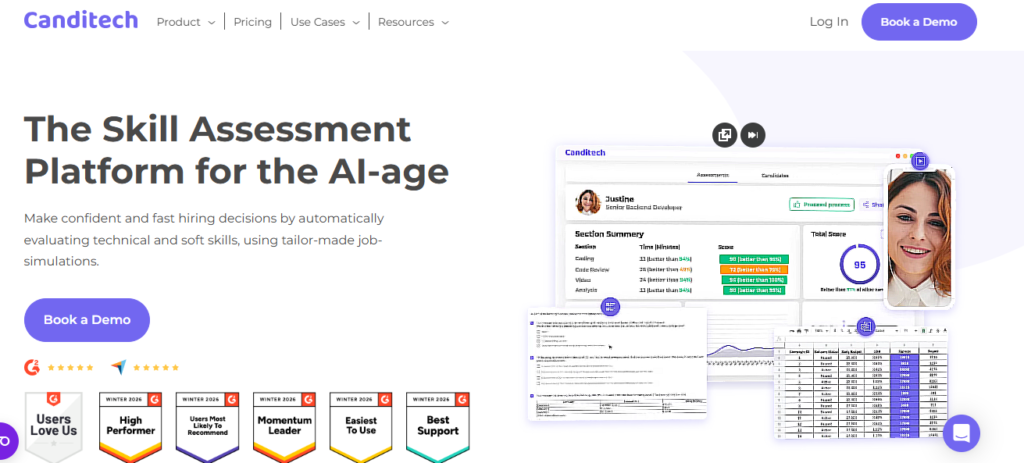
Canditech built its platform around one question: can a candidate actually do the work, including the AI-assisted parts of it. Assessments combine technical tasks, soft-skill scenarios, and increasingly common AI fluency checks such as working inside ChatGPT or building a formula in Google Sheets or Excel.
For a small firm, this matters because so many entry-level and mid-level jobs now involve some level of AI-assisted work, and Canditech is one of the few tools that treats that as a measurable skill rather than an afterthought. An AI assessment builder can generate a role-specific test directly from a job description or job posting link, cutting setup time significantly.
The standout differentiator is the AI Assessment Builder itself. A hiring manager can paste in a job description and get a relevant assessment back in minutes, instead of hand-picking questions from a generic library.
✅ Key Features
- AI Assessment Builder that generates a custom test directly from a job description, saving significant setup time for a small HR team.
- Support for open-text, video, multiple choice, spreadsheet, coding, and SQL question types inside a single assessment.
- Built-in AI fluency testing, including ChatGPT-based tasks, that reflects how modern roles actually use AI tools day to day.
- AI auto-scoring that grades technical and open-ended responses without manual review.
- One-way video interviews combined with skills testing in a single candidate flow.
- WhatsApp and SMS-based candidate outreach for teams that want faster response rates on invites.
✅ Pros
- AI-generated assessments cut setup time dramatically for a small hiring team.
- Covers modern AI-assisted skills that most competitors do not test for at all.
- Wide range of question formats fits both technical and non-technical roles.
- Broad ATS integration list, including Greenhouse, Lever, and JazzHR.
- Competitive entry pricing for a small business budget.
❌ Cons
- AI-generated questions occasionally need manual editing to match a very niche role.
- Smaller overall test library compared to TestGorilla or TestTrick.
- Some advanced reporting features require a higher-tier plan.
- Newer platform means fewer long-term user reviews to lean on compared to older competitors.
Best For: Small firms hiring for roles that involve day-to-day AI tool usage and want assessments built automatically from an existing job description.
4. TestTrick
TestTrick – Best Budget All-in-One for Startups
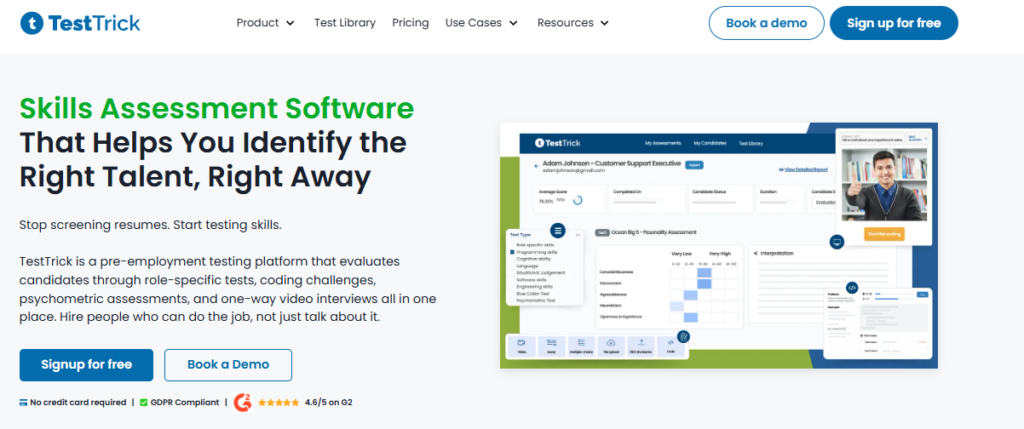
TestTrick was built with a specific buyer in mind: the early-stage startup that needs skills tests, coding assessments, and video interviews but cannot justify a four-figure monthly software bill. Its pricing starts under $40 a month, which is meaningfully lower than most competitors on this list.
The platform ranks well here because it does not force a small team to choose between depth and affordability. A single subscription covers cognitive testing, psychometric evaluation, situational judgment, and coding challenges across a dozen programming languages, plus one-way video interviews for early-stage screening.
What sets it apart is the anti-cheating stack. Beyond a standard browser lockdown, it uses AI face detection and dual-screen detection to catch candidates trying to get help from a second monitor, along with code paste detection for technical tests, which is a level of proctoring rigor rarely seen at this price point.
✅ Key Features
- 500+ test library covering cognitive ability, psychometrics, language, and role-specific technical topics.
- Coding assessments across 12+ programming languages with a coding playback feature to review how a candidate approached the problem.
- AI face detection and dual-screen detection that flag impersonation or second-monitor cheating in real time during remote tests.
- One-way video interviews with manual or AI-assisted scoring for early screening rounds.
- Real-time ATS integrations with Greenhouse, Lever, JazzHR, and Manatal, so scores sync directly into existing hiring workflows.
- A detailed activity log for every assessment session, useful for audit trails and compliance documentation.
✅ Pros
- One of the most affordable full-featured platforms for early-stage startups.
- Strong anti-cheating stack that goes beyond basic browser lockdown.
- Coding playback gives real insight into a developer candidate’s problem-solving process.
- Seven-day free trial plus a free demo lowers the risk of trying it.
- Native ATS syncing reduces manual data entry for a lean HR team.
❌ Cons
- Interface feels dated next to some newer competitors.
- Language support for candidate-facing tests is currently limited to English and Spanish.
- Advanced reporting and analytics require moving up to a higher plan.
- Smaller brand footprint means fewer independent case studies to review before buying.
Best For: Cash-conscious startups and small businesses that need coding tests, psychometric evaluation, and video interviews in one affordable subscription.
5. Willo
Willo – Best for Async Video and Behavioral Screening on a Budget
Willo focuses on a narrower but highly practical use case for small teams: letting candidates record video answers to interview questions on their own schedule, paired with lightweight cognitive and behavioral checks. There is nothing to install, so candidates answer directly from a browser link.
It ranks well for small firms because it solves a real logistical headache. A five-person hiring committee no longer needs to coordinate five calendars for a first-round interview; everyone reviews the same recorded answers whenever they have time.
The differentiator is simplicity paired with enterprise-grade security. Encryption, GDPR-aligned data handling, and multi-factor authentication come standard even on the entry-level plan, which is not always true of budget competitors.
✅ Key Features
- Asynchronous one-way video interviews that candidates complete through a browser link with no app or plugin required.
- Shared review dashboard so multiple hiring team members can score the same responses without scheduling a joint call.
- Basic cognitive and behavioral screening questions layered onto the video interview flow.
- Video editing and clip-sharing tools for pulling standout answers into a hiring committee discussion.
- Enterprise-grade encryption and GDPR-aligned data handling included even on lower-tier plans.
- Multi-factor authentication and access controls to protect sensitive candidate video data.
✅ Pros
- Removes scheduling friction for first-round interviews entirely.
- Strong data security standards at a small-business price point.
- Simple enough that non-technical hiring managers adopt it quickly.
- 15-day free trial before any payment is required.
- Works well alongside a separate skills-testing tool for a lightweight two-tool stack.
❌ Cons
- Assessment depth is thinner than dedicated skills-testing platforms.
- No native cognitive ability or job-simulation library to speak of.
- Best used as a complement to, not a replacement for, a full skills assessment tool.
- Reporting is geared toward video review rather than statistical candidate comparison.
Best For: Small businesses that want to replace scheduling headaches for first-round interviews with simple, secure async video screening.
6. EmployTest
EmployTest – Best for Office and Admin Role Testing
EmployTest carved out a niche that many broader platforms overlook: testing candidates on the actual Microsoft Office tasks they will do on the job, like formatting a document in Word, building a formula in Excel, or assembling slides in PowerPoint.
For a small business hiring administrative assistants, bookkeepers, or office coordinators, this matters more than an abstract cognitive score. A hiring manager gets a direct answer to the question that matters most: can this person actually do the spreadsheet work the role requires.
The differentiator is the realism of the simulations themselves. Instead of multiple-choice questions about Excel functions, candidates work inside an environment that mirrors the real Office interface, so the results reflect genuine day-to-day proficiency.
✅ Key Features
- Interactive Microsoft Office simulations covering Word formatting, Excel formulas, and PowerPoint slide-building tasks.
- A job-specific test library spanning administration, healthcare, IT, and customer service roles.
- Validated behavioral and personality assessments for evaluating workplace fit alongside hard skills.
- Custom test creation that lets a small firm combine library questions with its own content.
- Live US-based phone support, useful for a small HR team without a dedicated IT department.
- Straightforward reporting that flags candidates who meet a defined proficiency threshold.
✅ Pros
- Best-in-class testing for real-world Microsoft Office proficiency.
- Wide range of job-specific libraries for common SMB roles.
- Live phone support is a rare and welcome touch for a small business.
- Behavioral assessments add a soft-skill layer without extra tools.
- Simple enough for a solo HR generalist to run without training.
❌ Cons
- No dedicated mobile app for candidates completing assessments on a phone.
- Reporting lacks the deeper analytics dashboards larger platforms provide.
- Native ATS integrations are not clearly documented, so custom API work may be needed.
- Less useful for technical or coding-heavy roles outside its office and admin focus.
Best For: Small businesses hiring administrative, bookkeeping, or office support roles where real Microsoft Office proficiency matters most.
7. Xobin
Xobin – Best Affordable Option for Growing SMEs
Xobin positions itself squarely as the budget-friendly choice for small and mid-sized companies that need reliable skills testing without enterprise pricing. It covers the fundamentals well: skills tests, cognitive checks, and basic psychometric evaluation.
It earns a spot on this list because it keeps things simple. A growing team can screen a batch of candidates across multiple roles without wading through an overwhelming feature set built for enterprise recruiting departments.
The differentiator is cost-consciousness baked into the product itself, with pricing tied to test usage and hiring volume rather than a flat enterprise contract, so a small firm only pays for what it actually uses.
✅ Key Features
- Skills assessments spanning multiple job roles and departments.
- Cognitive ability tests for evaluating problem-solving and learning speed.
- Basic psychometric evaluations for measuring workplace behavior and fit.
- Candidate screening dashboards with standardized scoring for fair comparisons.
- Volume hiring support designed for early-stage and growing teams.
- Usage-based pricing structure that scales with actual hiring activity.
✅ Pros
- Genuinely budget-friendly for SMEs watching every dollar.
- Covers the core testing categories most small firms actually need.
- Simple enough to deploy without a dedicated recruiting operations person.
- Usage-based pricing avoids paying for unused capacity.
- Reasonable fit for volume hiring during a growth spurt.
❌ Cons
- Feature depth is lighter than platforms like TestGorilla or Criteria.
- Public pricing details are limited, requiring a sales conversation for specifics.
- Fewer advanced proctoring features than security-focused competitors.
- Smaller test library than the category leaders.
Best For: Cost-conscious SMEs that need dependable core skills and cognitive testing without paying for enterprise extras.
8. HiPeople
HiPeople – Best for Automated Reference Checks
HiPeople solves a different piece of the hiring puzzle than most tools here. Instead of testing skills directly, it automates reference checks, sending structured questionnaires to a candidate’s references and compiling the responses into a readable report.
For a small business, this closes a gap that skills tests cannot fill. A candidate might score well on a cognitive test and still be a poor fit for a team, and reference feedback from former managers adds context that no assessment can replicate.
The differentiator is speed and structure. Reference checks that used to take a recruiter days of phone tag now come back automatically, with responses standardized so a hiring manager can compare candidates on the same criteria.
✅ Key Features
- Automated reference check requests sent directly to a candidate’s listed references.
- Structured questionnaires that standardize feedback across every candidate for fair comparison.
- Behavioral science-based insights layered on top of raw reference responses.
- Direct integration with candidate profiles inside connected assessment platforms and ATS tools.
- Reduced manual follow-up, since reminders go out automatically until references respond.
- Data-driven summaries that flag concerning patterns across multiple reference responses.
✅ Pros
- Removes one of the most time-consuming manual steps in the hiring process.
- Adds real context that skills tests and personality assessments cannot capture.
- Standardized questions make comparing candidates far easier.
- Works well as a final-stage add-on to any of the skills-testing tools above.
- Reduces the awkwardness of chasing down references by phone.
❌ Cons
- Does not test skills, cognitive ability, or behavior on its own, so it needs a companion tool.
- Value depends heavily on how responsive a candidate’s references actually are.
- Smaller company means fewer long-term reviews to evaluate.
- Best suited as a final-stage add-on rather than a full assessment platform.
Best For: Small firms that already have a skills-testing tool in place and want to automate the reference-checking step at the final stage of hiring.
9. Equip
Equip – Best Usage-Based Pricing for Small Teams
Equip takes a straightforward approach to assessment: broad skills testing across technical and non-technical roles, priced by actual usage rather than a flat monthly seat license. That model appeals directly to small firms with irregular hiring volume.
It ranks here because it removes the guesswork from budgeting. A company that hires in bursts, three roles this quarter and none the next, only pays when it is actually testing candidates, instead of carrying a subscription during quiet months.
The differentiator is that pay-as-you-go flexibility, paired with candidate comparison tools that make it easy to see scored results side by side without a steep learning curve.
✅ Key Features
- Skills tests covering both technical and non-technical roles.
- Candidate screening built around clear, comparable assessment data.
- Candidate profiles with comparative scoring across multiple applicants.
- Support for volume hiring spikes without a long-term contract commitment.
- Structured recruitment workflow tools that keep candidate data organized.
- Usage-based billing that ties cost directly to hiring activity.
✅ Pros
- Pay-as-you-go pricing fits irregular small-business hiring cycles well.
- No pressure to commit to a long annual contract upfront.
- Straightforward enough for a non-specialist to manage.
- Covers a reasonable range of technical and non-technical roles.
- Good fit for occasional or seasonal hiring needs.
❌ Cons
- Usage-based costs can add up quickly during a high-volume hiring push.
- Feature set is narrower than full-suite competitors like Criteria or Mercer.
- Less brand recognition, so fewer independent user reviews exist.
- Advanced proctoring and analytics are limited compared to specialized tools.
Best For: Small businesses with irregular or seasonal hiring volume that want to pay only for the assessments they actually run.
10. Codility
Codility – Best for Technical Hiring in Small Dev Teams
Codility is built specifically for one job: evaluating real coding ability. For a small startup hiring its first few engineers, that narrow focus is exactly the point. It skips personality quizzes and cognitive puzzles in favor of live coding tests, pair programming sessions, and take-home technical challenges.
It earns a place on this list because early engineering hires make or break a small company’s product velocity, and a resume full of listed languages tells a hiring manager very little about how someone actually writes code under pressure.
The differentiator is depth on the technical side specifically, including live coding interviews that let a small engineering team watch a candidate think through a problem in real time, not just review a final submitted answer.
✅ Key Features
- Coding assessments covering programming logic, algorithms, and problem-solving across major languages.
- Live coding interviews and pair-programming sessions for real-time technical evaluation.
- Plagiarism checks and proctoring controls to protect the integrity of remote technical tests.
- Candidate profiles that store full coding results and submission history.
- Take-home technical challenges for asynchronous evaluation of early-career or remote candidates.
- Detailed scoring breakdowns that show exactly where a candidate’s solution succeeded or fell short.
✅ Pros
- Best-in-class depth for evaluating genuine coding ability.
- Live coding interviews reveal real problem-solving process, not just final output.
- Plagiarism detection protects test integrity for remote technical hiring.
- Well suited for a small engineering team’s first few technical hires.
- Detailed scoring helps justify hiring decisions to non-technical stakeholders.
❌ Cons
- Offers nothing for non-technical roles, so a small firm needs a second tool for the rest of its hiring.
- Pricing runs higher than general-purpose SMB testing platforms.
- Steeper learning curve for hiring managers without a technical background.
- Overkill for a company that only occasionally hires developers.
Best For: Small startups and dev teams hiring their first engineers who need rigorous, real-world coding evaluation.
11. Spark Hire
Spark Hire – Best for Predictive Behavioral Fit
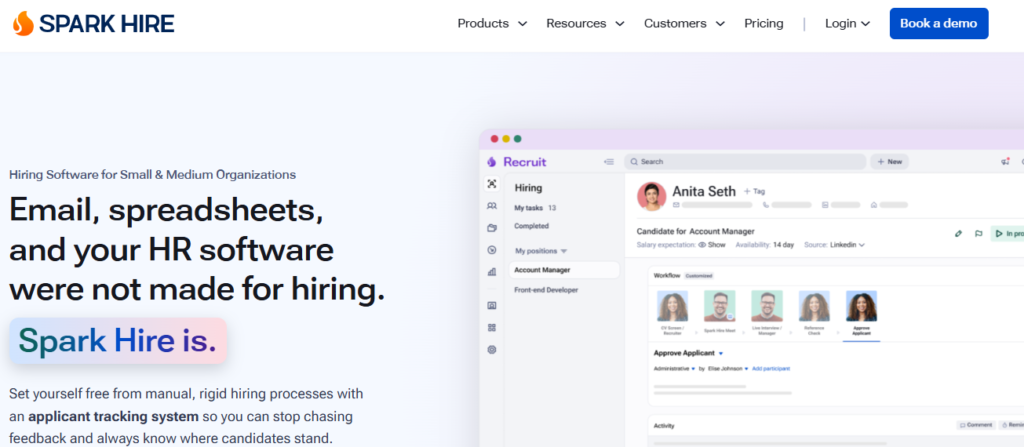
Spark Hire built its assessment around one specific, well-validated question: will this candidate behave in ways that predict success in this particular role. It measures job-specific behavioral competencies and workplace motivations rather than generic personality traits.
It ranks here because behavioral fit is often the exact thing a small business gets wrong when hiring quickly. A candidate can look great on paper and in an interview, then struggle with the day-to-day behaviors a role actually demands, and Spark Hire’s job-targeted approach catches that mismatch earlier.
The differentiator is the combination of validated behavioral science with one-way video interviewing in a single workflow, so a small hiring team reviews assessment scores and recorded answers together instead of juggling two separate tools.
✅ Key Features
- Job-specific behavioral assessments built from 40+ predefined profiles or custom competency mapping.
- Hiring, coaching, and individual reports generated instantly after a candidate completes the assessment.
- Adverse impact analysis run for every job profile to help reduce hiring bias.
- Assessments that complete in under 20 minutes and work on any device.
- Integrated one-way video interviewing alongside behavioral scoring in a single platform.
- Automated candidate reminders that improve assessment completion rates.
✅ Pros
- Strong scientific validation behind the behavioral scoring model.
- Reports are genuinely easy to read without specialized training.
- Bias-reduction analysis built into every assessment profile.
- Combines behavioral testing and video interviewing in one place.
- Responsive support and a candidate-friendly testing experience.
❌ Cons
- No technical or coding skills testing included at all.
- Pricing sits well above budget options like TestTrick or Xobin.
- Best used alongside a separate skills test for technical roles.
- No published free trial, only a demo request.
Best For: Growing small businesses hiring for customer-facing, sales, or management roles where behavioral fit predicts success better than a skills score.
12. The Predictive Index
The Predictive Index – Best for Role-Specific Behavioral and Cognitive Targeting
The Predictive Index pairs two distinct assessments: a behavioral test that maps workplace drives like dominance and patience, and a short cognitive test that measures numerical, verbal, and abstract reasoning. Together they build a clear target profile for a specific role.
It fits small businesses that are ready to move past gut-feel hiring but do not want to build an in-house people-analytics team to do it. Job targeting lets a hiring manager define the behavioral and cognitive requirements for a role once, then compare every future candidate against that same target.
The differentiator is the job-targeting workflow itself. Rather than scoring candidates in isolation, PI benchmarks them against a target profile the hiring manager sets, which keeps evaluations consistent even as different people on a small team do the interviewing.
✅ Key Features
- Behavioral Assessment measuring workplace drives like dominance, extraversion, patience, and formality.
- Cognitive Assessment, a 12-minute test measuring numerical, verbal, and abstract reasoning.
- Job Targeting that lets hiring managers define ideal behavioral and cognitive benchmarks for a role.
- A broader talent optimization suite covering team building and leadership development beyond hiring.
- Support for 70+ languages, useful for small firms hiring internationally or remotely.
- Integrations with major HR and ATS platforms to keep candidate data centralized.
✅ Pros
- Fast for candidates, with the behavioral test taking roughly 10 minutes.
- Job targeting keeps evaluation criteria consistent across multiple interviewers.
- Unlimited assessments under a flat plan structure once subscribed.
- Extends naturally into team building and leadership development later.
- Widely validated and compliant across many countries and languages.
❌ Cons
- Does not measure motivation, emotional intelligence, or technical skills on its own.
- No public pricing listed, so budgeting requires a sales conversation.
- Risk of over-relying on behavioral labels instead of using them as one data point.
- Some users report a learning curve on the mobile experience.
Best For: Small businesses that want a consistent, benchmarked way to compare behavioral and cognitive fit across every candidate for a role.
13. Criteria
Criteria – Best Comprehensive Assessment Suite
Criteria takes the opposite approach from single-purpose tools on this list, offering cognitive aptitude, personality, emotional intelligence, risk, and skills testing all inside one platform, plus built-in one-way video interviewing.
It earns a spot here for small firms that would rather standardize on one comprehensive vendor than stitch together three or four point solutions. Adaptive testing adjusts question difficulty in real time based on how a candidate is answering, giving a more precise read on true ability.
The differentiator is breadth without sacrificing rigor. Few platforms at this depth also let a small business build fully customized assessment packages by mixing and matching from the full test library for each specific role.
✅ Key Features
- A broad assessment library spanning cognitive, personality, emotional intelligence, risk, and skills testing.
- Adaptive testing that adjusts question difficulty based on candidate responses for a more precise result.
- Customizable assessment packages that let a hiring manager build a role-specific battery of tests.
- Intuitive reporting with benchmarking against custom baselines set by the company.
- Built-in one-way video interviewing alongside the testing suite.
- Responsive onboarding support to help a small team set up its first assessment batteries.
✅ Pros
- One of the broadest validated assessment libraries on this list.
- Adaptive testing improves accuracy compared to static, fixed-difficulty tests.
- Highly customizable for building role-specific test batteries.
- Real-time reporting and benchmarking speed up decision-making.
- Combines testing and video interviewing without a second subscription.
❌ Cons
- Pricing can run high for a small business with infrequent hiring needs.
- No pay-per-assessment option for occasional, low-volume hiring.
- Some users report a learning curve when interpreting advanced reports.
- Lacks the immersive job simulations that tools like Vervoe or Canditech offer.
Best For: Small businesses ready to standardize hiring on one comprehensive, science-backed assessment vendor instead of juggling several tools.
14. Wonderlic
Wonderlic – Best Multi-Measure Score for Predicting Performance
Wonderlic has been a fixture in pre-employment testing for decades, and its current offering condenses three separate signals, cognitive ability, personality, and motivation, into a single interpretable score that answers whether a candidate can do the job, how they will do it, and whether they actually want to.
It fits small businesses that want one clean number to anchor a hiring decision around, rather than juggling separate cognitive and personality reports. Job-specific scoring profiles exist for nearly every role type, removing the need to build custom benchmarks from scratch.
The differentiator is that single, holistic score. Where many tools hand a hiring manager three or four separate reports to reconcile, Wonderlic compresses the signal into one easy comparison point across candidates.
✅ Key Features
- A multi-measure assessment combining cognitive ability, personality, and motivation into one score.
- Job-specific scoring profiles available off the shelf for nearly any role type.
- Standardized, science-backed results designed to reduce bias in side-by-side comparisons.
- Guided interview questions generated from assessment results for the next hiring stage.
- Onboarding tips tailored to a new hire’s assessment profile.
- Structured comparison reports that simplify reviewing multiple candidates at once.
✅ Pros
- Single holistic score simplifies decision-making for small hiring teams.
- Job-specific profiles remove the need to build benchmarks from scratch.
- Strong track record and decades of validation research behind the model.
- Reduces resume-screening time by surfacing high-potential candidates early.
- Guided interview tools carry the assessment insight into the next hiring round.
❌ Cons
- No public pricing, so a small business needs a custom quote from sales.
- No technical skills testing or job simulation component included.
- Limited flexibility for customizing assessments to unusual or hybrid roles.
- Best treated as one input in the process, not the sole hiring decision-maker.
Best For: Small firms that want one clear, holistic score combining ability, personality, and motivation instead of several separate reports to interpret.
15. Everything DiSC
Everything DiSC – Best for Team Communication Styles, Not Hiring Decisions
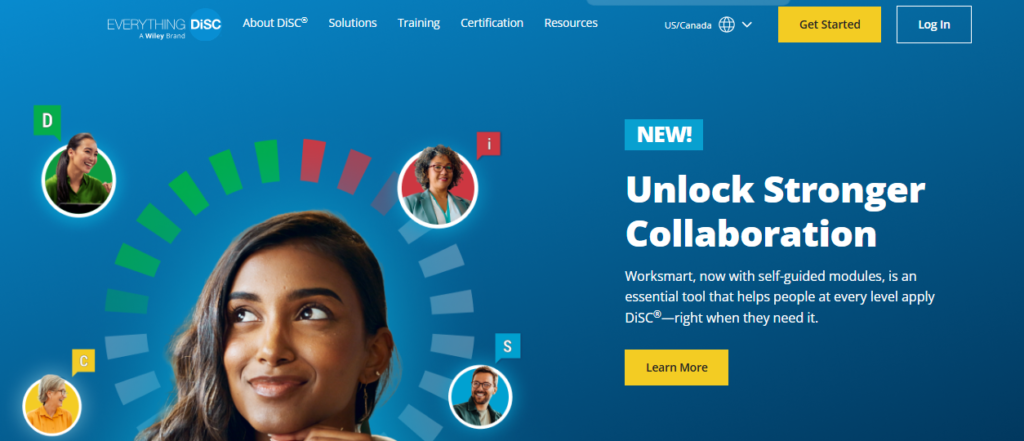
Everything DiSC deserves an honest mention on this list because it shows up constantly in talent assessment searches, even though it was never designed to screen candidates. It measures four behavioral styles, Dominance, Influence, Steadiness, and Conscientiousness, to help people understand how they communicate.
For a small business, it earns its place as a team-building and onboarding tool rather than a pre-hire screening tool. Once someone joins the team, a DiSC workshop can genuinely improve how a small group communicates and resolves friction.
The differentiator worth calling out plainly: unlike every other tool on this list, DiSC was not built or validated for predicting job performance, and using it to screen candidates risks a false sense of certainty in a hiring decision it was never meant to inform.
✅ Key Features
- A simple four-style framework that gives teams shared language for discussing communication preferences.
- Instant PDF reports covering individual and group results after a short assessment.
- Multiple report formats, including Workplace, Management, and Sales versions, for different internal uses.
- Quick administration, with most assessments completed in 15 to 20 minutes.
- Wide adoption across HR, education, and leadership training, so most new hires can find guidance online.
- Facilitator resources for running team workshops around the results.
✅ Pros
- Genuinely useful for improving communication and reducing conflict on a small team.
- Fast, simple, and requires no special training to administer.
- Widely recognized, so most people have some familiarity with the framework.
- Affordable on a per-assessment basis for post-hire team activities.
- Multiple report types fit different departments and use cases.
❌ Cons
- Not validated for predicting job performance and should never be used as a hiring filter.
- Results can vary noticeably between repeat assessments of the same person.
- Lacks the scientific rigor of purpose-built pre-employment assessments.
- Easy to over-interpret as more predictive than it actually is.
Best For: Small businesses that want a low-cost team-building tool for existing employees, not a pre-hire candidate screening solution.
Comparison Table: Best Talent Assessment Software for Small Firms
| Tool Name | Best For | Key Strength | Integrations | Ease of Use | Platform Type |
|---|---|---|---|---|---|
| TestGorilla | Small businesses & startups | Huge free-to-start test library | Greenhouse, BambooHR, Workable | Very Easy | Web-based |
| Vervoe | Sales & support hiring | Realistic job simulations with AI grading | Greenhouse, PageUp, Zapier | Easy | Web-based |
| Canditech | AI-skills & technical roles | AI-generated assessments from job posts | Workday, SAP, Greenhouse, Lever | Easy | Web-based |
| TestTrick | Budget-conscious startups | Strong anti-cheating stack at low cost | Greenhouse, Lever, Manatal | Easy | Web-based |
| Willo | Async video screening | Simple, secure video interview flow | Zapier, custom API | Very Easy | Web-based |
| EmployTest | Admin & office roles | Real Microsoft Office simulations | API-based custom integration | Easy | Web-based |
| Xobin | Cost-conscious SMEs | Usage-based, budget-friendly pricing | Standard ATS via API | Easy | Web-based |
| HiPeople | Reference checking | Automated, structured reference reports | Assessment platforms & ATS | Very Easy | Web-based |
| Equip | Seasonal/irregular hiring | Pay-as-you-go pricing model | Standard ATS via API | Easy | Web-based |
| Codility | Technical dev hiring | Live coding interviews & plagiarism checks | GitHub, ATS via API | Moderate | Web-based |
| Spark Hire | Behavioral fit for customer roles | Science-backed behavioral scoring | BambooHR, iCIMS, SmartRecruiters | Easy | Web-based |
| Predictive Index | Consistent role benchmarking | Job Targeting against defined profiles | Major HR & ATS platforms | Moderate | Web-based |
| Criteria | All-in-one testing suite | Adaptive testing across five test types | Multiple ATS platforms | Moderate | Web-based |
| Wonderlic | One holistic hire score | Combined ability + personality + motivation | Custom integration | Easy | Web-based |
| Everything DiSC | Post-hire team building | Simple four-style communication model | Standalone / EPIC account | Very Easy | Web & PDF reports |
Final Verdict
TestGorilla is the strongest all-around pick for most small firms thanks to its free tier and enormous test library. Startups hiring for sales or support should look at Vervoe, while a lean engineering team is better served by Codility. Firms that want behavioral fit alongside skills testing should pair Spark Hire or The Predictive Index with one of the skills-first tools on this list.
How to Choose the Right Talent Assessment Software for a Small Firm
1. Match the Test Type to the Role
A cognitive test tells you almost nothing useful about a sales candidate’s ability to handle objections. Start by listing the two or three roles a small firm hires most often, then pick tools built for those specific test types instead of a generic all-purpose platform.
2. Check Real Pricing, Not Just the Homepage Number
Many platforms advertise a low starting price but require an annual contract or hide advanced features behind a custom quote. Confirm whether a plan includes unlimited candidates or charges per assessment before comparing costs across vendors.
3. Prioritize Candidate Experience
A clunky, 45-minute assessment scares off strong candidates before they ever finish it. Look for tools that let candidates skip account creation, complete tests on mobile, and finish in under 20 minutes for most roles.
4. Confirm ATS and Payroll Integrations Early
A talent assessment tool that does not sync with an existing applicant tracking system creates duplicate data entry for a small HR team. Many firms pair their assessment platform with the best recruiting software for small business to keep candidate data flowing in one direction automatically.
5. Look for Bias-Reduction and Compliance Features
Standardized scoring, adverse impact analysis, and clear audit trails protect a small business from both bad hires and legal exposure. A tool without at least basic bias-reduction reporting is a harder sell to justify internally.
6. Track Results Over Time
The real value of assessment data shows up months later, when a firm can compare assessment scores against actual performance reviews. Feeding that data into one of the best HR analytics tools on the market turns a one-time hiring decision into a long-term hiring accuracy improvement.
Firms hiring specifically for revenue-generating roles should also compare notes against the best sales hiring tools, since sales assessments often weigh behavioral competencies differently than a general admin or technical role would.
Final Thoughts
The best talent assessment software for a small firm is rarely the one with the longest feature list. It is the one that fits the roles a company actually hires for, respects a tight budget, and gives candidates a fair, quick, and honest shot at showing what they can do.
TestGorilla, Vervoe, and TestTrick cover most small-business needs at a reasonable price, while Codility and EmployTest solve for more specific technical and administrative hiring gaps. Behavioral-focused tools like Spark Hire and The Predictive Index add another layer once a small team is ready to formalize its process.
Start with a free trial or demo on two or three tools from this list, run a real job requisition through each one, and let the candidate experience and report quality make the final call.