Finding the right talent assessment tools can make or break a hiring strategy in 2026. Resumes and gut-feel interviews still fail to predict who will actually succeed on the job, and a single bad hire can quietly drain a budget once recruiting, training, and lost productivity are added up.
This guide breaks down the 20 best talent assessment tools on the market right now, covering everything from coding tests for developers to behavioral fit scoring for sales teams, so hiring managers can pick the right talent assessment software for their team size, budget, and hiring volume.
What Is Talent Assessment Software?
Talent assessment software is a category of pre-employment tools that measure a candidate’s skills, cognitive ability, personality, and behavioral style before a hiring decision is made. Instead of relying only on a resume and a gut feeling, recruiters use a talent assessment tool to gather objective data on how a candidate is likely to perform in a specific role.
Most platforms fall into one of a few buckets: cognitive and aptitude tests, personality and behavioral questionnaires, technical or job-specific skills tests, and game-based or video simulations. The best predictive talent assessment software usually blends two or three of these types together, since no single test type tells the whole story on its own.
Used well, assessment tools for talent management do more than screen out weak applicants. They help teams standardize the hiring process, reduce unconscious bias, and build a repeatable framework that scales as a company grows.
Top 20 Best Talent Assessment Tools for 2026
Every talent management assessment tool below was chosen for a specific reason, whether that is validity research, ease of use, or a genuine gap it fills that generic competitors miss. Here is the full breakdown.
1. SHL
SHL — Global Leader in Predictive Talent Assessment Software
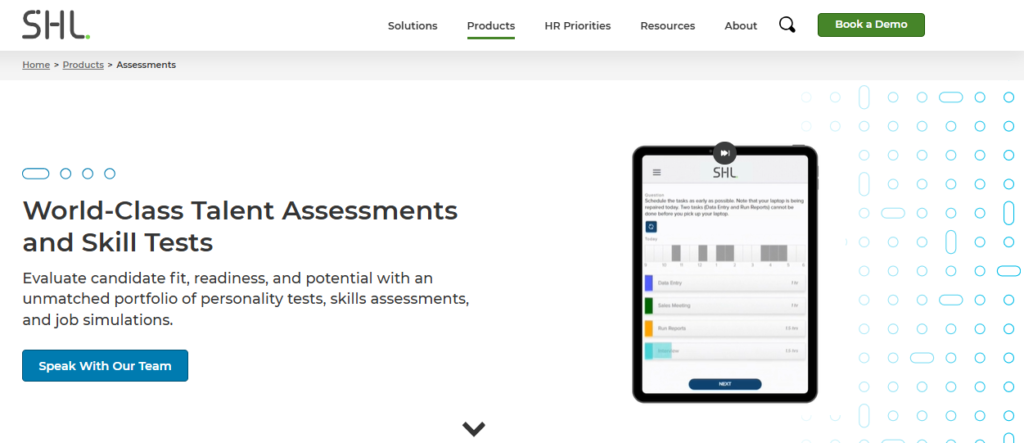
SHL has been in the assessment business for more than 40 years and has built a reputation as one of the most trusted names in predictive talent assessment software. Its assessments are grounded in decades of validated research on job performance, which is why so many large companies still rely on it for high-stakes hiring decisions.
What sets SHL apart is the depth of its Verify ability tests and the OPQ personality questionnaire, both refined against enormous global data sets. That gives hiring teams confidence that scores actually predict on-the-job success rather than just measuring test-taking skill.
SHL works best for large enterprises hiring across multiple countries and job families, especially where consistency and legal defensibility matter as much as raw accuracy.
✅ Key Features
- Verify ability tests covering numerical, verbal, and inductive reasoning
- OPQ32 personality questionnaire built on the Big Five framework
- Global norm groups covering more than 150 countries
- Configurable competency frameworks tied to specific job roles
- Built-in adverse impact and bias monitoring
- API access for enterprise ATS integrations
✅ Pros
- Backed by decades of validated research
- Strong global and multilingual coverage
- Detailed, easy to interpret reports for hiring managers
- Trusted brand that candidates rarely question
- Scales well across departments and countries
❌ Cons
- Pricing sits at the higher end, tough for small teams
- Implementation can take weeks for larger rollouts
- Interface feels dated next to newer platforms
- Customization often needs vendor support rather than self-service
🎯 Best For: Multinational enterprises that need scientifically validated, legally defensible assessments across many countries and job families.
2. Criteria
Criteria — Science-Based Talent Assessment Software for Mid-Market Teams
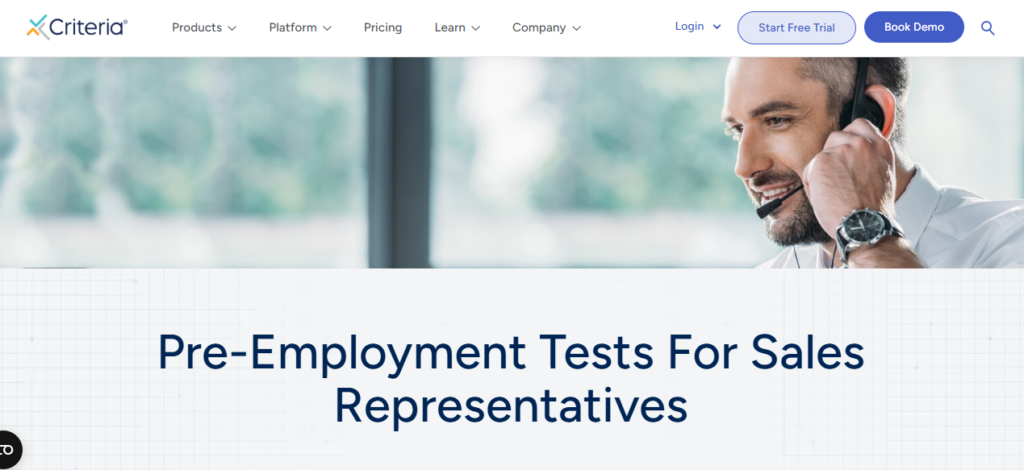
Criteria built its name on being the accessible, science-backed option in a market once dominated by expensive enterprise tools. It combines cognitive aptitude, personality, and skills testing in one platform without the steep learning curve.
The CCAT cognitive aptitude test is the standout feature, since it correlates strongly with job performance across almost every role type. Pair that with the personality and emotional intelligence assessments, and hiring teams get a rounded picture without needing three separate vendors.
Mid-market companies that want validity data on par with enterprise providers, without the enterprise price tag or a six-week onboarding process, tend to land here.
✅ Key Features
- CCAT cognitive aptitude test validated across industries
- Personality and emotional intelligence assessments
- Skills tests for roles like sales, customer service, and admin work
- Custom test builder for role-specific screening
- Adverse impact analysis built into every report
- Simple candidate-facing test experience on any device
✅ Pros
- Transparent, mid-market friendly pricing
- Strong validity data backing the cognitive test
- Fast setup, often live within a day
- Clean, modern candidate experience
- Good customer support for smaller HR teams
❌ Cons
- Fewer deep customization options than enterprise suites
- Reporting dashboards feel basic for data-heavy teams
- Limited video interview functionality
- Smaller global norm base than SHL or Mercer Mettl
🎯 Best For: Mid-size companies that want validated cognitive and personality testing without enterprise complexity or cost.
3. Mercer | Mettl
Mercer | Mettl — Holistic Enterprise Talent Assessment Platform
Mercer Mettl built its reputation as a one-stop assessment shop for enterprises that need to test everything from coding skills to psychometric traits under one roof. It is especially popular across Asia-Pacific and among large IT services firms doing high-volume campus hiring.
The platform’s remote proctoring and AI monitoring are genuinely strong, catching everything from tab switching to unusual eye movement during video assessments. That matters a great deal for companies running thousands of assessments during placement season.
Combined with its library of coding simulators, cognitive tests, and behavioral assessments, Mercer Mettl gives large hiring teams one dashboard instead of five separate vendor logins.
✅ Key Features
- Coding simulators covering 40+ programming languages
- Psychometric and cognitive test library
- AI-based remote proctoring with webcam and screen monitoring
- Bulk assessment scheduling for campus and volume hiring
- Configurable score reports mapped to job competencies
- Integration with major HRIS and ATS platforms
✅ Pros
- Extremely strong for high-volume technical hiring
- Advanced anti-cheating and proctoring tools
- Wide assessment library covers almost every role type
- Good support for Asia-Pacific hiring operations
❌ Cons
- Interface can feel cluttered with so many modules
- Onboarding takes longer because of platform depth
- Pricing structure is not transparent upfront
- Occasional lag reported during peak testing windows
🎯 Best For: Large enterprises and IT services firms running high-volume technical and campus hiring drives.
4. HackerRank
HackerRank — The Standard for Developer Skills Assessment
HackerRank has become the default choice when a company needs to test whether a developer can actually code, not just talk about coding. The platform’s coding environments mirror real job conditions, from debugging broken functions to building small features from scratch.
Its library covers dozens of languages and frameworks, and the plagiarism detection is strong enough that most engineering teams trust the results without manually re-checking candidates. Live pair programming interviews add another layer for final-round technical screens.
Teams building out a wider Best AI HR and Recruitment Tools stack often use HackerRank as the technical filter early in the funnel, then bring only top scorers into human interviews.
✅ Key Features
- Real coding environments supporting 40+ languages
- Live technical interview and pair programming tool
- Automated plagiarism and copy-paste detection
- Role-specific coding challenge libraries
- Detailed skill breakdowns per candidate
- ATS integrations for automated screening workflows
✅ Pros
- Best in class for evaluating real coding ability
- Strong anti-cheating detection
- Large, actively updated question library
- Trusted heavily by engineering hiring managers
❌ Cons
- Narrow focus, not useful outside technical roles
- Can feel intimidating for junior candidates
- Reporting is technical and less HR-friendly
- Higher tier plans needed for advanced proctoring
🎯 Best For: Engineering and technical hiring teams that need rigorous, real-world coding assessments.
5. Codility
Codility — Practical Engineering Skills Assessment for Serious Tech Teams
Codility focuses squarely on evaluating engineers through realistic coding tasks rather than trivia-style quizzes. Its take-home and live assessments are designed to mimic actual sprint work, from fixing bugs to reviewing a teammate’s code.
The code review environment is a genuine differentiator. Instead of a one-way test, candidates review sample code the way they would on a real team, which gives hiring managers insight into communication and reasoning, not just correctness.
Engineering leads who care about long-term technical culture fit, not only raw problem-solving speed, tend to prefer Codility over faster, more gamified competitors.
✅ Key Features
- Realistic project-style coding assessments
- Peer-style code review simulation
- Automated anti-cheating and behavior tracking
- Technical interview compiler for live sessions
- Custom test creation for niche tech stacks
- Detailed skill scoring by language and category
✅ Pros
- Assessments feel closer to actual engineering work
- Strong anti-cheating tech reduces fraud risk
- Good for evaluating senior and mid-level engineers
- Clear, structured reporting for tech leads
❌ Cons
- Steeper learning curve for hiring managers new to the platform
- Less useful for non-technical roles
- Pricing scales quickly with assessment volume
- Candidate experience can feel long for entry-level roles
🎯 Best For: Engineering teams that want to assess real-world coding judgment, not just speed or trivia.
6. Harver
Harver — Bias-Free, Gamified Assessments for High-Volume Hiring
Harver, which absorbed pymetrics’ neuroscience-based gamified assessments, built its platform around removing bias from high-volume hiring. Instead of long questionnaires, candidates play short games that measure attention, memory, and decision-making patterns.
That gamified format keeps completion rates high, which matters enormously for retail, call center, and hospitality hiring where drop-off is a constant problem. The DEI-focused algorithms are also regularly audited for adverse impact, giving HR teams a paper trail if hiring decisions are ever questioned.
Companies that hire thousands of frontline workers a year and care about candidate experience as much as prediction accuracy usually shortlist Harver first.
✅ Key Features
- Neuroscience-based gamified cognitive and behavioral games
- Automated DEI and adverse impact auditing
- Job simulation modules for frontline and operational roles
- High-volume scheduling and workflow automation
- Mobile-first candidate experience
- Predictive analytics tied to retention outcomes
✅ Pros
- Excellent candidate completion rates thanks to gamification
- Strong, independently audited bias reduction
- Built for speed at high hiring volumes
- Good retention prediction data
❌ Cons
- Less depth for senior or specialized hiring
- Game-based format can feel unfamiliar to older candidates
- Limited customization for niche competency frameworks
- Support response times vary by region
🎯 Best For: High-volume hiring in retail, hospitality, and call centers where candidate experience and bias reduction both matter.
7. TestGorilla
TestGorilla — The Most Flexible Talent Assessment Software for Growing Teams
TestGorilla built its reputation on sheer flexibility. With a test library that covers everything from Excel and coding to personality and culture fit, small and mid-size companies can build a custom assessment in minutes without needing an account manager.
Pricing is refreshingly transparent, and the self-serve setup means a hiring manager can launch a first test the same day they sign up. That accessibility is exactly why growing companies, still relying on Best Recruiting Software for Small Business to manage the rest of their funnel, often add TestGorilla as their first dedicated assessment tool.
It will not out-muscle enterprise platforms on validity research depth, but for lean HR teams it delivers most of the value at a fraction of the cost.
✅ Key Features
- Library of 400+ ready-made skills and personality tests
- Custom test builder with question mixing
- Anti-cheating tools including webcam and plagiarism checks
- One-way video interview add-on
- Candidate ranking and automated shortlisting
- Integrations with major ATS and HRIS platforms
✅ Pros
- Extremely fast to set up, no sales call required
- Transparent, budget-friendly pricing
- Huge variety of ready-made tests
- Simple, intuitive interface for non-technical HR staff
❌ Cons
- Validity research is less rigorous than legacy providers
- Some niche tests feel generic
- Limited support for complex enterprise workflows
- Reporting customization is fairly basic
🎯 Best For: Small and mid-size businesses that want a fast, affordable, self-serve assessment platform.
8. Wonderlic
Wonderlic — The Original Quick Cognitive Screening Test
Wonderlic has been around since the 1930s and is still one of the fastest ways to get a reliable read on general cognitive ability. The classic 12-minute test has been used everywhere from factory floors to NFL draft rooms, and it remains one of the most studied assessments in existence.
Because it is short and simple, completion rates stay high even for high-volume, entry-level roles where candidates will not tolerate a 45-minute test. Modern versions have added personality and motivation modules, but the cognitive core is still the main draw.
Companies that need a quick, defensible early screen before moving candidates into deeper interviews often keep Wonderlic in the mix purely for its speed.
✅ Key Features
- 12-minute general cognitive ability test
- Personality and motivation add-on modules
- Large historical norm database for benchmarking
- Simple, mobile-friendly candidate experience
- Fast turnaround scoring
- Basic ATS integration options
✅ Pros
- Extremely quick to administer
- Decades of validity research behind it
- Easy for candidates to complete on any device
- Affordable for high-volume screening
❌ Cons
- Limited depth compared to modern multi-module platforms
- Fewer configuration options for specific job families
- Interface feels basic next to newer competitors
- Not designed for senior or specialized hiring
🎯 Best For: High-volume, entry-level hiring where a fast, well-validated cognitive screen is the priority.
9. Hogan Assessments
Hogan Assessments — Personality Science for Leadership and Long-Term Performance
Hogan Assessments made its name studying the darker side of personality, meaning the traits that surface under pressure and can derail otherwise talented leaders. That focus makes it a favorite for succession planning and executive hiring, not just entry-level screening.
The HPI, HDS, and MVPI suite gives a genuinely three-dimensional view of a candidate: how they present day to day, how they behave under stress, and what actually motivates them. Few platforms dig this deep into leadership derailment risk.
Hogan is less about speed and more about precision, which is exactly why executive search firms and leadership development consultants lean on it so heavily.
✅ Key Features
- HPI test measuring everyday personality traits
- HDS test identifying derailing behaviors under stress
- MVPI assessment of core values and motivators
- Leadership potential and derailment risk reports
- Certified consultant network for interpretation support
- 360-degree feedback integration options
✅ Pros
- Exceptional depth for leadership and executive roles
- Strong academic research foundation
- Identifies derailment risks other tools miss
- Widely respected in executive search circles
❌ Cons
- Requires certified interpretation, which adds cost and time
- Overkill for high-volume or entry-level hiring
- Not designed for fast, self-serve workflows
- Reports need trained HR staff to apply well
🎯 Best For: Executive and leadership hiring where understanding long-term derailment risk matters more than speed.
10. The Predictive Index
The Predictive Index — Behavioral Assessment Built Around Team and Role Fit
The Predictive Index built its platform around one simple idea: hire for behavioral fit first, then verify skills separately. Its Behavioral Assessment takes about six minutes and maps a candidate’s natural work style against a specific role’s behavioral target.
PI shines brightest in sales hiring, where drive, persistence, and social confidence matter as much as technical knowledge. Teams researching Best Sales Hiring Tools often shortlist PI specifically because its behavioral pattern matching predicts sales performance unusually well.
The platform also includes a cognitive assessment and team-level analytics, so managers can see how a new hire’s style will mesh with the existing team dynamic before an offer goes out.
✅ Key Features
- Six-minute Behavioral Assessment mapping work style
- Separate cognitive assessment for learning agility
- Job Target profiles matching roles to ideal behavioral patterns
- Team dynamics and management strategy reports
- Coaching and onboarding guides based on results
- Native integrations with major ATS platforms
✅ Pros
- Fast for candidates, rarely causes drop-off
- Excellent fit-prediction data for sales and client-facing roles
- Strong team dynamics reporting beyond just hiring
- Backed by decades of behavioral research
❌ Cons
- Cognitive assessment feels like an add-on rather than core
- Less useful for pure technical skills testing
- Behavioral model takes time for managers to learn well
- Higher-tier plans needed for full team analytics
🎯 Best For: Sales and client-facing hiring where behavioral fit and team dynamics drive performance.
11. Plum
Plum — Potential-Based Talent Intelligence Platform
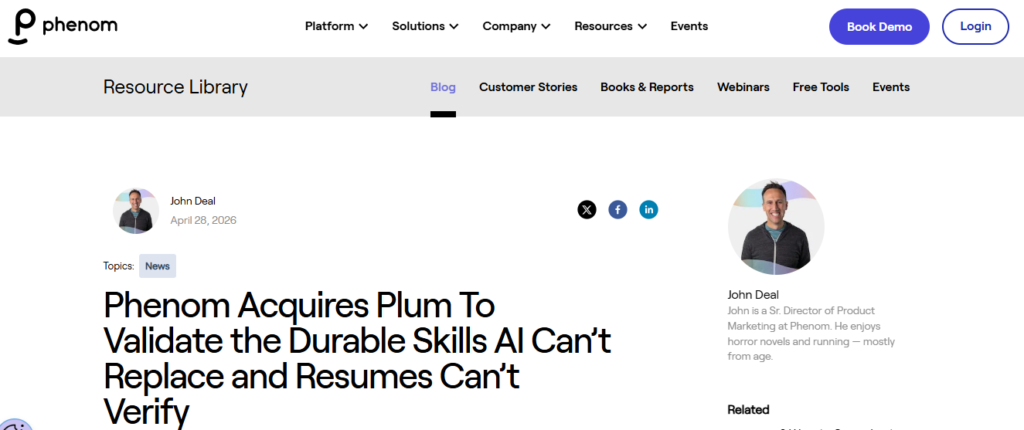
Plum takes a different angle from most competitors by scoring candidates on potential rather than just current skills or personality. Its science is built on industrial-organizational psychology research designed to predict how someone will grow into a role over time, not just perform on day one.
The platform’s talent profile compares candidates against both the role requirements and existing high performers on the team, which gives hiring managers a genuinely predictive shortlist instead of a resume-ranked one.
Plum also doubles as an internal mobility tool, letting HR teams identify employees ready for promotion using the same scoring model used in external hiring.
✅ Key Features
- Science-based potential and capability scoring
- Role benchmarking against existing top performers
- Internal mobility and succession planning module
- Bias-reduced, structured candidate comparisons
- Talent insights dashboard for hiring managers
- Integration with popular ATS and HRIS systems
✅ Pros
- Strong focus on long-term potential, not just current skill
- Doubles as an internal talent mobility tool
- Solid bias-reduction methodology
- Useful analytics for workforce planning teams
❌ Cons
- Newer brand with a smaller public validity track record than SHL or Hogan
- Best value requires buying into the full talent platform
- Smaller test library than pure-play assessment vendors
- Onboarding takes time to configure benchmarks properly
🎯 Best For: Companies that want to hire and promote based on long-term potential, not just resume-matched skills.
12. Traitify
Traitify — Fast, Visual Personality Assessment for High-Volume Screening
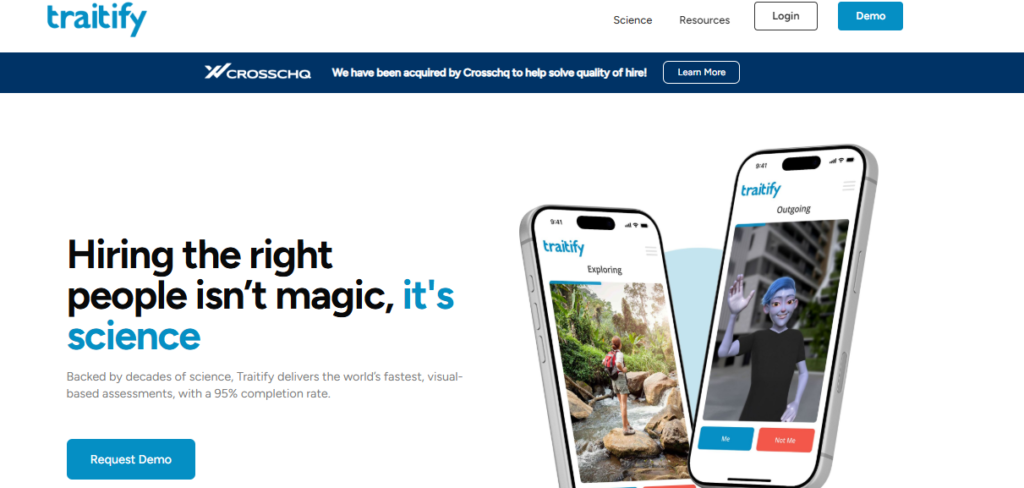
Traitify rebuilt the personality test around speed, replacing long question sets with an image-based format candidates can finish in about 90 seconds. That single design choice massively cuts drop-off during high-volume, mobile-first hiring campaigns.
Despite the speed, the underlying model still maps to recognized personality frameworks, so results remain useful for team fit and role matching rather than just a novelty exercise.
Retail, staffing agencies, and gig-economy employers who need to screen thousands of applicants quickly on a phone screen tend to get the most value from Traitify.
✅ Key Features
- Image-based personality assessment completed in under 2 minutes
- Mobile-first design built for phone completion
- Role fit scoring against configurable job profiles
- API for embedding directly into career sites
- Bulk candidate processing for high-volume campaigns
- Basic bias monitoring across candidate pools
✅ Pros
- Extremely fast completion time
- Very high candidate completion rates
- Great mobile experience
- Affordable for high-volume, lower-wage hiring
❌ Cons
- Less depth than full psychometric suites
- Not well suited for senior or technical hiring
- Smaller research base than legacy personality tools
- Limited standalone cognitive or skills testing
🎯 Best For: High-volume, mobile-first hiring where speed and completion rate matter more than assessment depth.
13. Berke Assessment
Berke Assessment — Culture-Fit Focused Assessment for Growing Businesses
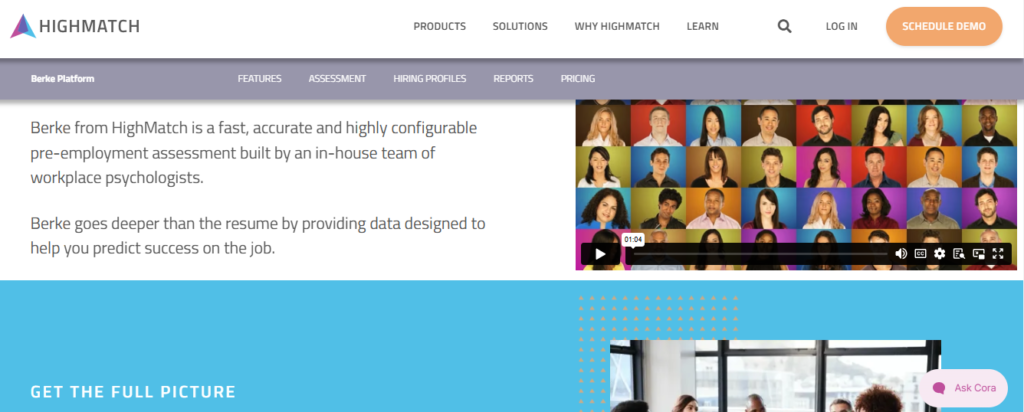
Berke built its platform for small and mid-size companies that care deeply about culture fit but do not have a dedicated I-O psychology team on staff. The assessment combines cognitive and personality scoring with a plain-language report that any hiring manager can actually read.
What stands out is the job model feature, which lets a company benchmark the assessment against its own best-performing employees rather than a generic industry average. That makes the results feel specific to the actual team, not a one-size-fits-all national norm.
Berke works well as a mid-funnel filter for growing companies that have outgrown gut-feel hiring but are not ready for an enterprise-grade platform.
✅ Key Features
- Combined cognitive and personality scoring
- Custom job models benchmarked against top performers
- Plain-language reports for non-HR hiring managers
- Coaching guides for onboarding new hires
- Candidate comparison and ranking tools
- ATS integration support
✅ Pros
- Reports are genuinely easy for managers to understand
- Custom benchmarking against real top performers
- Good value for growing small and mid-size teams
- Fast turnaround on results
❌ Cons
- Smaller global norm database than enterprise providers
- Limited technical or coding skills testing
- Fewer language options than global competitors
- Less brand recognition than legacy assessment providers
🎯 Best For: Growing small and mid-size businesses that want culture-fit hiring without an enterprise price tag.
14. Sova Assessment
Sova Assessment — Enterprise-Grade Assessment Built for Global, Inclusive Hiring
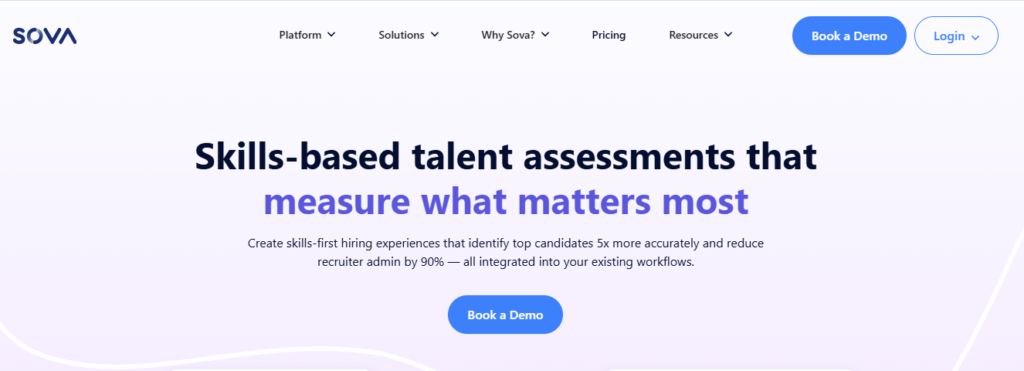
Sova was built from the ground up with DEI and global scalability as core design principles rather than an afterthought. Its assessments run in more than 30 languages and are regularly audited for adverse impact across different demographic groups.
The platform blends situational judgment tests, cognitive ability, and personality into a single candidate journey, which reduces assessment fatigue compared to stitching together several point solutions. Enterprise clients particularly value Sova’s configurable competency frameworks, which map cleanly to internal leadership models.
Large, global organizations running graduate and early-career hiring programs across multiple regions tend to find Sova’s inclusive design and configurability worth the investment.
✅ Key Features
- Situational judgment tests tailored by industry and role level
- Cognitive and personality assessment suite
- Assessments available in 30+ languages
- Regular third-party adverse impact audits
- Configurable competency frameworks for leadership pipelines
- Graduate and early-career program management tools
✅ Pros
- Strong global language and cultural coverage
- Genuine, audited focus on inclusive hiring
- Good for structured graduate and early-career programs
- Configurable to match internal competency models
❌ Cons
- Pricing geared toward large enterprise budgets
- Implementation timeline runs longer than self-serve tools
- Smaller footprint in the US market than in Europe
- Requires HR involvement to configure competency frameworks well
🎯 Best For: Global enterprises running structured, inclusive graduate and early-career hiring programs.
15. iMocha
iMocha — AI-Powered Skills Intelligence for Hiring and Upskilling
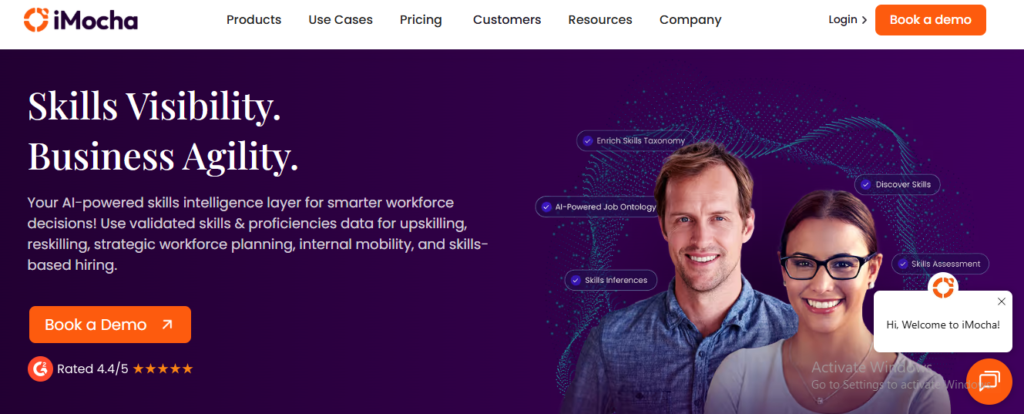
iMocha positions itself as a skills intelligence platform rather than a pure hiring test, which means the same assessment data can inform both recruitment decisions and internal upskilling plans. Its AI-based job description to skill mapping is one of the more genuinely useful automation features on the market.
The test library spans technical, cognitive, and soft skills, and the platform’s remote interview and coding sandbox tools hold up well against dedicated developer-hiring competitors. Companies building out a broader Best AI HR and Recruitment Tools stack often use iMocha as the skills layer that connects hiring data to workforce planning later.
HR teams juggling both talent acquisition and learning and development tend to get the most value, since the skills data carries over long after the hire is made.
✅ Key Features
- AI-based job description to skills mapping
- Technical, cognitive, and soft skills test library
- Remote coding sandbox and live interview tools
- Skills gap analytics for existing employees
- Customizable assessment builder
- Integration with major ATS and LMS platforms
✅ Pros
- Skills data useful beyond just the hiring decision
- Strong AI-assisted test creation
- Good technical assessment depth
- Useful for combined hiring and upskilling strategies
❌ Cons
- Broader feature set means a steeper learning curve
- Less specialized than pure-play technical testers like Codility
- Reporting can feel dense for non-technical hiring managers
- Full value requires committing to the wider platform
🎯 Best For: HR teams that want assessment data to inform both hiring decisions and long-term upskilling plans.
16. eSkill
eSkill — Fully Customizable, Job-Specific Skills Testing
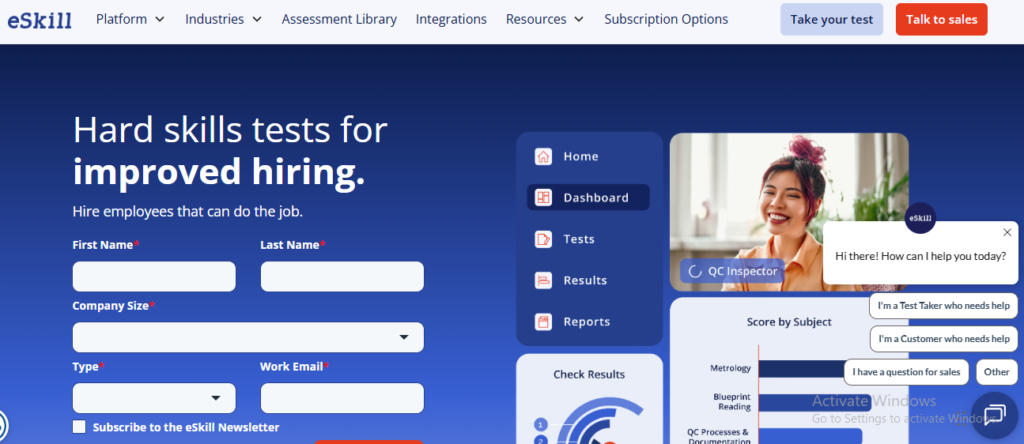
eSkill built its reputation on customization, letting companies build assessments that mirror the exact tasks a role requires rather than relying only on generic off-the-shelf tests. That flexibility matters for niche roles where standard test libraries fall short.
The platform supports everything from typing and data entry tests to industry-specific simulations for healthcare, finance, and manufacturing roles. Hiring teams can mix and match question types from eSkill’s library or write their own from scratch.
Companies with unusual or highly specific job requirements, where generic assessments feel like a poor fit, tend to get the most value from eSkill’s flexibility.
✅ Key Features
- Fully customizable test builder with a large question bank
- Industry-specific simulations for niche roles
- Typing, data entry, and software proficiency tests
- Video interview and skills test combination workflows
- Detailed skill-by-skill scoring breakdowns
- ATS and HRIS integration options
✅ Pros
- Excellent flexibility for niche or unusual roles
- Large content library across many industries
- Good value for the level of customization offered
- Detailed, specific skill reporting
❌ Cons
- So much flexibility can slow down initial setup
- Interface feels less polished than newer competitors
- Fewer built-in personality or behavioral assessments
- Support quality varies depending on plan tier
🎯 Best For: Companies hiring for niche, specialized roles that need highly customized skills testing.
17. Vervoe
Vervoe — AI-Graded Work Sample Tests for Skills-First Hiring
Vervoe leans fully into skills-first hiring by having candidates complete real work samples, like drafting a marketing email or debugging code, then using AI to grade the output against a scoring rubric. That approach cuts through inflated resumes better than most personality or cognitive tests alone.
The AI grading engine gets more accurate the more assessments run through it, and hiring teams can build custom work sample tests for almost any role without needing a psychometrics background. This makes it a strong fit for companies that have decided to stop screening by degree or years of experience.
Marketing, sales, customer support, and creative roles, where seeing actual work output matters more than test scores, are where Vervoe consistently performs best.
✅ Key Features
- AI-graded work sample and simulation tests
- Custom test builder for role-specific tasks
- Automated candidate ranking by skill score
- Anti-cheating and plagiarism detection
- Chrome extension for quick assessment creation
- Integration with popular ATS platforms
✅ Pros
- Strong focus on real work output over credentials
- AI grading saves significant reviewer time
- Flexible enough for creative and non-technical roles
- Good candidate experience, feels less like a test
❌ Cons
- AI grading accuracy depends on well-built rubrics
- Smaller validity research base than legacy providers
- Less depth in personality or cognitive assessment
- Best results require some setup investment upfront
🎯 Best For: Skills-first hiring for marketing, sales, and creative roles where real work samples beat resumes.
18. Cangrade
Cangrade — Predictive Analytics for Bias-Reduced Hiring Decisions
Cangrade built its platform around predictive analytics, using machine learning models trained on a company’s own top performers to forecast which candidates are most likely to succeed. That personalization is a step beyond the generic industry norms used by many competitors.
The platform’s adverse impact monitoring runs automatically in the background, flagging any hiring pattern that could create legal exposure before it becomes a problem. Teams comparing Best Sales Hiring Tools often find Cangrade’s predictive scoring especially strong for roles where performance data is easy to track and model against.
Companies that already collect solid performance data on existing employees get the most value, since the predictive model improves as more hiring outcomes feed back into it.
✅ Key Features
- Machine learning models trained on company-specific performance data
- Automated adverse impact and bias monitoring
- Personality, cognitive, and skills assessment combination
- Predictive turnover and performance risk scoring
- Candidate ranking dashboards for hiring managers
- ATS integration for automated screening
✅ Pros
- Genuinely predictive scoring tied to actual performance data
- Strong, automated bias and adverse impact monitoring
- Useful turnover risk predictions
- Model improves in accuracy over time
❌ Cons
- Needs existing performance data to reach full potential
- Smaller brand recognition than legacy assessment providers
- Setup requires HR analytics involvement to configure well
- Less useful for brand-new companies without historical hiring data
🎯 Best For: Companies with existing performance data who want predictive, bias-audited hiring scores.
19. Thomas International
Thomas International — Global Psychometric Suite Built for Data-Driven HR Teams
Thomas International has spent decades building a psychometric suite that covers personality, aptitude, and emotional intelligence under one roof. Its GIA general intelligence assessment and PPA personality profile are widely used across Europe and increasingly in North America.
The platform’s reporting connects cleanly into broader HR Analytics Tools, giving people teams a way to track assessment data alongside performance and retention metrics over time rather than treating hiring as a one-off event.
HR teams that want assessment results to feed into a larger, ongoing people analytics strategy, not just a single hiring decision, tend to find the most long-term value here.
✅ Key Features
- Thomas GIA aptitude and reasoning assessment
- PPA personality profiling based on the DISC model
- Emotional intelligence and behavioral assessments
- Team dynamics and management style reports
- API access for HR analytics and BI integrations
- Global norm groups across dozens of countries
✅ Pros
- Strong global track record and brand trust
- Reporting integrates well with broader people analytics
- Good balance of aptitude, personality, and EQ testing
- Useful management and team dynamics insights
❌ Cons
- Interface feels less modern than newer competitors
- Full value requires HR analytics maturity to use well
- Pricing not transparent without a sales conversation
- Onboarding takes longer than self-serve platforms
🎯 Best For: HR teams that want assessment data connected to a broader, long-term people analytics strategy.
20. HireVue
HireVue — Video Interviewing and Game-Based Assessment Combined
HireVue combines structured video interviewing with game-based cognitive and behavioral assessments, which makes it less a pure testing tool and more a full first-round screening replacement. Candidates record responses on their own time, and the platform’s structured scoring keeps evaluations consistent across large applicant pools.
The game-based assessments measure things like working memory and risk tolerance through short, engaging exercises rather than traditional questionnaires, which keeps completion rates high even among younger candidate pools. Large enterprises running thousands of first-round interviews a month lean on HireVue heavily to cut early-stage recruiter workload.
HireVue works best when a company wants to replace, not just support, early-stage phone screens with something scalable and structured.
✅ Key Features
- One-way and live structured video interviewing
- Game-based cognitive and behavioral assessments
- Automated scoring rubrics for interview consistency
- Bulk scheduling for high-volume interview campaigns
- Candidate comparison dashboards for hiring managers
- Integration with major ATS platforms
✅ Pros
- Strong replacement for early-stage phone screens at scale
- Game-based assessments keep candidate engagement high
- Consistent, structured scoring across large candidate pools
- Well suited to high-volume enterprise hiring
❌ Cons
- Some candidates find on-demand video interviews impersonal
- Game-based scoring can feel opaque without training
- Pricing geared toward large-scale enterprise use
- Less useful for smaller companies hiring occasionally
🎯 Best For: Large enterprises that want to replace early-stage phone screens with scalable video and game-based assessment.
Talent Assessment Tools Comparison Table
A side-by-side view makes it easier to shortlist two or three talent assessment softwares before booking demos.
| Tool Name | Best For | Key Strength | Integrations | Ease of Use | Platform Type |
|---|---|---|---|---|---|
| SHL | Global enterprises | Validated psychometrics | ATS/HRIS via API | Moderate | Enterprise |
| Criteria | Mid-market companies | CCAT cognitive validity | ATS integrations | Easy | Mid-market |
| Mercer | Mettl | High-volume technical/campus hiring | Coding tests + proctoring | HRIS/ATS | Moderate | Enterprise |
| HackerRank | Engineering teams | Real coding environments | ATS | Moderate | Technical/Enterprise |
| Codility | Senior engineering hiring | Realistic code review | ATS | Moderate | Technical |
| Harver | High-volume frontline hiring | Gamified bias reduction | ATS/HRIS | Easy | Mid-market/Enterprise |
| TestGorilla | SMB and growing teams | Test library variety | ATS | Very easy | SMB |
| Wonderlic | High-volume entry-level roles | Speed of screening | Basic ATS | Very easy | SMB/Enterprise |
| Hogan Assessments | Executive and leadership hiring | Derailment risk analysis | Consultant-led | Moderate | Enterprise |
| The Predictive Index | Sales and client-facing roles | Behavioral fit prediction | ATS | Easy | SMB/Mid-market |
| Plum | Potential-based hiring | Growth potential scoring | ATS/HRIS | Moderate | Mid-market/Enterprise |
| Traitify | High-volume mobile-first hiring | Under 2-minute completion | API/career site | Very easy | SMB/Enterprise |
| Berke Assessment | Growing small businesses | Custom job models | ATS | Easy | SMB |
| Sova Assessment | Global inclusive hiring | DEI auditing + multilingual | HRIS/ATS | Moderate | Enterprise |
| iMocha | Hiring plus upskilling teams | AI skills intelligence | ATS/LMS | Moderate | Mid-market/Enterprise |
| eSkill | Niche, specialized roles | Full test customization | ATS/HRIS | Moderate | Mid-market |
| Vervoe | Skills-first, creative roles | AI-graded work samples | ATS | Easy | SMB/Mid-market |
| Cangrade | Data-driven hiring teams | Predictive ML scoring | ATS | Moderate | Mid-market/Enterprise |
| Thomas International | People-analytics-driven HR | Global psychometric depth | API/BI tools | Moderate | Enterprise |
| HireVue | Large-scale first-round screens | Video + game assessment | ATS | Easy | Enterprise |
Final Verdict
For pure technical hiring, HackerRank and Codility remain the sharpest choices. For high-volume, bias-conscious hiring, Harver and Sova lead the pack. Small businesses on a budget get the most value from TestGorilla, while enterprises that need airtight, legally defensible validity data should stick with SHL, Mercer Mettl, or Hogan. Sales-heavy organizations should start their shortlist with The Predictive Index or Cangrade.
How to Choose the Right Talent Assessment Tool
Start With the Role, Not the Tool
A coding-heavy platform like Codility makes no sense for a customer support hire, and a behavioral tool like PI will not catch a weak developer. Map the assessment type to the actual skills the role demands before comparing vendors.
Match the Assessment Type to Hiring Volume
High-volume, entry-level roles need something fast and mobile-friendly, like Wonderlic or Traitify. Senior and executive hires justify a slower, deeper process, like Hogan or SHL, where precision matters more than speed.
Check for Bias and Adverse Impact Data
Any serious best talent assessment software vendor should be able to share adverse impact data by demographic group. If a vendor cannot answer this clearly, treat that as a warning sign, not a minor detail.
Weigh Integration and Ease of Use
A powerful assessment tool that does not talk to the existing ATS creates manual work nobody has time for. Confirm integration support before signing a contract, especially for teams already using dedicated HR Analytics Tools to track hiring metrics.
Protect the Candidate Experience
A 45-minute test with no clear purpose will scare off strong candidates before they finish. The best talent assessment tools respect a candidate’s time and explain why each test matters to the role.
Final Thoughts
The right talent assessment tools turn hiring from a guessing game into a repeatable, data-backed process. Enterprises with global hiring needs tend to do well with SHL, Mercer Mettl, or Sova, while growing companies often get more value from flexible, budget-friendly options like TestGorilla or Criteria. Technical teams should lean on HackerRank or Codility, and sales-focused hiring benefits most from The Predictive Index or Cangrade.
There is no single best talent assessment software for every company. The smartest move is picking two or three platforms from this list that match the actual roles being hired for, running a trial with real candidates, and comparing the data before committing to a long-term contract.