

Running a healthcare practice in 2026 means juggling packed schedules, rising patient expectations, and an endless stream of administrative work pulling your team away from actual care. The best CRM for healthcare changes all of that. From automated appointment reminders and HIPAA-compliant messaging to referral tracking and patient journey management, the best CRM software for the healthcare industry gives your team the tools to deliver better outcomes without the burnout.
Whether you run a solo clinic, a multi-specialty group, or a growing healthcare startup, the platform you choose will directly impact how patients experience your practice. According to the U.S. Department of Health and Human Services, patient engagement is a core driver of better health outcomes, and a strong CRM sits at the center of that engagement strategy.
We analyzed and reviewed the top 9 healthcare CRM platforms available in 2026 so you can skip the guesswork and find the solution that actually fits your workflow.
Top 9 Best CRM Software for Healthcare Industry in 2026
1. Salesforce Health Cloud
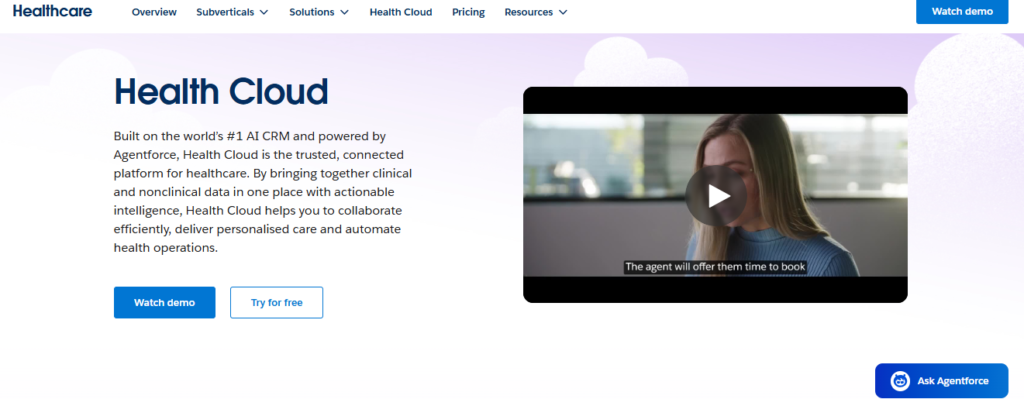
Salesforce Health Cloud is the undisputed leader in enterprise-grade healthcare CRM. Built on the world’s most powerful CRM foundation, it was redesigned specifically for health systems, payers, and specialty care providers that need deep customization, rock-solid compliance, and the ability to scale across thousands of patients and care teams.
What sets it apart is its 360-degree patient view. Every appointment, interaction, care plan, and communication lives in a single unified profile. This is not just a CRM; it is a full care coordination engine. For large hospital networks managing complex referral pipelines, it is genuinely difficult to beat.
If your organization needs a platform that grows with you while keeping compliance front and center, Salesforce Health Cloud is arguably the most complete solution on the market right now. It is also one of the most commonly referenced platforms when healthcare IT teams evaluate enterprise-level CRM options.
✅ Key Features
- 360-degree patient profiles that consolidate EHR data, appointments, and full communication history into a single view for every care team member
- AI-powered Einstein Analytics that predicts patient risk scores, flags follow-up opportunities, and surfaces actionable insights for care coordinators
- Care team collaboration tools connecting doctors, nurses, and coordinators in real time with shared task management and secure messaging
- HIPAA-compliant data architecture with enterprise-grade encryption, audit logs, and role-based access controls across the entire platform
- Pre-built FHIR-compliant integrations with Epic, Cerner, and other major EHR systems, enabling seamless patient data flow without custom development
- Patient journey mapping that visualizes every touchpoint in the care cycle to help teams identify gaps and optimize follow-up processes
✅ Pros
- ✅ Unmatched customization depth for complex healthcare organizations with unique workflows
- ✅ Best-in-class analytics and AI capabilities accessible to clinical and administrative teams
- ✅ Massive integration ecosystem with 3,000+ apps on AppExchange covering virtually every healthcare use case
- ✅ Industry-leading security, compliance certifications, and audit-ready reporting
- ✅ Scales effortlessly from mid-size specialty clinics to large multi-site hospital systems
❌ Cons
- ❌ Pricing starts at $300+ per user per month, making it a significant investment for smaller organizations
- ❌ Implementation typically takes months and often requires a certified Salesforce consulting partner
- ❌ Steep learning curve for non-technical and clinical staff during the onboarding phase
- ❌ Many of the most powerful features require additional paid modules on top of the base license
🎯 Best For: Large hospital networks, health systems, specialty care providers, and payers that need enterprise-level customization, deep EHR integration, and advanced analytics at scale.
2. HubSpot for Healthcare
HubSpot has evolved into one of the most widely used CRM platforms in the world, and its healthcare capabilities have made it a compelling choice for clinics and practices focused on patient engagement and practice growth. The platform blends CRM with marketing automation, giving healthcare teams a powerful combination of tools in a single interface.
From automated email sequences and patient segmentation to appointment booking workflows and satisfaction surveys, HubSpot handles the relationship side of running a healthcare practice with impressive efficiency. The interface is clean and approachable, which means front desk staff and marketing teams can get productive quickly without weeks of training.
For healthcare startups and growing clinics that need both patient relationship management and inbound marketing in one platform, HubSpot is one of the smartest options available. It also happens to be one of the most affordable paths into serious CRM functionality for organizations that are watching their budgets.
✅ Key Features
- Automated patient email sequences for appointment reminders, post-visit follow-ups, re-engagement campaigns, and seasonal health outreach
- Contact segmentation by diagnosis category, visit history, location, insurance type, or any custom health-related criteria your team defines
- Online appointment scheduling tools embedded directly in landing pages, emails, and website pages that sync automatically with staff calendars
- Built-in patient satisfaction surveys to gather feedback after visits and flag dissatisfied patients before they churn to another provider
- HIPAA-compliant configuration available for healthcare-specific deployments with a Business Associate Agreement (BAA) in place
- Marketing analytics dashboard showing which campaigns and channels are generating the most new patient inquiries and appointment bookings
✅ Pros
- ✅ Generous free tier makes it accessible for very small practices and healthcare startups with limited budgets
- ✅ Intuitive interface that administrative and marketing staff can learn quickly without formal training programs
- ✅ Strong marketing automation tools built directly into the CRM rather than requiring a separate platform
- ✅ Extensive integration library covering Google Workspace, Zoom, Stripe, and many healthcare-adjacent tools
- ✅ Active user community and extensive self-service support resources including HubSpot Academy
❌ Cons
- ❌ Full HIPAA compliance requires specific configuration steps and a signed BAA; it is not automatic out of the box
- ❌ Advanced features that healthcare practices often need sit behind paid tiers that can add up quickly as contact lists grow
- ❌ Not purpose-built for healthcare, so some clinical workflow features require workarounds or third-party integrations
- ❌ Reporting and dashboard customization is noticeably limited on lower-cost plans
🎯 Best For: Healthcare startups, growing clinics, private practices, and medical marketing teams that need a flexible CRM with strong patient engagement and digital marketing capabilities.
3. NexHealth
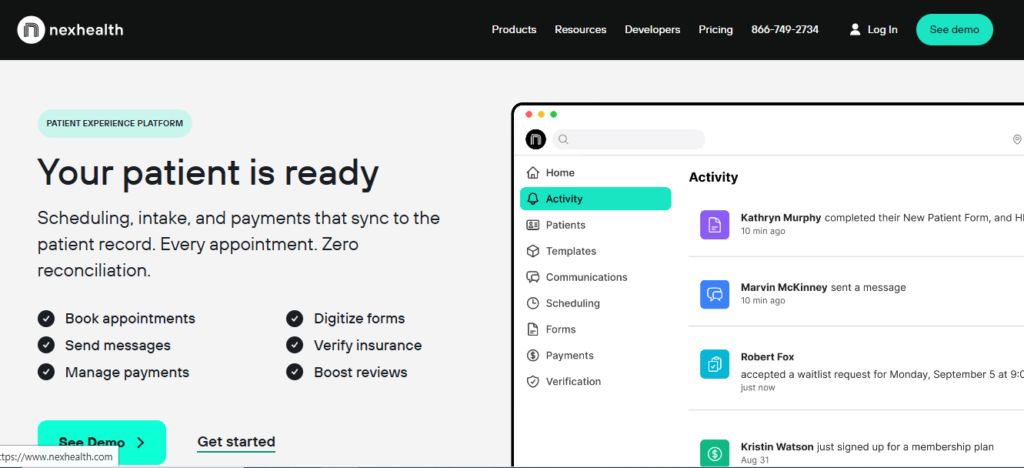
NexHealth is one of the most modern and purpose-built patient engagement platforms available for healthcare providers. Unlike general-purpose CRMs that have been retrofitted for clinical use, NexHealth was designed from day one with the specific needs of medical and dental practices at its core, which shows in almost every feature it offers.
The platform connects directly to existing EHR and practice management systems, pulling live patient data to keep records in sync without manual double entry. This real-time bidirectional sync is a genuine differentiator. Most CRMs in this space either lack direct EHR integration or require expensive middleware solutions to bridge the gap.
For practices that are tired of managing multiple disconnected platforms and want one tool that actually communicates with their EHR in real time, NexHealth removes the friction and delivers a clean, modern experience for both staff and patients. It is particularly well-regarded in dental, optometry, and primary care settings.
✅ Key Features
- Real-time bidirectional EHR sync with 15+ practice management systems including Dentrix, Eaglesoft, Athenahealth, and more, keeping patient records always current
- Online patient scheduling with intelligent calendar management, automated appointment confirmations, and custom booking rules for different appointment types
- Automated recall campaigns that identify lapsed patients and send personalized outreach to bring them back without any manual effort from staff
- HIPAA-compliant patient messaging via text and email, with all communication automatically logged to the patient record in the connected EHR
- Digital intake forms that replace paper entirely, collecting patient information electronically and syncing directly to the practice management system
- Automated post-visit review requests to help practices build and maintain their online reputation on Google and other key review platforms
✅ Pros
- ✅ Purpose-built for healthcare with native EHR integration that works out of the box without middleware
- ✅ Extremely clean and modern interface that patients find easy to use for self-service scheduling and communication
- ✅ Proven to reduce no-show rates significantly through intelligent and timely appointment reminder sequences
- ✅ Automates recall and reactivation campaigns that most practices acknowledge need doing but rarely have time to execute
- ✅ Dedicated healthcare customer support team with genuine clinical workflow expertise
❌ Cons
- ❌ Pricing is not publicly listed and can be a significant expense for very small practices
- ❌ Primarily focused on outpatient, dental, and optometry settings; less suitable for large hospital or inpatient care environments
- ❌ Customization options are more limited compared to enterprise-tier CRM platforms
- ❌ Some users have reported occasional synchronization delays with older EHR system versions
🎯 Best For: Dental offices, primary care clinics, optometry practices, and outpatient providers that need seamless EHR integration, modern patient communication tools, and automated scheduling.
4. Tebra
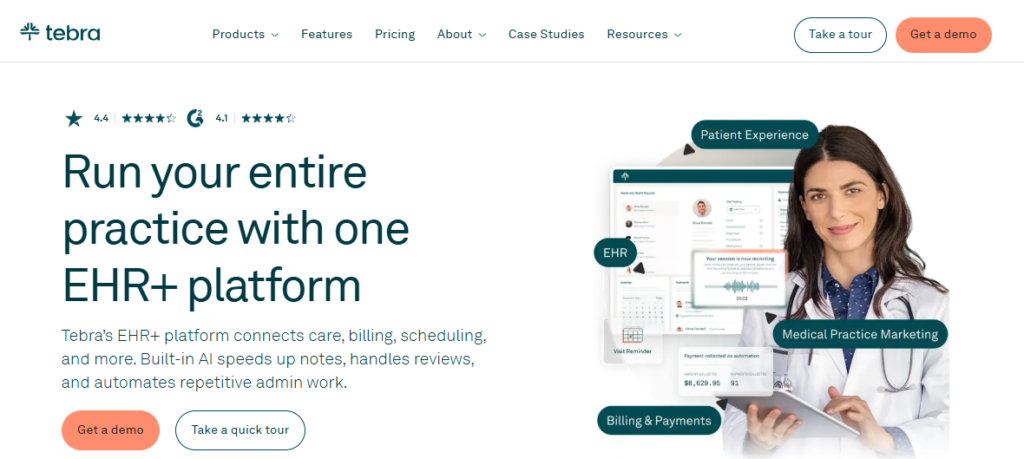
Tebra was formed from the merger of Kareo and PatientPop, two well-respected names in healthcare technology. The result is a comprehensive platform that covers the full patient lifecycle, from digital marketing and online presence all the way through scheduling, clinical documentation, and billing. For independent practices managing multiple vendors, that consolidation is a significant advantage.
What makes Tebra particularly compelling is its all-in-one approach. You get a patient engagement CRM, a practice website builder with built-in SEO tools, and billing automation in one subscription. There are very few platforms that bridge the gap between patient acquisition and back-office operations this effectively for independent practices.
If you run a small to mid-size independent practice and want a single platform that handles marketing, scheduling, patient communication, and billing without stitching together multiple subscriptions, Tebra is one of the strongest options available. It is especially well-suited for practices that want to grow their patient volume while keeping operational complexity low.
✅ Key Features
- Integrated patient engagement tools covering online scheduling, automated reminders, and secure two-way messaging in a single unified workflow
- Practice website creation and ongoing SEO optimization tools to improve search visibility and attract new patients from Google and other search engines
- Patient billing and online payment processing with a self-service payment portal that reduces collections friction for both patients and staff
- Built-in EHR module for clinical documentation, chart management, and prescription workflows within the same platform environment
- Automated reputation management with post-visit review requests sent to patients, helping practices build strong ratings on Google and Healthgrades
- Insurance eligibility verification integrated directly into the intake workflow, reducing billing errors and administrative rework
✅ Pros
- ✅ True all-in-one platform covering CRM, marketing, billing, and clinical documentation under one subscription
- ✅ Ideal for independent practices that want to reduce vendor complexity and simplify their technology stack
- ✅ Strong patient acquisition features that actively drive new appointment bookings through improved online presence
- ✅ Online payment tools improve revenue collections and create a more convenient experience for patients
- ✅ Good mobile application for providers and administrative staff who manage their practice on the go
❌ Cons
- ❌ The sheer breadth of features can make the platform feel complex and overwhelming to navigate during initial onboarding
- ❌ The built-in EHR module is not as clinically deep as dedicated EHR platforms, which may be limiting for complex specialties
- ❌ Customer support response times and quality have received mixed reviews from some independent practice users
- ❌ Better suited to independent practices; less appropriate for large hospital systems or complex inpatient environments
🎯 Best For: Independent primary care practices, specialty clinics, and solo providers that want an all-in-one platform for patient engagement, online marketing, billing, and basic clinical documentation.
5. LeadSquared for Healthcare
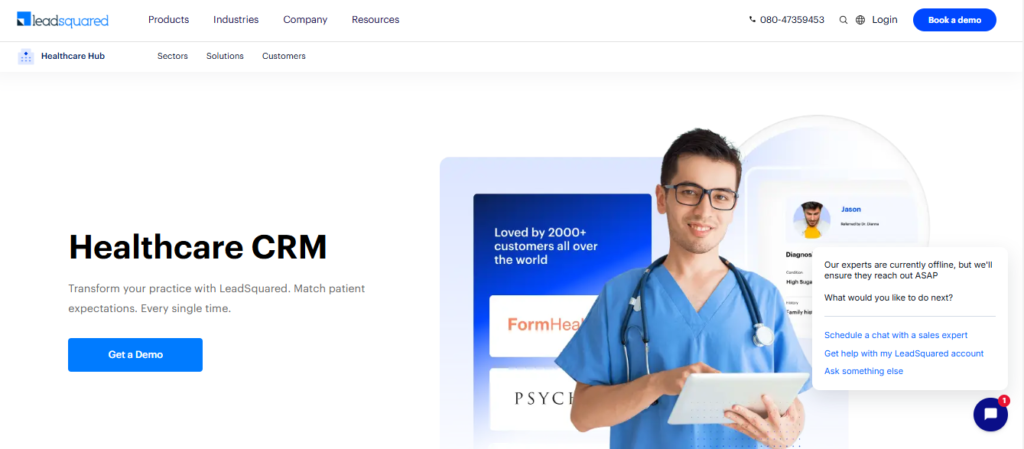
LeadSquared has quietly become one of the most powerful CRM platforms for healthcare organizations focused on patient acquisition and lead management. It was built for high-volume environments where lead conversion speed matters, making it a natural fit for healthcare systems managing large volumes of incoming patient inquiries, referrals, and appointment requests across multiple channels.
The platform’s automation capabilities are genuinely impressive at this price point. Healthcare marketing teams can build complex multi-step workflows that automatically route new patient leads to the right department, trigger personalized follow-up sequences, and track where prospective patients drop off in the appointment booking funnel. That level of operational visibility is genuinely valuable.
If your healthcare organization is focused on growing patient volume and needs a CRM that treats patient acquisition with the same rigor that a B2B sales team applies to closing deals, LeadSquared was essentially built for that exact use case. It also integrates well with common healthcare marketing stacks.
✅ Key Features
- Multi-channel patient lead capture from website forms, paid advertising, referral portals, call centers, and third-party healthcare directories
- Automated lead routing engine that assigns incoming patient inquiries to the correct department, care coordinator, or location based on custom rule sets
- Drip email and SMS automation campaigns to nurture prospective patients from initial inquiry through to confirmed appointment booking
- EHR and hospital management system (HMS) integration to sync confirmed patient data with clinical records once an appointment is scheduled
- Detailed conversion funnel analytics showing at exactly which stage prospective patients are dropping off before completing a booking
- Mobile CRM application for field health educators, outreach staff, and community health workers to update patient records and tasks remotely
✅ Pros
- ✅ Outstanding lead management and automation capabilities built specifically for high-inquiry healthcare environments
- ✅ Purpose-designed workflows for healthcare marketing teams focused on patient acquisition and referral management
- ✅ Handles very high inquiry volumes without performance degradation, which matters for busy health systems
- ✅ Detailed reporting and funnel analytics that healthcare marketing teams find directly actionable
- ✅ Strong integration capabilities with healthcare-specific platforms, ad networks, and communication tools
❌ Cons
- ❌ The interface can feel dense and overwhelming for front-line staff using it for the first time
- ❌ Initial setup requires significant configuration time to properly align with healthcare-specific workflows and compliance requirements
- ❌ Per-contact pricing can scale quickly as patient databases and inquiry volumes grow
- ❌ Customer support quality has been inconsistent according to some independent user reviews online
🎯 Best For: Healthcare systems, hospital networks, specialty practices, and healthcare marketing teams focused on patient acquisition, referral pipeline management, and multi-channel lead nurturing at scale.
6. Microsoft Dynamics 365 for Healthcare
Microsoft Dynamics 365 is a comprehensive CRM and ERP platform, and its healthcare capabilities have expanded significantly in recent years. For organizations already embedded in the Microsoft ecosystem, running Teams, Outlook, Azure, and Office 365 across their operations, Dynamics 365 is a logical extension that eliminates the friction of working across disconnected tools.
The platform’s core strength is its deep interoperability across the Microsoft stack. Patient data, appointment scheduling, team communication, and business analytics all flow through a connected environment. Power BI dashboards built directly into the CRM give healthcare administrators and executives real-time visibility into practice performance, patient satisfaction trends, and operational bottlenecks without needing a separate analytics tool.
For large healthcare organizations that live inside the Microsoft ecosystem and want a CRM that feels like a natural extension of the tools their team uses every day, Dynamics 365 is a very compelling option. It is particularly strong for integrated health systems that need both clinical and administrative functions in one connected platform.
✅ Key Features
- Seamless integration with Microsoft Teams, Outlook, Office 365, and Azure Health Data Services, enabling a fully connected care coordination environment
- Power BI analytics dashboards built natively into the CRM for real-time patient trend analysis, staff productivity tracking, and operational reporting
- Patient case management tools linking clinical notes, communication history, referrals, and care plans in a single connected patient record
- FHIR-compliant healthcare data framework enabling bidirectional interoperability with EHR systems including Epic, Cerner, and Allscripts
- Automated appointment workflows including multi-channel reminders, follow-up sequences, and no-show management powered by Microsoft Power Automate
- Role-based security, audit logging, and compliance tools aligned with HIPAA requirements and built on Microsoft’s global compliance infrastructure
✅ Pros
- ✅ Seamless native fit for organizations already running the Microsoft 365 stack across clinical and administrative teams
- ✅ Enterprise-grade security and compliance backed by Microsoft’s globally trusted infrastructure
- ✅ Powerful analytics through Power BI without needing a separate standalone analytics subscription or tool
- ✅ Flexible enough to serve both clinical coordination and administrative management use cases within one platform
- ✅ Extensive global partner ecosystem providing implementation, customization, and ongoing support services
❌ Cons
- ❌ Total cost of ownership can be high when factoring in full Dynamics 365 licensing plus Azure and add-on modules
- ❌ Implementation complexity is significant and almost always requires an experienced Microsoft implementation partner
- ❌ The interface can feel more rigid and dated compared to newer, healthcare-native CRM platforms
- ❌ Not ideal for small practices without dedicated IT resources to manage and maintain the system
🎯 Best For: Large hospitals, integrated health systems, and healthcare organizations already running Microsoft 365 that want a unified CRM, analytics, and care coordination environment.
7. Zoho CRM for Healthcare

Zoho CRM is one of the most flexible and affordable CRM platforms on the market, and its healthcare capabilities have improved substantially in recent years. For clinics and practices that need serious CRM functionality without enterprise-level pricing, Zoho hits a sweet spot that very few competitors can match at this price tier.
The platform’s breadth is genuinely impressive for its cost. From patient contact management and appointment workflow automation to AI-powered analytics and multi-channel communication, Zoho covers the core needs of most small to mid-size healthcare providers. The broader Zoho One suite also bundles billing, HR, and customer support tools, making it a practical choice for practices that want to consolidate their software stack affordably.
If you are running a growing clinic or a healthcare startup and you are looking for the best CRM for small business that can scale without crushing your budget, Zoho CRM deserves serious consideration. It is worth visiting Thelistify for additional software comparisons tailored to growing healthcare businesses.
✅ Key Features
- Customizable patient contact modules with tailored fields for medical histories, appointment notes, treatment records, and insurance details
- Workflow automation engine to trigger follow-up emails, SMS appointment reminders, and internal task assignments based on patient actions and milestones
- AI assistant Zia providing predictive analytics, anomaly detection in patient data trends, and intelligent scheduling suggestions for administrative teams
- Deep integration with Zoho Books for billing, Zoho Desk for patient support management, and 800+ third-party tools via REST API and Zapier
- Multi-channel communication hub bringing together email, phone, SMS, WhatsApp, and live chat interactions in a single patient record
- HIPAA-compliant configuration available with appropriate BAA and data handling policies applied across the platform
✅ Pros
- ✅ Very competitive pricing with plans starting around $14 to $20 per user per month, accessible for small and growing practices
- ✅ Highly customizable workflow and data structure that can be shaped to fit almost any healthcare practice model
- ✅ Strong ecosystem of complementary Zoho apps for billing, support ticketing, and HR without needing third-party subscriptions
- ✅ AI-powered tools like Zia accessible even on mid-tier plans, not locked behind expensive enterprise tiers
- ✅ Good mobile application for managing patient communications and tasks from any location
❌ Cons
- ❌ HIPAA compliance requires deliberate configuration steps and is not enabled by default out of the box
- ❌ The sheer number of customization options creates a learning curve for non-technical users during initial setup
- ❌ Customer support response times and quality can vary noticeably depending on the plan tier
- ❌ Not purpose-built for healthcare, so clinical-specific workflows sometimes require creative workarounds
🎯 Best For: Small to mid-size healthcare clinics, private practices, and healthcare startups that need an affordable, highly customizable CRM with room to grow as their patient base expands.
8. eClinicalWorks
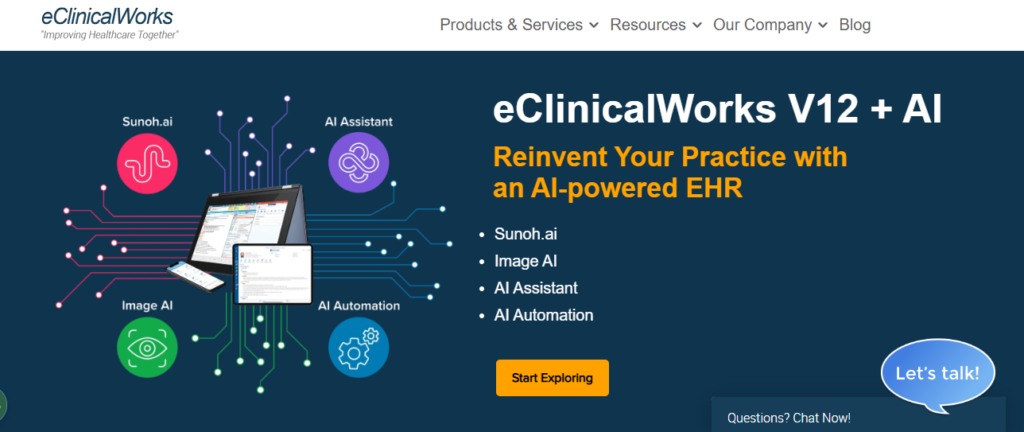
eClinicalWorks is one of the most widely adopted clinical and patient management platforms in the United States, serving over 180,000 providers across more than 50 specialties. Unlike most tools on this list, it combines a full electronic health record with CRM and patient engagement features, making it a genuine all-in-one clinical system rather than a standalone CRM.
The platform’s Patient Engagement Hub is its CRM core. It manages appointment scheduling, automated reminders, secure patient messaging, and telehealth all from the same environment where clinical documentation happens. For practices that want their clinical workflow and patient relationship management in the same system, eClinicalWorks eliminates the need to switch between platforms entirely.
For clinics and practices that want their CRM and EHR genuinely integrated under one roof rather than loosely connected via API, eClinicalWorks is one of the few platforms that delivers on that promise at meaningful scale. The best CRM for healthcare clinics with EHR integration often comes down to this platform or Tebra, depending on specialty and size.
✅ Key Features
- Fully integrated EHR with CRM functionality, allowing patient data to flow naturally between clinical notes, scheduling, and patient communication workflows
- Patient portal giving patients 24/7 self-service access to medical records, secure messaging, appointment scheduling, and lab result review
- Built-in telehealth capabilities for virtual visits that are embedded directly in the scheduling and communication workflow without third-party tools
- Automated multi-channel appointment reminders via text, email, and phone that measurably reduce no-show rates across specialties
- healow branded patient engagement mobile app connecting patients to their care team with a customizable, practice-branded experience
- Population health management tools for proactive outreach to high-risk patient groups based on diagnosis codes, visit history, and care gaps
✅ Pros
- ✅ True EHR-plus-CRM integration in a single platform, eliminating data silos between clinical and administrative workflows
- ✅ Widely adopted platform with a large user community, abundant training resources, and regular software updates
- ✅ Built-in telehealth capabilities that remove the need for a separate virtual care platform
- ✅ Strong patient portal with self-service features that improve engagement and reduce inbound administrative calls
- ✅ Suitable for a wide range of specialties and clinic sizes from solo practitioners to large multispecialty groups
❌ Cons
- ❌ The interface design feels dated compared to newer, more modern healthcare CRM platforms
- ❌ Customer support has received criticism for slow response times and resolution quality in independent user reviews
- ❌ Initial implementation and staff training can take several months to complete fully
- ❌ Pricing is not transparent and requires a custom quote; costs can be higher than expected once all modules are included
🎯 Best For: Outpatient clinics, multispecialty practices, community health centers, and federally qualified health centers that want a unified EHR and patient engagement CRM in one platform.
9. Creatio Healthcare CRM
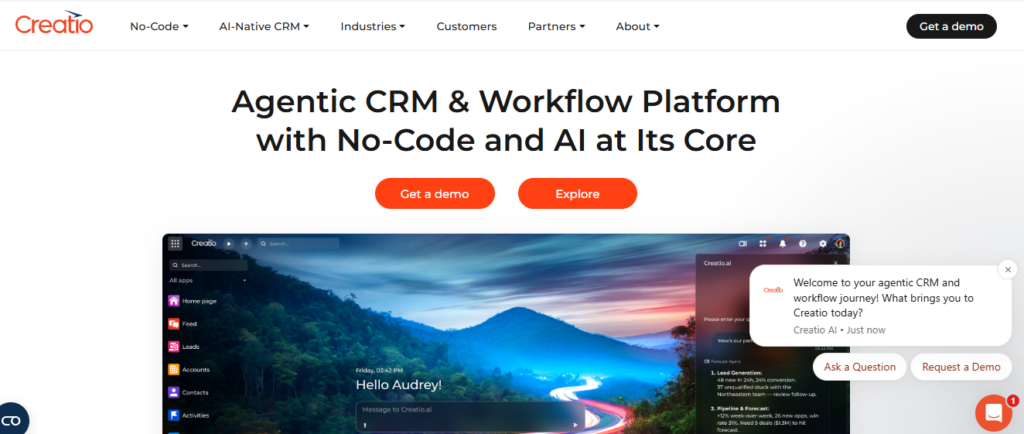
Creatio is a low-code CRM and business process automation platform that has earned genuine traction in the healthcare industry. Its core strength is flexibility. Unlike rigid out-of-the-box solutions built for a generic healthcare use case, Creatio lets healthcare organizations design and modify their own workflows without writing a single line of code, which is a significant advantage for organizations with unique processes.
The platform covers the full spectrum of patient relationship management from initial inquiry and appointment scheduling through to ongoing care coordination, referral management, and billing follow-ups. Its Studio Creatio tool allows administrators to build custom automation flows visually, meaning practices can adapt the CRM to their specific workflows without waiting on an external IT team.
For healthcare organizations that have outgrown generic CRM tools but do not want the full cost and complexity of enterprise platforms like Salesforce, Creatio offers a powerful middle ground. It is a particularly strong fit for mid-size specialty groups and multi-site practices that need sophisticated automation without enterprise price tags.
✅ Key Features
- No-code visual workflow builder allowing healthcare administrators to create and modify automation flows for any process without developer involvement
- 360-degree patient profile consolidating contact information, appointment history, communication logs, referrals, and care coordination notes in one place
- Automated care coordination workflows for multi-step patient journeys including referral management, pre-authorization follow-ups, and post-discharge outreach
- Built-in analytics dashboards tracking patient engagement rates, staff productivity metrics, referral conversion rates, and operational performance
- Integration with EHR systems, billing platforms, and third-party healthcare tools via pre-built connectors and a well-documented open API
- Compliance management tools supporting HIPAA data handling requirements with configurable data access controls and audit logging
✅ Pros
- ✅ Exceptional flexibility through low-code customization that makes the platform adaptable to almost any healthcare workflow or specialty
- ✅ Clean and modern interface that non-technical healthcare staff find genuinely intuitive after initial onboarding
- ✅ Strong process automation capabilities that eliminate significant amounts of manual administrative work across departments
- ✅ Scalable architecture that grows from small clinics to large multi-site healthcare organizations without requiring a platform change
- ✅ Active development cadence with regular feature updates driven by healthcare industry feedback
❌ Cons
- ❌ Pricing is not publicly listed and requires a consultation with the sales team before getting specific numbers
- ❌ Advanced integrations with some EHR and billing platforms require technical resources and time to configure properly
- ❌ Fully leveraging the platform’s customization capabilities takes time to master, especially for organizations new to low-code tools
- ❌ Lower brand recognition compared to Salesforce or HubSpot may require more internal justification when presenting to decision-makers
🎯 Best For: Mid-size healthcare organizations, specialty care groups, multi-site practices, and healthcare networks that need flexible and customizable CRM workflows without heavy enterprise IT overhead.
Healthcare CRM Comparison Table 2026
Use this side-by-side comparison to quickly identify which platform aligns best with your organization’s size, budget, and specific operational needs.
| Tool Name | Best For | Key Strength | EHR Integration | Ease of Use | Platform Type |
|---|---|---|---|---|---|
| Salesforce Health Cloud | Enterprise hospitals & health systems | 360 patient view + AI analytics | Epic, Cerner (FHIR) | Moderate | Enterprise Cloud |
| HubSpot for Healthcare | Startups, marketing-driven clinics | Marketing automation + CRM | Via integrations | Very Easy | Cloud SaaS |
| NexHealth | Dental, optometry, primary care | Real-time EHR sync + scheduling | Native (15+ systems) | Very Easy | Healthcare-Native |
| Tebra | Independent practices | All-in-one (CRM + EHR + billing) | Built-in EHR module | Moderate | All-in-One SaaS |
| LeadSquared | Patient acquisition teams | Lead management + funnel analytics | EHR/HMS APIs | Moderate | Cloud SaaS |
| Dynamics 365 | Microsoft-embedded orgs | MS ecosystem integration + Power BI | FHIR / Epic / Cerner | Moderate | Enterprise Cloud |
| Zoho CRM | Small/growing clinics | Affordable & highly customizable | Via API/Zapier | Moderate | Cloud SaaS |
| eClinicalWorks | Outpatient & multi-specialty clinics | Unified EHR + CRM + telehealth | Native (full EHR) | Moderate | EHR + CRM Hybrid |
| Creatio | Mid-size specialty groups | Low-code workflow automation | Via API connectors | Easy to Moderate | Low-Code Cloud |
Final Verdict
If budget is not a constraint and you run a large health system, Salesforce Health Cloud is the most complete platform available. For independent practices that want everything in one place, Tebra and eClinicalWorks both deliver strong all-in-one value. Growing clinics and healthcare startups will find HubSpot or Zoho CRM offer the best balance of functionality and affordability. Healthcare organizations focused specifically on patient acquisition should evaluate LeadSquared closely. And if you need deep EHR integration right out of the box, NexHealth consistently delivers the smoothest implementation experience for outpatient settings.
To explore more in-depth comparisons like this, visit TheListify, where we regularly publish expert-curated lists of the best tools and software for businesses across various industries. Whether you’re searching for Best CRM Tools, Best Accounting Software, Best Recruiting Software, Best Project Management Software, Best marketing tools, or productivity solutions, our detailed guides help you make informed decisions faster.
Frequently Asked Questions
What is the best CRM for healthcare in 2026?
The best CRM for healthcare in 2026 depends on your needs. Salesforce Health Cloud is ideal for enterprises, while HubSpot and Zoho CRM are great for startups and small clinics.
Why do healthcare providers need a CRM system?
Healthcare providers use CRM systems to manage patient relationships, automate communication, improve engagement, and streamline workflows while ensuring data security and compliance.
Which CRM is best for healthcare startups?
Zoho CRM and HubSpot are among the best CRM options for healthcare startups due to their affordability, ease of use, and strong automation capabilities.
What features should I look for in a healthcare CRM?
Look for features like EHR integration, patient data management, automation, HIPAA compliance, billing integration, analytics, and multi-channel communication tools.
What is the best CRM for healthcare clinics with EHR integration?
Salesforce Health Cloud and Microsoft Dynamics 365 are top choices for healthcare clinics that require seamless EHR integration and advanced data management.