

Finding the right buyer at the right time can make or break your sales pipeline. Reps waste hours digging through outdated contact lists, guessing at buying signals, and chasing leads that never convert. That is where the best sales intelligence tools come in.
These platforms hand your team verified contact data, real-time buying signals, and account insights so reps spend more time selling and less time researching. Choosing the wrong tool means wasted budget and missed quota. Choosing the right one means faster deals and a fuller pipeline.
This guide breaks down the top sales intelligence software on the market in 2026, what each one does best, and how to pick the platform that fits your sales motion.
What Is Sales Intelligence Software?
Sales intelligence software gathers and organizes data about your prospects, target accounts, and buying signals into one place. Instead of manually searching LinkedIn or guessing which companies are ready to buy, reps get verified emails, phone numbers, firmographic details, and real-time alerts on buyer activity.
Most platforms pull from several data sources at once. Common data types include:
- Contact data: verified emails and direct-dial phone numbers for decision makers
- Firmographics: company size, revenue, industry, and location
- Technographics: which tools and platforms a company already uses
- Intent signals: behavior that shows a prospect is actively researching a solution
- Trigger events: funding rounds, leadership changes, and new hires that open sales opportunities
Good sales intelligence software turns this raw data into action. According to industry research, the sales intelligence market was valued at billions of dollars in 2025 and continues to expand at a fast pace each year, which shows how much sales teams now depend on this category of tools. Instead of a rep spending 30 minutes researching one account, the platform surfaces the same insight in seconds. That extra time goes straight back into selling.
Top 7 Best Sales Intelligence Tools for 2026
1. ZoomInfo
Enterprise B2B Data and Intent Platform
ZoomInfo runs one of the largest B2B databases in the industry, with well over 100 million company profiles and hundreds of millions of verified contacts. Sales teams use it to build target account lists, pull direct-dial numbers, and layer buyer intent data on top of firmographic details.
The platform ranks near the top of most sales intelligence software lists because it pairs raw data scale with AI features like ZoomInfo Copilot, which flags which accounts to prioritize and when to reach out. It connects natively with Salesforce and HubSpot, so enriched data flows straight into your CRM without manual entry.
ZoomInfo works best for mid-market and enterprise teams that need deep account coverage and can invest in a RevOps team to manage the platform. Smaller teams sometimes find the learning curve and price tag steep compared to leaner alternatives.
✅ Key Features
- Massive contact and company database covering firmographics, technographics, and org charts
- Buyer intent signals that flag accounts actively researching related solutions
- Real-time trigger alerts for job changes, funding news, and hiring surges
- Native two-way sync with Salesforce and HubSpot
- AI-powered recommendations that suggest next best actions for reps
- Website visitor identification that reveals which companies are browsing your site
✅ Pros
✓ One of the largest verified B2B databases available
✓ Strong data accuracy backed by frequent refresh cycles
✓ Deep CRM integrations that cut down manual data entry
✓ AI-powered recommendations save reps research time
✓ Reliable trigger event alerts for timely outreach
❌ Cons
✗ Pricing is on the higher end and often requires a custom quote
✗ Can feel overwhelming for small teams without dedicated admin support
✗ Outreach and sequencing features are limited compared to dedicated engagement tools
✗ Contract terms typically require an annual commitment
🎯 Best For: Mid-market and enterprise sales teams that need the broadest possible data coverage and have the budget to match.
2. Apollo
Budget-Friendly Data Plus Outreach
Apollo combines a large contact database with built-in email sequencing, call tracking, and a Chrome extension for prospecting on LinkedIn. Instead of buying separate tools for data and outreach, teams can run their entire top-of-funnel motion from one dashboard.
The platform earns its spot on this list because it removes a real barrier for growing teams: cost. Apollo offers a genuinely useful free tier, and paid plans stay far more affordable than most enterprise sales intelligence platforms. That makes it a popular starting point for startups and small sales teams.
Reps who need to prospect, send sequences, and track calls without switching tabs tend to get the most value here. Larger teams with strict data accuracy requirements sometimes pair Apollo with a secondary data provider to fill in gaps.
✅ Key Features
- Contact database covering millions of verified emails and phone numbers
- Built-in email sequencing and multi-step outreach cadences
- Chrome extension for capturing leads directly from LinkedIn
- Call dialer with recording and activity logging
- Email verification to help reduce bounce rates
- Salesforce and HubSpot integrations for CRM sync
✅ Pros
✓ Free tier makes it accessible for solo reps and small teams
✓ Combines data and outreach so you skip buying a second tool
✓ Simple, intuitive interface with a short learning curve
✓ Frequent product updates and an active user community
✓ Flexible pricing tiers that scale with team size
❌ Cons
✗ Data accuracy can lag behind premium providers on certain accounts
✗ Higher email bounce rates have been reported by some users
✗ Advanced automation features sit behind higher-priced plans
✗ Support response times can be slow on lower tiers
🎯 Best For: Startups, SMBs, and lean sales teams that want data and outreach in one affordable platform.
3. Cognism
Best for European and GDPR-Compliant Data
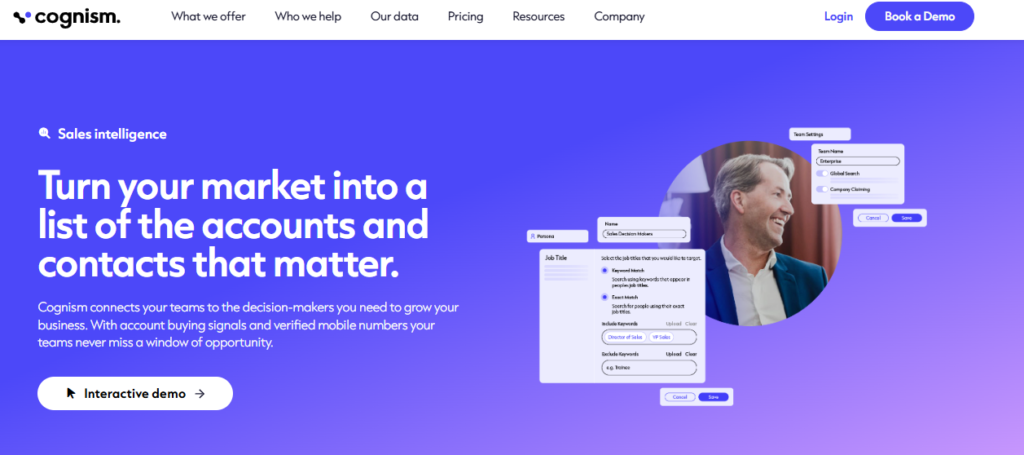
Cognism focuses on delivering compliant, phone-verified contact data for teams selling into Europe and other regulated markets. Its manual verification process checks mobile numbers closely, which pushes connection rates well above what most competitors offer on EMEA contacts.
This tool stands out in a crowded market because compliance is built into the product, not added as an afterthought. Cognism follows GDPR and CCPA requirements automatically, so legal and compliance teams spend less time reviewing outbound campaigns before they launch.
Sales teams selling primarily into the UK, EU, or other regulated territories get the most value from Cognism. Teams focused only on the US market may find better value with a domestic-first provider instead.
✅ Key Features
- Manually verified mobile numbers for EMEA contacts
- Built-in GDPR and CCPA compliance checks
- Firmographic and technographic filtering for account targeting
- Sales trigger events including funding rounds and leadership changes
- Chrome extension for LinkedIn-based prospecting
- CRM integrations with Salesforce, HubSpot, and Pipedrive
✅ Pros
✓ Strong phone number accuracy for European contacts
✓ Compliance features reduce legal risk for regulated industries
✓ Clean, straightforward interface with fast search filters
✓ Reliable customer support during onboarding
✓ Regularly refreshed data reduces outdated contact issues
❌ Cons
✗ Weaker contact coverage for North American accounts
✗ No native outreach or sequencing tools included
✗ Intent data requires a separate add-on
✗ Custom pricing makes budgeting harder for smaller teams
🎯 Best For: Sales teams targeting European markets that need verified phone data and built-in compliance safeguards.
4. LinkedIn Sales Navigator
Best for Social Selling
LinkedIn Sales Navigator turns LinkedIn’s professional network into a prospecting engine. Reps get advanced search filters, real-time alerts on job changes, and InMail credits that let them message prospects outside their existing network.
The tool holds a spot on nearly every sales intelligence software comparison because no other platform offers the same depth of relationship data. Sales Navigator shows mutual connections, shared groups, and recent posts, which gives reps natural conversation starters that cold data alone cannot provide.
Reps who rely on social selling and warm introductions get the most out of this tool. Teams that need broad database coverage beyond LinkedIn’s network usually pair it with a dedicated data provider.
✅ Key Features
- Advanced lead and account search filters by industry, seniority, and company size
- Real-time alerts when prospects change jobs or companies make news
- InMail credits for messaging prospects outside your network
- TeamLink for surfacing warm introductions through colleague connections
- Custom lead lists with saved search alerts
- CRM sync with Salesforce, HubSpot, and Microsoft Dynamics
✅ Pros
✓ Unmatched relationship and network mapping data
✓ Job change alerts create natural, well-timed outreach moments
✓ Familiar interface for anyone who already uses LinkedIn
✓ Strong for building warm, referral-based pipeline
✓ Regular feature updates including AI-powered account insights
❌ Cons
✗ Contact data is limited to what prospects share on LinkedIn
✗ No email sequencing or outbound automation built in
✗ InMail credits run out fast during high-volume prospecting
✗ Monthly cost adds up quickly across a full sales team
🎯 Best For: Sales teams that lean on social selling, warm introductions, and relationship-based outreach.
5. 6sense
Best for Account-Based Marketing Intelligence
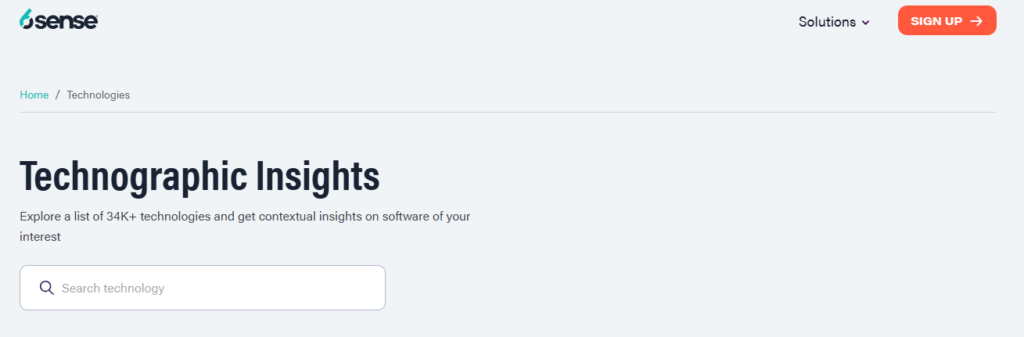
6sense specializes in identifying accounts that are researching a solution before they ever fill out a form or contact sales. It analyzes anonymous website activity, content engagement, and third-party intent signals to score how close an account is to buying.
This platform earns its place on this list for a specific reason: it sees demand that other tools miss. Where most sales intelligence software tracks known contacts, 6sense surfaces research activity that happens before a prospect ever raises their hand.
Enterprise marketing and sales teams running coordinated account-based programs benefit most from 6sense. Smaller teams without a dedicated ABM strategy often find the platform more complex than they need.
✅ Key Features
- Predictive account scoring based on buying stage
- Anonymous website visitor identification at the account level
- Third-party intent data showing what topics accounts are researching
- Advertising orchestration to target in-market accounts
- Integration with marketing automation platforms and CRMs
- Free tier offering limited data credits for smaller teams
✅ Pros
✓ Identifies buying intent before prospects engage directly
✓ Strong for coordinating marketing and sales around target accounts
✓ Detailed account scoring helps prioritize outreach
✓ Free tier available for testing the platform
✓ Integrates well into existing ABM tech stacks
❌ Cons
✗ Account-level insight only, without individual contact-level intent
✗ No built-in outreach or sequencing tools
✗ Steeper learning curve than simpler data providers
✗ Best features require enterprise-level pricing
🎯 Best For: Enterprise teams running account-based marketing programs that need predictive intent data at the account level.
6. Lusha
Best for Quick Contact Lookups
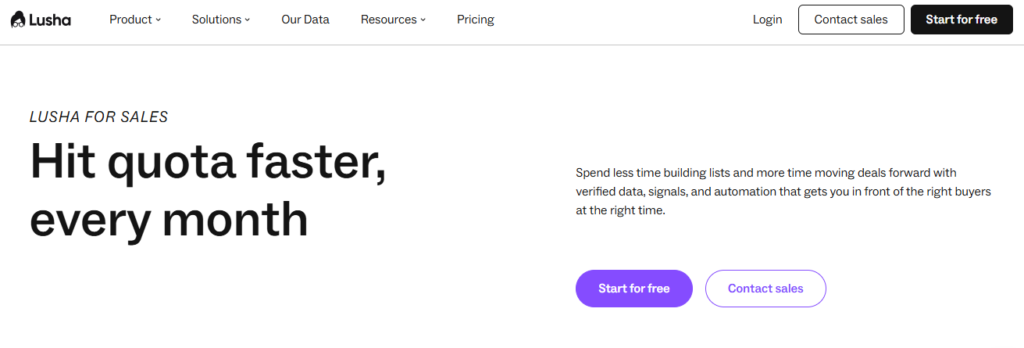
Lusha is built around speed. Its Chrome extension surfaces a prospect’s business email and phone number directly from their LinkedIn profile or company website, without leaving the browser tab.
The tool made this list because it solves a narrow but common problem well: getting a verified contact detail fast, without a complicated setup. Reps who need occasional lookups rather than a full prospecting platform find Lusha’s simplicity refreshing compared to heavier tools.
Individual reps and small teams doing manual, on-the-fly prospecting get the most value here. Teams running high-volume outbound campaigns typically need a more robust platform alongside Lusha.
✅ Key Features
- Chrome extension for instant contact lookups on LinkedIn and company sites
- Direct-dial phone numbers and verified business emails
- Bulk enrichment for uploading and enriching contact lists
- CRM integrations with Salesforce and HubSpot
- API access for custom data workflows
- GDPR and CCPA compliant data handling
✅ Pros
✓ Extremely fast and simple to use
✓ Low entry price compared to enterprise platforms
✓ Useful free tier for occasional lookups
✓ Clean Chrome extension that fits naturally into existing workflows
✓ Bulk enrichment saves time on list building
❌ Cons
✗ Credit-based pricing can feel restrictive at scale
✗ No outreach, sequencing, or engagement features
✗ Phone number accuracy varies by region
✗ Higher-volume plans require contacting sales
🎯 Best For: Individual reps and small teams that need fast, occasional contact lookups without a full platform commitment.
7. Seamless.AI
Best for Real-Time Contact Search
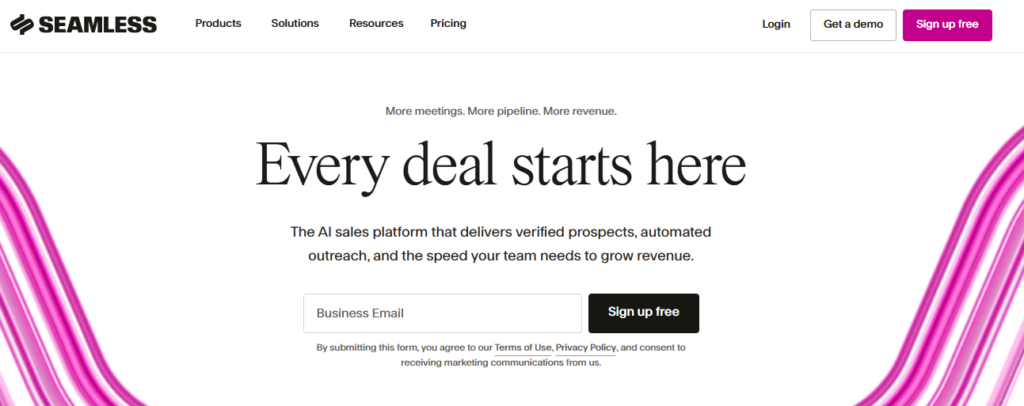
Seamless.AI positions itself as a real-time search engine for B2B contacts. Instead of pulling from a static database, the platform continuously verifies emails and phone numbers as reps search, which helps cut down on outdated data.
This tool stands out because of its search-first approach. Reps can filter by job title, company size, industry, and location, then pull verified contact details on demand rather than waiting for a database refresh cycle.
Teams running high-volume outbound prospecting who need fresh contact data on demand benefit most from Seamless.AI. Teams that prioritize deep firmographic or intent data may find other platforms a better fit.
✅ Key Features
- Real-time search and verification of emails and phone numbers
- Chrome extension for prospecting on LinkedIn and company websites
- Customizable filters by title, industry, company size, and location
- Bulk export for building targeted account and contact lists
- CRM integrations with Salesforce and HubSpot
- AI-powered search engine that continuously updates results
✅ Pros
✓ Real-time verification helps reduce outdated contact data
✓ Free tier available for smaller-scale testing
✓ Strong filtering options for targeted list building
✓ Fast search results compared to static databases
✓ Simple interface with a short onboarding time
❌ Cons
✗ Data accuracy can vary depending on the source
✗ No native outreach or sequencing tools
✗ Paid tiers require contacting sales for pricing
✗ Bulk searches can trigger rate limits during high-volume use
🎯 Best For: High-volume outbound teams that need real-time, on-demand contact verification.
Sales Intelligence Tools Comparison
Here is a quick side-by-side look at how these seven platforms stack up.
| Tool Name | Best For | Key Strength | Integrations | Ease of Use | Platform Type |
|---|---|---|---|---|---|
| ZoomInfo | Enterprise & mid-market teams | Largest verified B2B database | Salesforce, HubSpot | Moderate | Web-based |
| Apollo | Startups & SMBs | Data + outreach in one platform | Salesforce, HubSpot | Easy | Web + Chrome extension |
| Cognism | EMEA & regulated markets | GDPR-compliant phone data | Salesforce, HubSpot, Pipedrive | Easy | Web + Chrome extension |
| LinkedIn Sales Navigator | Social sellers | Relationship & network mapping | Salesforce, HubSpot, Dynamics | Easy | Web-based |
| 6sense | Enterprise ABM teams | Predictive account-level intent | Marketing automation, CRMs | Moderate | Web-based |
| Lusha | Individual reps | Fast browser-based lookups | Salesforce, HubSpot | Very Easy | Chrome extension |
| Seamless.AI | High-volume outbound teams | Real-time contact verification | Salesforce, HubSpot | Easy | Web + Chrome extension |
Final Verdict
If budget is no obstacle and you need the widest possible data coverage, ZoomInfo is the safest bet. Teams that want data and outreach bundled together at a lower price point should start with Apollo. For EMEA-focused compliance, Cognism wins.
Sales teams that lean on relationships should stick with LinkedIn Sales Navigator, and enterprise ABM programs get more value from 6sense. Lusha and Seamless.AI fit best as lightweight, fast lookup tools for reps who need contact details on the fly.
How to Choose the Right Sales Intelligence Tool
Picking the right platform depends on your sales motion, budget, and how your team already works. A few factors matter more than flashy feature lists.
Data Accuracy and Coverage
Outdated contact data wastes rep time and hurts your sender reputation. Check how often a vendor refreshes its database and whether it covers your target regions and industries.
Integration With Your Existing Stack
Your sales intelligence software should sync cleanly with your CRM and outreach tools. Native integrations save your team from manual data entry and reduce the chance of duplicate records.
Budget and Pricing Model
Some platforms charge per seat, others use credit-based pricing. Map your expected usage against pricing tiers before committing, since credit systems can get expensive fast at scale.
Compliance Requirements
If you sell into Europe or other regulated markets, confirm the vendor follows GDPR, CCPA, or other relevant data privacy laws before you sign a contract.
Team Size and Technical Support
Larger platforms often need a dedicated RevOps person to manage setup and maintenance. Smaller teams usually do better with a simpler, self-serve tool that does not require heavy onboarding support.
Conclusion
Choosing the best sales intelligence tools comes down to matching the platform to your sales motion. ZoomInfo makes sense if you need the deepest data coverage and have the budget for it. Apollo works well for lean teams that want data and outreach bundled together.
Cognism, LinkedIn Sales Navigator, 6sense, Lusha, and Seamless.AI each solve a more specific problem, from EMEA compliance to fast contact lookups. Before you commit, test a free trial or demo where available and compare data accuracy on your actual target accounts, not just the vendor’s marketing claims.
The right sales intelligence software should save your reps time every single day, not add another tool to manage. Start with the platform that matches your biggest bottleneck today, then expand from there.
To explore more in-depth comparisons like this, visit TheListify, where we regularly publish expert-curated lists of the best tools and software for businesses across various industries. Whether you’re searching for Best CRM Tools, Best Accounting Software, Best Recruiting Software, Best Project Management Software, Best marketing tools, or productivity solutions, our detailed guides help you make informed decisions faster.