
Bad reviews spread fast, and one unanswered comment can cost you a customer before they ever pick up the phone. That is why more companies now rely on online reputation management software to track what people say about them across Google, Yelp, Facebook, and dozens of other sites. The right platform does more than watch for negative feedback. It helps you request new reviews, respond to customers in minutes instead of days, and turn scattered feedback into real business decisions. In this guide, we break down the top 10 online reputation management software tools for 2026, based on real features, pricing signals, and what actually matters for building a trustworthy brand online.
What Is Online Reputation Management Software?
Online reputation management software is a tool that helps businesses track, collect, and respond to reviews, ratings, and mentions across the web. Instead of checking Google, Yelp, Facebook, and industry-specific review sites one by one, these platforms pull everything into a single dashboard.
Most platforms also let you send review requests through email or text after a purchase or appointment, so you are not waiting around for customers to leave feedback on their own. Many tools add sentiment analysis, which sorts feedback into positive, negative, or neutral so your team can spot problems before they spread.
For businesses with more than one location, this software also keeps listings consistent across directories like Google Business Profile and Bing Places. That matters more than most owners realize, since consumer research from BrightLocal’s annual review survey shows a growing share of shoppers say they always check reviews before choosing a business, up sharply from the year before.
Top 10 Best Online Reputation Management Software Tools for 2026
Choosing the right online reputation management software depends on your business size, how many locations you manage, and whether you need social media tools bundled in. Below is a closer look at the ten platforms worth your attention this year, based on their features, ease of use, and where each one truly stands out.
1. Birdeye
Review Automation and AI Insights for Multi-Location Brands
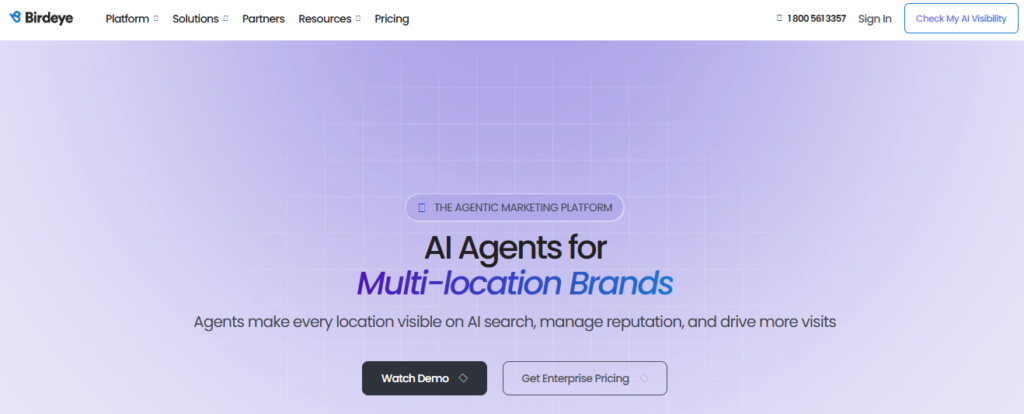
Birdeye is one of the most recognized names in online reputation management software, and it earns that spot by handling review requests, monitoring, and messaging from one dashboard. The platform pulls in reviews from more than 150 sites and uses AI to flag patterns in customer sentiment before they turn into bigger problems.
What makes Birdeye stand out is how well it fits businesses with many locations. Franchise owners and healthcare groups use it to keep every location’s review activity visible at the corporate level while local teams still respond in their own voice. The unified inbox also pulls in texts, webchat, and social messages, so nothing slips through the cracks.
Compared to smaller review tools, Birdeye leans toward mid-market and enterprise budgets, but the depth of automation and reporting tends to justify the cost for teams managing dozens of properties at once.
✅ Key Features
▪ Review monitoring across 150+ sites through a single unified dashboard for every location
▪ Automated review request campaigns triggered by appointment or point-of-sale integrations
▪ AI-powered sentiment analysis that flags recurring complaints before they escalate
▪ Unified inbox combining texts, webchat, social messages, and review replies in one place
▪ Competitor benchmarking that compares your review volume and rating against nearby rivals
▪ Local SEO reporting that ties review activity to search ranking improvements
✅ Pros
✓ Covers one of the widest ranges of review sites in the category
✓ Strong automation cuts down manual review request work significantly
✓ AI sentiment tools catch problems early, before they become bigger complaints
✓ Scales well for franchises and multi-location healthcare or retail brands
✓ Responsive customer support according to most verified user feedback
❌ Cons
✗ Pricing sits higher than most small business budgets can justify
✗ The dashboard has a learning curve for first-time users
✗ Some social integrations, including TikTok, are still limited
✗ Advanced reporting features are locked behind higher-tier plans
🎯 Best For: Multi-location franchises, healthcare networks, and retail chains that need centralized reputation oversight across dozens or hundreds of locations.
2. Podium
Text-First Reputation Management for Local Businesses
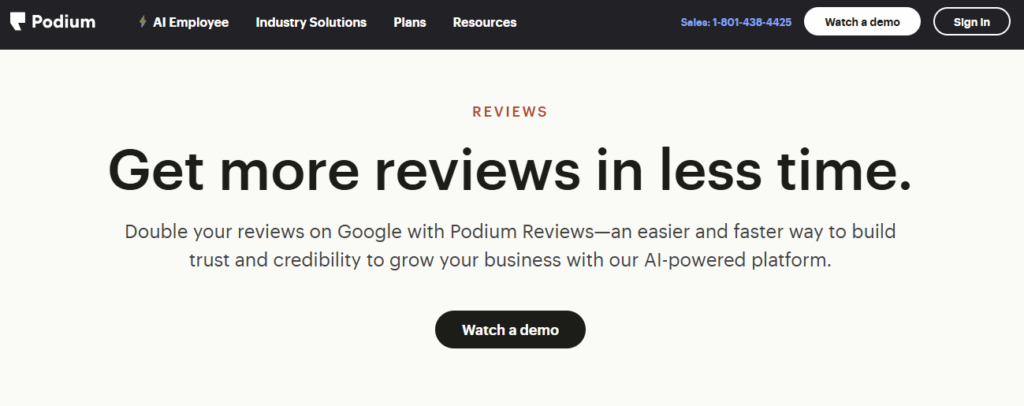
Podium built its name by leaning into text messaging instead of email, which matches how most customers actually want to communicate today. The platform lets businesses request reviews, answer questions, and even collect payments through SMS, all tracked in one inbox.
For local businesses like auto shops, dental offices, and home service companies, this text-first approach tends to produce faster review completion rates than email-based tools. Customers get a link right after their appointment and can leave a Google review in a few taps, with no app download or account required.
Podium also includes AI features that cover conversations outside business hours, so leads and review requests do not go cold overnight. It is not built for heavy social media management, but for review generation tied to real-time customer communication, it performs well.
✅ Key Features
▪ Automated SMS review requests sent right after a completed appointment or sale
▪ Unified inbox for text, webchat, and review replies across every location
▪ AI-powered lead coverage that responds to inquiries during off-hours
▪ Google Business Profile integration for direct review monitoring and response
▪ Payment collection built into the same messaging thread as review requests
▪ Reporting dashboard that tracks review volume, response time, and lead conversion
✅ Pros
✓ Text-based requests get higher completion rates than email in most cases
✓ Simple setup that does not require heavy technical knowledge
✓ Strong fit for service-area businesses where phone and text drive bookings
✓ Reliable Google Reviews integration with fast notification alerts
✓ Support team gets consistently positive marks from verified users
❌ Cons
✗ Limited social media management compared to full reputation suites
✗ Pricing can climb quickly once you add multiple users or locations
✗ Some users report a steep learning curve for advanced automation features
✗ Missing deeper reporting exports that larger teams may want
🎯 Best For: Local service businesses such as auto repair shops, dental practices, and home services companies that rely on phone and text communication with customers.
3. Sprout Social
Reputation and Social Media Management Combined
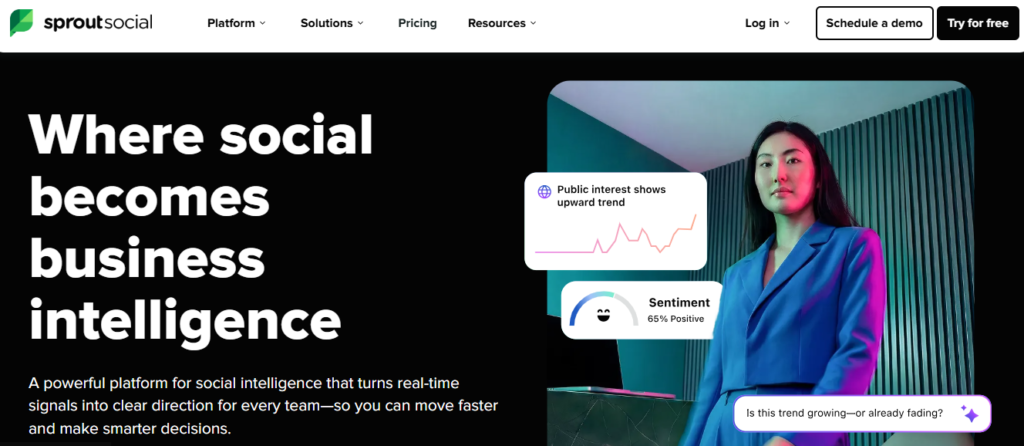
Sprout Social started as a social media scheduling tool, but it has grown into a serious contender in online reputation management software because it merges review monitoring with full social listening. That combination matters more than it used to, since customers now complain and praise brands just as often on social platforms as they do on review sites.
The Smart Inbox pulls every mention, comment, and review into one feed, so your team is not toggling between five different tabs. Sentiment analysis flags shifts in tone across brand mentions, which helps marketing teams catch a developing issue before it turns into a bigger crisis.
Sprout Social fits best for teams that already treat social media and reputation as connected disciplines rather than separate departments. It is less specialized in pure review generation than tools built specifically for that job.
✅ Key Features
▪ Smart Inbox combining reviews, social comments, and direct messages into one feed
▪ AI-driven sentiment analysis across social mentions and customer reviews
▪ Collaborative workspace tools for teams managing reputation across departments
▪ Review management integration for Google and Facebook alongside social scheduling
▪ Presentation-ready reporting for demonstrating reputation and social ROI to leadership
▪ Crisis alerts that flag unusual spikes in negative brand mentions
✅ Pros
✓ Strong fit for brands that manage social media and reputation together
✓ Collaborative tools make it easier for larger marketing teams to divide work
✓ Sentiment analysis is detailed and updates close to real time
✓ Reporting exports are polished enough to share directly with leadership
✓ Wide range of platform integrations beyond just review sites
❌ Cons
✗ Review management features are lighter than dedicated ORM platforms
✗ Pricing is based on social plans, which can feel steep for review-only needs
✗ No built-in SMS-based review request automation
✗ Full reputation features often require committing to higher-tier plans
🎯 Best For: Marketing teams that want reputation monitoring bundled with full social media management rather than a standalone review tool.
4. Yext
Listings Accuracy and Review Management at Scale
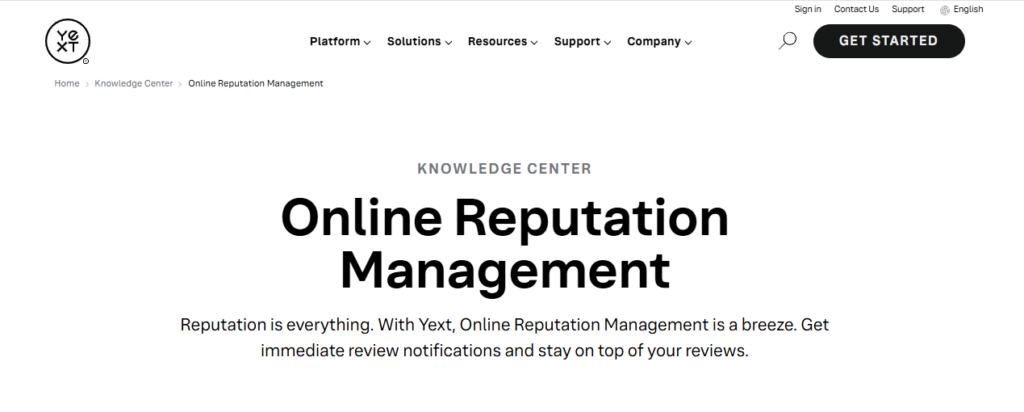
Yext solves a problem that many online reputation management software tools only address halfway: keeping your business information accurate everywhere it appears online. If your hours, address, or phone number are wrong on even a handful of directories, customers lose trust before they ever read a review.
Yext pushes updates across hundreds of directories, search engines, and apps at once, so a single change corrects your listings everywhere simultaneously. On top of that, it layers in review monitoring and AI-assisted response suggestions, giving multi-location brands one place to manage both listings and reviews.
Where Yext really separates itself is scale. Businesses managing hundreds of locations use it to avoid the kind of listing chaos that quietly damages local search rankings and confuses customers trying to find the right store.
✅ Key Features
▪ Mass listing updates pushed across hundreds of directories from a single dashboard
▪ AI-assisted review response suggestions to help teams reply faster and consistently
▪ Real-time notifications for new reviews across every connected location
▪ Local search analytics showing how listing accuracy affects search visibility
▪ Duplicate listing detection and cleanup across major directories
▪ Centralized review dashboard covering Google, Facebook, and industry-specific sites
✅ Pros
✓ Best-in-class listing accuracy tools reduce local search visibility issues
✓ Helps reduce Google Business Profile suspensions tied to inconsistent data
✓ Strong fit for brands with a large number of physical locations
✓ Helpful customer support noted consistently in verified reviews
✓ Centralized dashboard simplifies management across many directories
❌ Cons
✗ Interface has a steep learning curve for teams new to listings management
✗ Review management features are less deep than review-first competitors
✗ Pricing structure can be confusing without a sales conversation
✗ Smaller businesses may find more capability here than they actually need
🎯 Best For: Multi-location brands and franchises that need airtight listing accuracy across directories alongside basic review monitoring.
5. NiceJob
Hands-Free Review Automation for Trade and Service Businesses
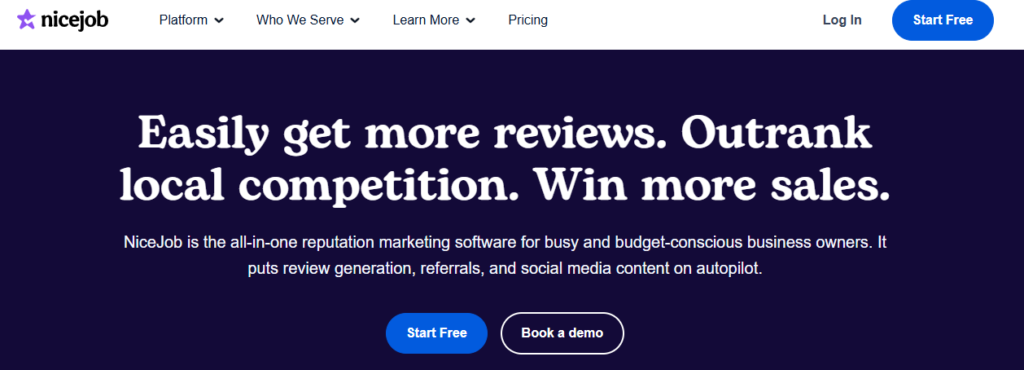
NiceJob keeps things simple, and that simplicity is exactly why trade businesses like contractors, landscapers, and cleaning companies tend to stick with it. The platform connects to your CRM or job management software and automatically sends a review request the moment a job closes.
Instead of a long form, customers get a short text-first sequence that takes seconds to complete, which keeps completion rates high without manual follow-up from staff. NiceJob also includes a Wow Score that estimates how likely a happy customer is to refer new business, giving owners another signal beyond star ratings.
It does not try to be an all-in-one marketing suite, and that focus is the point. For businesses that just need consistent Google reviews without a complicated setup, NiceJob delivers quickly.
✅ Key Features
▪ Automatic review request sent the moment a job or work order closes
▪ Text-first request sequence designed to minimize customer drop-off
▪ CRM and job management software integrations for hands-free automation
▪ Wow Score referral likelihood tracking based on customer feedback patterns
▪ Website widget that displays fresh reviews to build trust with new visitors
▪ Simple analytics dashboard tracking review volume and rating trends over time
✅ Pros
✓ Extremely easy setup with minimal training required for staff
✓ Automation genuinely removes the need for manual follow-up
✓ Strong fit for trades and home service businesses specifically
✓ Noticeable increase in Google review volume within weeks for most users
✓ More affordable than full enterprise reputation suites
❌ Cons
✗ Feature set is narrow and does not cover social media management
✗ Pricing can feel steep for solo operators relative to the feature depth
✗ Client list uploads can be clunky for teams with large customer databases
✗ Limited reporting customization compared to broader ORM platforms
🎯 Best For: Contractors, landscapers, cleaning companies, and other trade businesses that want automated Google review generation without extra complexity.
6. Reputation.com
Enterprise-Grade Reputation Scoring for Multi-Property Brands
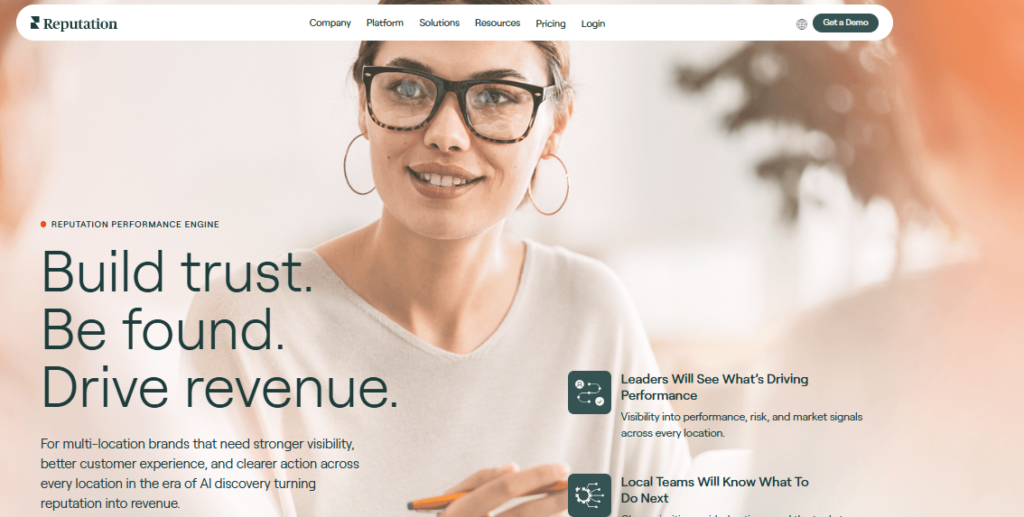
Reputation.com built its platform around a single number: the reputation score. That score pulls together reviews, ratings, and social sentiment into one metric that executives can track the same way they track revenue or customer satisfaction.
For hospitality groups, property managers, and multi-location healthcare practices, that scoring system makes it much easier to compare performance across dozens or hundreds of properties at once. The platform also includes AI-assisted social post generation and survey tools, so teams can act on feedback instead of just watching it pile up.
Reputation.com tends to fit larger organizations with dedicated reputation or customer experience teams rather than small businesses managing everything solo. The depth of analytics is a real strength, but it comes with a learning curve smaller teams may not need.
✅ Key Features
▪ Proprietary reputation score that consolidates reviews, ratings, and sentiment into one metric
▪ Cross-property benchmarking to compare performance across every managed location
▪ AI-assisted social post generation for consistent brand presence at scale
▪ Survey and voice-of-customer tools tied directly into the same dashboard
▪ Centralized response management across review sites and social platforms
▪ Custom reporting built for enterprise and regional management teams
✅ Pros
✓ Reputation scoring gives leadership a clear, trackable performance metric
✓ Strong fit for large portfolios of hotels, clinics, or retail properties
✓ AI social publishing tools save time for teams managing many accounts
✓ Detailed cross-location analytics highlight underperforming sites quickly
✓ Wide range of integrations across review and social platforms
❌ Cons
✗ Pricing and setup complexity make this a poor fit for small businesses
✗ Some users report confusion around how the reputation score is calculated
✗ Reporting can require tweaking to match specific business needs
✗ Survey email deliverability issues have been noted by some users
🎯 Best For: Enterprise hospitality groups, property management companies, and multi-location healthcare networks that need a unified reputation score across many sites.
7. Brand24
Affordable Social Listening and Brand Mention Monitoring
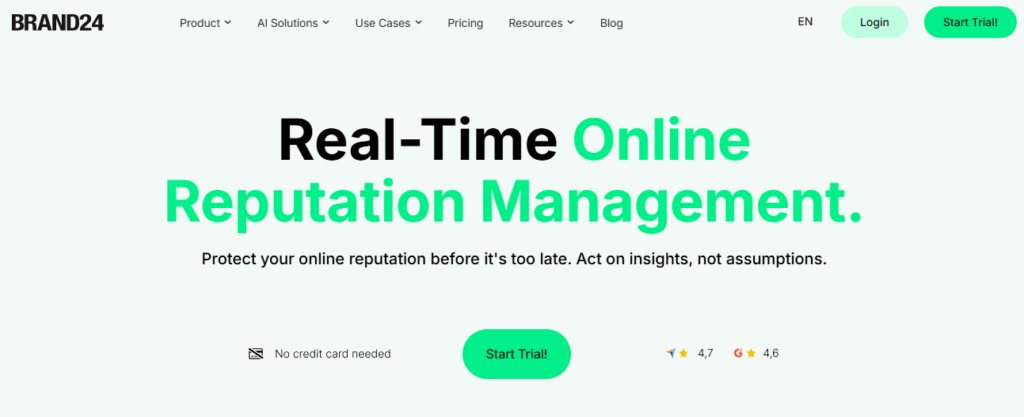
Brand24 takes a different angle than most tools on this list. Instead of focusing purely on review site management, it specializes in tracking mentions of your brand, product, or keywords across social media, blogs, forums, podcasts, and news sites.
That broader net catches conversations that never touch a formal review site, which matters more than businesses often expect. A frustrated customer venting on social media or a positive mention buried in a forum thread can shape opinion just as much as a Google review, and Brand24 is built to surface both.
The platform includes sentiment analysis and influence scoring, so teams can prioritize which mentions actually matter instead of chasing every single one. It works well as a companion to a review-focused tool rather than a full replacement for one.
✅ Key Features
▪ Real-time mention tracking across social media, blogs, forums, and news sites
▪ Sentiment analysis that separates positive, negative, and neutral brand mentions
▪ Influence scoring that highlights which mentions carry the most reach
▪ Slack and email alerts for sudden spikes in negative mentions
▪ Hashtag and keyword tracking beyond just brand name mentions
▪ Exportable reports for tracking mention volume and sentiment trends over time
✅ Pros
✓ Covers a much wider range of sources than typical review tools
✓ Pricing is more accessible for small and mid-sized businesses
✓ Sentiment analysis updates quickly, which helps during fast-moving situations
✓ Useful for tracking competitor mentions alongside your own brand
✓ Straightforward interface that does not require extensive training
❌ Cons
✗ Does not include review request automation like review-first platforms
✗ Deeper sentiment features require a higher-tier plan
✗ Not built for managing multi-location Google Business Profile listings
✗ Best results depend on setting up keyword tracking carefully from the start
🎯 Best For: Marketing and PR teams that need broad social listening and mention tracking alongside, not instead of, dedicated review management.
8. Trustpilot
Public Trust Platform for E-Commerce and B2B Brands
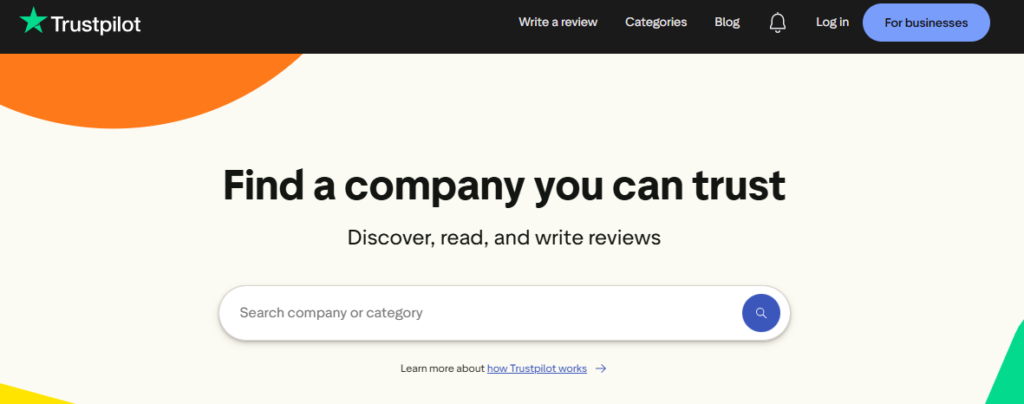
Trustpilot works differently than most tools on this list because it is also a public destination where consumers search for reviews before buying. That dual role, both a review collection tool and a trusted third-party review site, gives it weight that private dashboards cannot match on their own.
E-commerce and B2B companies use Trustpilot to collect verified reviews, then display trust badges and star ratings directly on their websites, in paid ads, and in Google search results through structured data. Because the reviews live on an independent platform, they tend to carry more credibility with shoppers wary of reviews collected only in-house.
Trustpilot also gives businesses tools to respond to reviews publicly and flag ones that violate its guidelines, which matters when unfair or fake reviews slip through.
✅ Key Features
▪ Independent, publicly searchable review platform that builds third-party credibility
▪ Star rating rich snippets that display directly in Google search results
▪ Automated review invitations sent via email after a purchase or service
▪ Review response tools for engaging with both positive and negative feedback
▪ Integration with major e-commerce platforms including Shopify and ad networks
▪ Review flagging and moderation tools to challenge policy-violating feedback
✅ Pros
✓ Public platform status adds independent credibility that in-house widgets lack
✓ Strong SEO benefit from star ratings appearing in search results
✓ Well recognized by consumers, which builds instant trust for new brands
✓ Solid integrations with common e-commerce and advertising platforms
✓ Useful for both product-level and company-level review collection
❌ Cons
✗ Free plan has limited features compared to paid tiers
✗ Some businesses report a slower process disputing questionable reviews
✗ Less useful for service businesses without a strong online storefront presence
✗ Setup for advanced widgets can require some technical comfort
🎯 Best For: E-commerce brands and B2B companies that want public, independently verified reviews to boost buyer trust and search visibility.
9. Grade.us
White-Label Review Management Built for Agencies
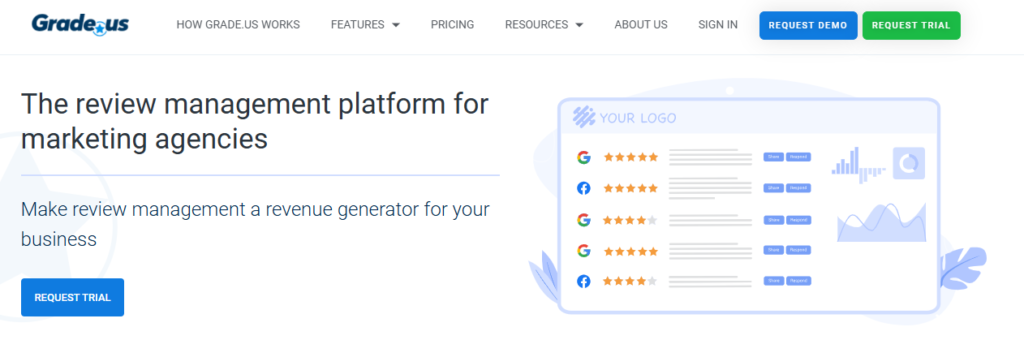
Grade.us takes a slightly different path than the consumer-facing brands on this list. It was built specifically for marketing agencies that manage online reputation management software on behalf of multiple clients, and that focus shows in how the platform is structured.
Agencies can white-label the entire dashboard, client reports, and review request emails under their own brand, so clients never see the Grade.us name. That matters for agencies trying to build their own brand equity instead of reselling someone else’s product with their logo bolted on.
The platform automates review requests, aggregates feedback from multiple sites, and produces branded reports that agencies can hand off directly to clients. It is not aimed at businesses managing their own single location, but for agencies juggling a client roster, it solves a real operational headache.
✅ Key Features
▪ Full white-label branding across dashboards, reports, and client-facing emails
▪ Multi-client management console for agencies overseeing many accounts at once
▪ Automated review request campaigns customizable per client brand voice
▪ Aggregated review feed pulling from Google, Facebook, and industry-specific sites
▪ Branded PDF and online reporting built for client hand-off
▪ Review widget generator for embedding client reviews on client websites
✅ Pros
✓ Strong agency focus with genuine white-label capability throughout
✓ Simplifies managing reputation for many clients from one login
✓ Reporting is built specifically to be client-ready without extra formatting
✓ Reasonable pricing structure for agencies reselling reputation services
✓ Straightforward review request automation that clients rarely need to touch
❌ Cons
✗ Not designed for individual businesses managing their own single account
✗ Feature set is narrower than full enterprise reputation platforms
✗ Some users want more customization options in report templates
✗ Limited native social media monitoring compared to broader tools
🎯 Best For: Marketing agencies that need a white-label reputation management solution to manage reviews for multiple clients under their own brand.
10. Broadly
All-in-One Reputation Tool for Small Local Businesses
Broadly is built for small business owners who need reputation management to just work without a dedicated marketing team running it. The platform combines review requests, a mobile-friendly web chat widget, and appointment reminders into one simple app.
Instead of separate logins for review generation, customer messaging, and scheduling, Broadly consolidates the daily tasks a small business owner actually touches into a single mobile-friendly interface. That matters for owners who are also the ones answering the phone, managing staff, and handling customer service themselves.
The platform leans toward simplicity over depth, which is exactly the trade-off many small local businesses want. It will not replace a full marketing stack, but for generating consistent Google reviews and staying responsive to customers, it covers the basics well.
✅ Key Features
▪ Automated review request campaigns sent via text and email after service
▪ Mobile-friendly web chat widget for capturing leads directly from your website
▪ Appointment reminders that reduce no-shows and keep customers engaged
▪ Centralized inbox for managing customer messages across channels
▪ Simple review monitoring dashboard covering Google and Facebook
▪ Mobile app access so owners can manage everything from a phone
✅ Pros
✓ Genuinely simple setup suited for owners without marketing experience
✓ Combines review generation with everyday customer communication tools
✓ Mobile app makes day-to-day management convenient for busy owners
✓ Affordable pricing tier aimed specifically at small business budgets
✓ Helps small businesses compete with larger brands on review volume
❌ Cons
✗ Feature depth is limited compared to multi-location enterprise platforms
✗ Reporting and analytics are basic compared to competitors on this list
✗ Not built for businesses managing many locations at once
✗ Some users want more customization in messaging templates
🎯 Best For: Small, single-location businesses that want an easy way to generate reviews and manage customer communication without a marketing department.
Online Reputation Management Software Comparison Table
Here is a side-by-side look at how the top 10 online reputation management software tools stack up on the factors that matter most when narrowing down your options.
| Tool Name | Best For | Key Strength | Integrations | Ease of Use | Platform Type |
|---|---|---|---|---|---|
| Birdeye | Multi-location franchises | Widest review site coverage + AI sentiment | 150+ apps, CRM & POS | Moderate | Cloud, web & mobile |
| Podium | Local service businesses | Text-first review requests | CRM, payments, GBP | Easy | Cloud, web & mobile |
| Sprout Social | Social + reputation teams | Unified social & review inbox | Facebook, IG, Google, LinkedIn | Moderate | Cloud, web & mobile |
| Yext | Multi-location listings | Mass directory listing sync | 200+ directories, POS, CRM | Steep | Cloud, web |
| NiceJob | Trades & service pros | Hands-free review automation | CRM & job management tools | Very Easy | Cloud, web & mobile |
| Reputation.com | Enterprise multi-property | Unified reputation score | Social platforms, surveys | Moderate to steep | Cloud, enterprise web |
| Brand24 | Marketing & PR teams | Broad social listening | Slack, email, social platforms | Easy | Cloud, web & mobile |
| Trustpilot | E-commerce & B2B brands | Public third-party credibility | Shopify, ad platforms, Google | Easy | Cloud, web |
| Grade.us | Marketing agencies | White-label multi-client management | Google, Facebook, review sites | Moderate | Cloud, web |
| Broadly | Small local businesses | All-in-one simplicity | Google, Facebook, scheduling | Very Easy | Cloud, web & mobile |
Final Verdict
If you manage multiple locations and need the deepest feature set, Birdeye and Reputation.com lead the pack. Local service businesses get the fastest results from Podium, NiceJob, or Broadly. Teams that already live inside social media should look at Sprout Social or Brand24, while e-commerce and B2B brands benefit most from the public credibility that Trustpilot provides. Agencies managing reputation for multiple clients will find Grade.us built exactly for that job, and multi-location brands fighting listing inconsistency should prioritize Yext.
How to Choose the Right Online Reputation Management Software
Not every business needs the same features, so before you commit to a platform, run through these decision points.
Number of Locations
If you manage one location, tools like NiceJob or Broadly cover the basics without extra cost. Multi-location brands need platforms built for scale, like Birdeye, Yext, or Reputation.com, which handle centralized reporting across dozens of properties.
Budget and Team Size
Small teams without a dedicated marketing hire benefit from simpler, lower-cost tools. Larger marketing departments can justify enterprise pricing if the reporting and automation save real staff hours every week.
Review Generation vs Social Listening
Some businesses mainly need more Google reviews, which points toward Podium or NiceJob. Others need to track brand sentiment across social platforms and forums, which is where Brand24 or Sprout Social fit better.
Industry and Broader Marketing Fit
Healthcare groups, real estate teams, and franchises often need industry-specific workflows, so it helps to compare your reputation software against your wider marketing stack. Small business owners juggling a tight budget often start with our roundup of the Best Marketing Tools for Small Business, while advisory firms with strict compliance requirements should check out the Best Marketing Software for Financial Advisors. Larger organizations comparing enterprise-level options can also see our breakdown of the Best Marketing Cloud Software Platforms for a wider view of what is available.
Integrations
Check whether the platform connects to your CRM, point-of-sale, or scheduling software. Automated review requests only work well when they trigger from a real customer event, not a manual list upload.
To explore more in-depth comparisons like this, visit TheListify, where we regularly publish expert-curated lists of the best tools and software for businesses across various industries. Whether you’re searching for Best CRM Tools, Best Accounting Software, Best Recruiting Software, Best Project Management Software, Best marketing tools, or productivity solutions, our detailed guides help you make informed decisions faster.
Frequently Asked Questions
What is the best online reputation management software for small businesses?
For most small, single-location businesses, NiceJob and Broadly offer the easiest setup and the best value. Both automate review requests without requiring a dedicated marketing hire.
What is the best online reputation management software for 2026?
Birdeye remains the strongest all-around pick for 2026 thanks to its review site coverage and AI sentiment tools, though the right choice still depends on how many locations you manage and your budget.
What’s the best online reputation management software for multi-location brands?
Birdeye, Yext, and Reputation.com are built specifically for multi-location and enterprise use, offering centralized dashboards and cross-location benchmarking that smaller tools do not provide.
What is online reputation management software used for?
Online reputation management software helps businesses monitor reviews, request new feedback, respond to customers, and track brand sentiment across review sites and social media from one dashboard.
Are online reputation management tools worth the cost?
For most businesses, yes. Manually tracking reviews across a dozen sites wastes hours every week, and platforms that automate review requests typically pay for themselves through higher review volume and better local search visibility.