
Finding the best AI HR and recruitment tools in 2026 is no longer optional for teams drowning in resumes, scheduling conflicts, and repetitive HR questions. If your inbox is full of candidates you haven’t screened and your HR team is stuck answering the same PTO question for the tenth time this week, you already know the problem. The good news is that AI tools for HR professionals have matured fast. They now screen candidates, run structured interviews, write inclusive job posts, and answer employee questions instantly.
As an HR professional who has tested and reviewed dozens of platforms based on real user feedback and hands-on use, I put together this list to save you the guesswork. Below are the 8 best AI HR tools worth your budget in 2026, why each one earns its spot, and who should actually use it.
What Is AI HR and Recruitment Software?
AI HR and recruitment software uses machine learning and natural language processing to automate the repetitive parts of hiring and people management. Instead of a recruiter manually reading every resume, the software screens candidates, ranks them by fit, schedules interviews, and even drafts job descriptions in seconds.
Adoption is picking up fast, but it is still uneven. Recent SHRM research found that recruiting is the single most common place HR teams apply AI, ahead of learning and development or employee experience, yet most organizations still have not adopted it at all. That gap is exactly why picking the right tool matters. A good ai hr tool should save hours every week without adding a new layer of busywork or bias.
The best ai tools for hr teams in 2026 fall into a few buckets: recruiting chatbots, video interview analysis, talent intelligence, applicant tracking, and AI assistants baked into full HR platforms. Some tools cover one job extremely well. Others try to do everything. Below, I break down where each one actually shines.
Top 8 Best AI HR and Recruitment Tools for 2026
We evaluated every tool below on real AI capability (not just marketing buzzwords), ease of implementation, integration depth, pricing transparency, and actual user reviews from G2, Capterra, and Reddit hiring threads. Here is Our ranked list of the best ai hr tools for 2026.
1. Paradox
AI Recruiting Assistant – Conversational Hiring at Scale
Paradox built its reputation on Olivia, a conversational AI assistant that chats with candidates the way a helpful recruiter would, over text, WhatsApp, or web chat. Instead of candidates filling out a ten-page application and waiting a week for a reply, Olivia answers questions, screens for basic qualifications, and books an interview slot in the same conversation.
It ranks highly here because it solves a very specific, very painful problem: high-volume, hourly, and frontline hiring where recruiters simply cannot respond fast enough. Retailers, restaurants, and healthcare staffing teams lean on Paradox because candidates expect an instant answer, not a black hole application form.
What sets Paradox apart from generic chatbots is that it is built entirely around the hiring conversation, not bolted onto an existing ATS. That focus shows up in how naturally it handles scheduling, rescheduling, and answering the same repetitive candidate questions without ever sounding robotic.
✅ Key Features
- Conversational screening that qualifies candidates through natural chat instead of static forms, cutting drop-off rates
- Automated interview scheduling that syncs recruiter and candidate calendars without back-and-forth emails
- Multilingual support so frontline and hourly candidates can apply in their preferred language
- Text, WhatsApp, and web chat channels meet candidates where they already spend time
- Event and career fair check-in tools that convert walk-up interest into scheduled interviews same day
- Built-in FAQ handling that reduces repetitive recruiter emails about pay, shifts, and location
✅ Pros
- Dramatically shortens time-to-first-response for high-volume roles
- Reduces candidate drop-off since replies feel instant, not automated
- Works well for frontline, retail, and hourly hiring where speed wins top talent
- Integrates with most major ATS platforms
- Strong customer support during onboarding
❌ Cons
- Initial setup and conversation-flow configuration takes real time
- Less useful for low-volume, executive, or highly specialized hiring
- Pricing is quote-based, which makes budgeting harder upfront
- Some candidates still prefer a human touch for higher-stakes roles
🎯 Best For: High-volume employers in retail, healthcare staffing, hospitality, or logistics that need to respond to hundreds of candidates a day without losing the personal feel of a real conversation.
2. HireVue
AI Video Interviewing & Structured Assessments
HireVue lets candidates record on-demand video interview responses on their own schedule, which the platform then analyzes for structure, keyword patterns, and communication clarity. It has walked back its older facial-analysis scoring after criticism, and now focuses its AI on transcript-based language patterns instead, which is a more defensible approach for enterprise hiring at scale.
It earns a spot on this list because structured, consistent interviewing is one of the hardest things to enforce across a large hiring team, and HireVue essentially forces every candidate through the same fair process. If you are researching the best assessment tools for hiring, this is one of the few platforms that pairs video interviewing with genuine psychometric and skills testing in one place.
HireVue’s real differentiator is scale. Large enterprises running thousands of interviews a quarter use it to compress weeks of scheduling into days, while still giving hiring managers a searchable video library instead of a stack of forgettable notes.
✅ Key Features
- On-demand video interviews candidates can record anytime, removing scheduling friction
- Transcript-based AI scoring that flags communication patterns and keyword relevance instead of appearance
- 1,000+ role-specific structured interview guides and question banks
- Game-based skills and psychometric assessments for technical and cognitive fit
- Bias-reduction controls including configurable scoring rules and audit logs
- Searchable video library so hiring panels can revisit specific candidate answers instantly
✅ Pros
- Standardizes interviews across large hiring teams for fairer comparisons
- Cuts scheduling time dramatically for high-volume roles
- Strong compliance and audit documentation for regulated industries
- Rich library of pre-built assessments saves prep time
- Widely used, so support and documentation are mature
❌ Cons
- Some candidates find recorded video interviews impersonal
- Occasional technical hiccups during live or recorded sessions
- Pricing is enterprise-quote only, not ideal for small teams
- Requires change management to get hiring managers comfortable trusting the scoring
🎯 Best For: Mid-size to enterprise hiring teams that need consistent, defensible interview scoring across hundreds or thousands of candidates per quarter.
3. Eightfold AI
Talent Intelligence Platform – Skills-Based Hiring at Enterprise Scale
Eightfold moves past keyword matching entirely. It builds a deep skills and potential map for every candidate and employee, so it can surface people who are qualified even if their resume never uses your exact job title. That is a real upgrade from tools that just scan for buzzwords.
It ranks highly because of its internal mobility feature, Project Marketplace, which lets current employees get matched to open internal projects based on actual skill data rather than manager memory. For large organizations trying to reduce costly external hiring, this alone can pay for the platform.
The differentiator here is depth of data. Eightfold’s model is trained on one of the largest talent datasets in the industry, and it anonymizes candidate profiles during early screening to reduce unconscious bias around names, schools, or employment gaps.
✅ Key Features
- Deep-learning talent matching that maps skills and potential instead of just keywords
- Anonymized candidate profiles during screening to reduce unconscious bias
- Project Marketplace for AI-matched internal mobility and gig-style project staffing
- Labor market and pipeline analytics that show talent gaps before they become urgent
- FedRAMP-authorized security tier suitable for government and highly regulated sectors
- Diversity-focused sourcing tools that widen the qualified candidate pool
✅ Pros
- Finds hidden, qualified candidates that keyword-based tools miss
- Strong internal mobility tools reduce costly external hiring
- Enterprise-grade security and compliance credentials
- Powerful analytics dashboards for workforce planning
- Reduces bias with anonymized early-stage screening
❌ Cons
- Accuracy depends heavily on clean, complete input data
- Can feel slow or heavy for smaller hiring teams
- Pricing is available by request only, so ROI planning takes extra work
- Steeper learning curve for teams new to skills-based hiring models
🎯 Best For: Large enterprises and public sector organizations that want AI-driven skills mapping, internal mobility, and bias-reduction tools built into one talent platform.
4. Zoho Recruit
Budget-Friendly AI ATS for Growing Teams
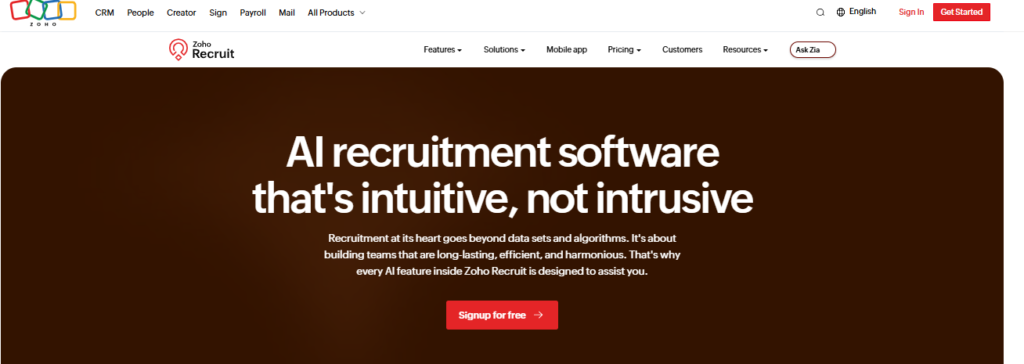
Zoho Recruit proves that AI-powered hiring does not have to come with an enterprise price tag. Its AI assistant, Zia, handles semantic candidate search, drafts job descriptions, and summarizes candidate profiles, all inside a plan that starts free and scales affordably from there.
It ranks well here because value and usability rarely show up together this cleanly. Staffing agencies and lean HR teams researching the best recruiting software for small business consistently point to Zoho Recruit for combining a real ATS, CRM, and AI matching engine without the six-figure enterprise contract.
Sales teams in particular benefit from Zia’s outreach drafting, which overlaps with what most hiring managers look for on a Best Sales Hiring Tools shortlist when they need AI-assisted candidate communication baked into their ATS.
✅ Key Features
- AI assistant (Zia) that drafts job descriptions, emails, and candidate summaries automatically
- Semantic candidate matching that ranks applicants by skills and experience, not just keywords
- Native ATS and CRM combined, so recruiting and client management live in one place
- Integrates with 75+ job boards and social platforms including LinkedIn and Indeed
- Chrome extension for pulling resumes directly from most websites
- Bulk candidate-to-job association for faster shortlisting
- Support for 26 languages, useful for global or multilingual hiring teams
- Forever-free plan available for teams just getting started
✅ Pros
- Extremely affordable compared to enterprise competitors
- Real AI matching, not just basic automation
- Good fit for staffing agencies managing many concurrent job orders
- Wide integration ecosystem for job boards and background checks
- Free plan lets small teams test the platform with zero risk
❌ Cons
- Free plan is capped at 256 MB storage and one active job
- Interface feels dated compared to newer competitors
- Advanced analytics require higher-tier plans
- AI matching is less sophisticated than dedicated talent-intelligence platforms
🎯 Best For: Small businesses, staffing agencies, and solo recruiters who want a genuinely useful AI ATS without an enterprise budget.
5. HiBob
AI-Powered HR Platform for Employee Engagement
HiBob takes a different angle than the recruiting-focused tools on this list. Its AI Assistant, built into the core HRIS, answers employee questions about benefits and policies instantly and helps HR teams analyze engagement survey data without spreadsheets.
It earns a spot here because engagement and retention matter just as much as hiring, and HiBob’s AI feels genuinely embedded rather than bolted on. The assistant works contextually, so it feels like an extension of the platform rather than a separate chatbot window.
The differentiator is how naturally the AI surfaces sentiment trends from surveys and feedback, giving HR leaders an early warning system for flight risk and disengagement before it shows up in exit interviews.
✅ Key Features
- AI Assistant that answers HR questions instantly by securely referencing your own HR data
- AI-powered survey analysis that automatically summarizes sentiment and engagement trends
- AI-assisted performance review and feedback writing support for managers
- Role-specific job description generation for internal postings
- Visual, people-first dashboards designed for HR teams without a data background
- Workflow automation for onboarding, anniversaries, and lifecycle milestones
✅ Pros
- AI feels contextual and natural rather than a separate bolted-on tool
- Strong for improving employee engagement and culture visibility
- Intuitive interface that non-technical HR teams pick up quickly
- Good middle ground between a full HRIS and pure engagement software
- Responsive customer support based on user reviews
❌ Cons
- Not built for end-to-end payroll or compliance automation
- AI Assistant can lack depth on complex or unusual HR scenarios
- Pricing is available by request only
- Less useful for companies under 100 employees with simple needs
🎯 Best For: Mid-sized companies (roughly 100 to 500 employees) that want AI-driven engagement insights and a genuinely pleasant HR platform, not just a recruiting tool.
6. Manatal
Lean AI Recruiting Software for High-Growth Companies
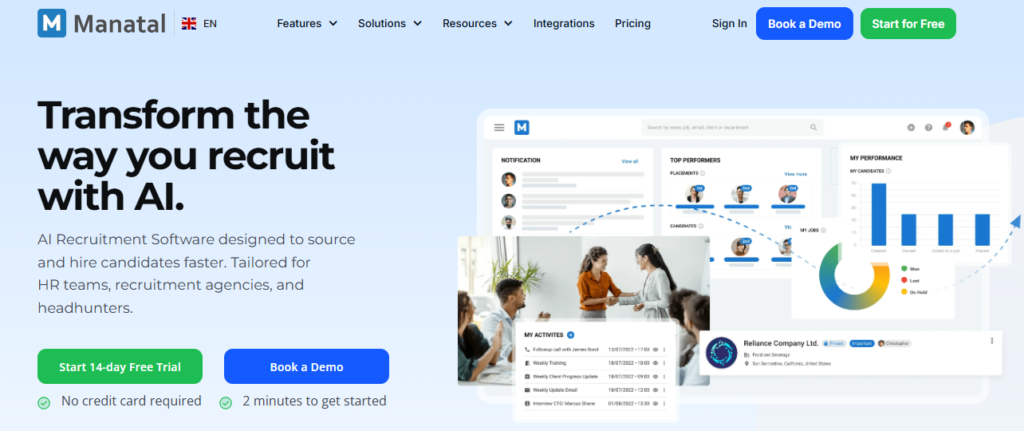
Manatal built its platform for teams that are hiring constantly but do not have an enterprise IT department to manage a complicated rollout. Its AI scores candidates against job requirements automatically and pulls in public data to enrich profiles beyond what is on the resume.
It ranks on this list because of how quickly teams can get it running. The drag-and-drop pipeline builder means a hiring manager can customize a workflow in minutes, not weeks, which matters enormously for fast-scaling startups.
✅ Key Features
- AI candidate scoring that compares skills, experience, and requirements automatically
- Candidate sourcing from 2,500+ channels including job boards and social platforms
- Drag-and-drop pipeline builder for fully customizable hiring workflows
- Public data enrichment that adds context beyond the resume itself
- Career page builder for capturing direct applicants without a job board
- Chrome extension for sourcing candidates directly from LinkedIn and other sites
✅ Pros
- Fast to set up and easy for non-technical hiring managers to use
- Highly customizable pipelines for different hiring workflows
- Affordable compared to enterprise-grade competitors
- 14-day free trial removes the risk of testing before committing
- Good fit for one of the best recruiting software tools shortlists for scaling teams
❌ Cons
- Chrome extension can lag with very large candidate lists
- API access is limited to higher-priced plans
- Lacks some enterprise reporting depth larger companies may need
- AI matching is solid but not as advanced as dedicated talent-intelligence tools
🎯 Best For: High-growth startups and small to mid-size businesses that need a fast, affordable, and genuinely easy AI recruiting tool without enterprise complexity.
7. hireEZ
Agentic AI Sourcing for Passive Talent
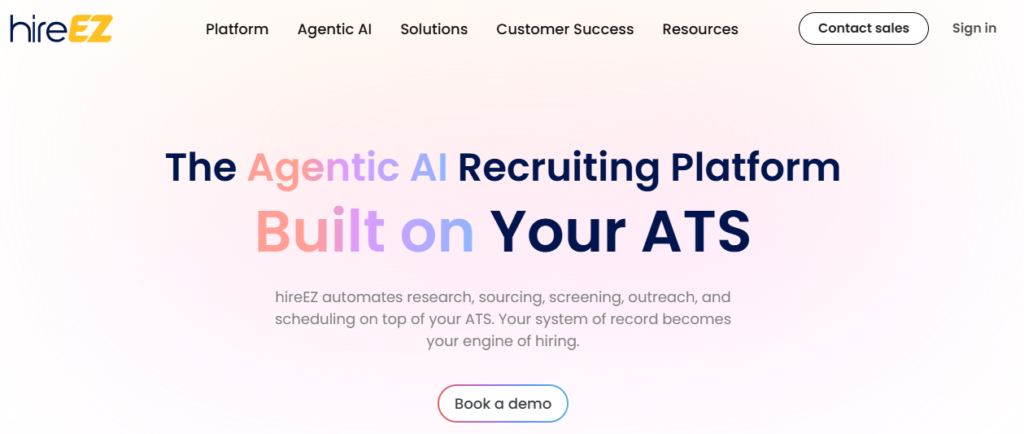
hireEZ started as a sourcing tool and has grown into a full agentic AI recruiting platform. Its EZ Agent searches the open web and your existing ATS to surface qualified candidates that a basic LinkedIn search would never find, then ranks them by actual role fit.
It ranks highly here because passive sourcing is genuinely difficult to do well at scale, and hireEZ automates the tedious parts, outreach sequencing, follow-ups, and candidate ranking, while still keeping a recruiter in control of final decisions.
The differentiator is its talent market insights feature. Upload a job description and hireEZ instantly returns real labor market data on talent availability and salary ranges, which is genuinely useful when a hiring manager asks for a candidate profile that does not realistically exist.
✅ Key Features
- EZ Agent that searches 800+ million profiles across 45+ platforms for qualified passive candidates
- Automated, customizable outreach and email drip campaigns with built-in follow-up
- Talent market insights showing salary ranges and candidate availability by role
- Diversity sourcing tools that help build a more inclusive candidate pipeline
- Integration with 30+ ATS platforms for a smooth handoff once candidates are sourced
- Chrome extension for sourcing directly from LinkedIn, Indeed, and Gmail
✅ Pros
- Excellent for finding passive candidates competitors overlook
- Saves significant time on outreach and follow-up sequencing
- Useful market data helps set realistic hiring expectations
- Strong integration options with existing ATS platforms
- Learns and improves targeting the more you use it
❌ Cons
- Contact information can occasionally be outdated or inaccurate
- Credit-based pricing model can limit exploratory searches
- Best value requires a dedicated sourcer or recruiter to run it well
- Pricing is available by request only
🎯 Best For: Recruiting teams and agencies focused on outbound sourcing for hard-to-fill or passive-candidate roles, including specialized sales and technical positions similar to what teams evaluating the best sales hiring tools typically need.
8. Textio
AI Writing Platform for Inclusive Job Postings
Textio takes a narrower but genuinely valuable approach. It analyzes job descriptions in real time and flags biased, gendered, or exclusionary language, then suggests more neutral alternatives that are proven to attract a broader, more diverse applicant pool.
It earns its spot on this list because job posting language is an underrated lever in hiring. A biased or jargon-heavy post quietly filters out qualified candidates before they even apply, and Textio’s scoring system makes that invisible problem visible.
The differentiator is the predictive scoring. Textio does not just flag a word, it estimates how a specific phrase is likely to affect your applicant pool’s diversity, based on data patterns across millions of job posts.
✅ Key Features
- Real-time bias detection that flags gendered, ageist, or exclusionary language as you type
- Predictive diversity scoring that estimates the likely impact of specific phrasing
- Library of pre-optimized job description templates by role and industry
- Integrations with major ATS platforms and LinkedIn for direct posting
- Browser extension for editing job posts anywhere on the web
- Color-coded suggestions similar to familiar grammar-checking tools for fast adoption
✅ Pros
- Meaningfully improves applicant pool diversity with small language changes
- Easy, intuitive interface that requires almost no training
- Strong complement to any of the other recruiting tools on this list
- Backed by data from millions of analyzed job posts
- Genuinely differentiated niche most competitors ignore
❌ Cons
- Guidance scoring is only available in English
- Limited integrations compared to full-suite competitors
- Customer support response times can be slow
- Does not screen or manage candidates, so it needs to be paired with an ATS
🎯 Best For: HR and recruiting teams serious about improving diversity in their applicant pool through better job posting language, used alongside a full ATS rather than in place of one.
Comparison Table: Best AI HR and Recruitment Tools
Here is a quick side-by-side snapshot of all 8 tools to help you shortlist faster.
| Tool Name | Best For | Key Strength | Integrations | Ease of Use | Platform Type |
|---|---|---|---|---|---|
| Paradox | High-volume, hourly hiring | Conversational AI screening | Major ATS platforms | Easy | Web, SMS, WhatsApp |
| HireVue | Enterprise interview scoring | Structured video interviews | Major ATS + HRIS | Moderate | Web |
| Eightfold AI | Enterprise talent intelligence | Skills-based matching | HRIS + ATS ecosystem | Moderate | Web |
| Zoho Recruit | Small business & agencies | Value + real AI matching | 75+ job boards, Zoho suite | Easy | Web, iOS, Android |
| HiBob | Mid-size employee engagement | Contextual AI HR assistant | HRIS-native integrations | Easy | Web, iOS, Android |
| Manatal | High-growth SMBs | Fast setup, flexible pipelines | 2,500+ sourcing channels | Easy | Web, iOS, Android |
| hireEZ | Passive candidate sourcing | Agentic AI sourcing | 30+ ATS platforms | Moderate | Web |
| Textio | Inclusive job postings | Predictive bias detection | ATS + LinkedIn | Easy | Web, browser extension |
Final Verdict
If you need one tool to cover the most ground, Paradox and Zoho Recruit deliver the broadest practical value for their price points. But the honest answer is that most HR teams end up pairing two of these tools, one for sourcing or screening and one for writing better job posts or running structured interviews, rather than expecting a single platform to do it all.
How to Choose the Right AI HR Tool for Your Team
Picking from the best ai tools for hr department use cases comes down to matching the tool to your actual bottleneck, not the flashiest AI feature. Start by asking where your team loses the most hours every week.
If resume volume is the problem, prioritize candidate screening and matching tools like Zoho Recruit or Eightfold. If interview consistency is the issue, look at Best Assessment Tools for Hiring to compare structured interview platforms like HireVue in more depth. And if you are a lean team without a dedicated recruiting stack yet, browse our full guide to the Best Recruiting Software Tools before committing to a single vendor.
A few practical rules that hold up across every tool on this list:
- Budget for pricing transparency. Tools that hide pricing behind a sales call usually cost more than advertised competitors.
- Test with your actual data. AI matching quality depends entirely on clean job descriptions and candidate profiles, not the vendor demo.
- Check integration depth, not just integration count. A tool that syncs deeply with your ATS beats one with 50 shallow connections.
- Keep a human in the loop for final decisions. Every reputable vendor on this list still recommends human review before a final hiring call.
If your company is scaling quickly and still hiring manually, our guide to the Best Recruiting Software for Small Business walks through budget-friendly options in more detail, and pairs well with several tools on this list.
Conclusion
The best AI HR and recruitment tools in 2026 are not the ones with the longest feature list. They are the ones that actually fix the bottleneck slowing your team down right now. If speed to first response is killing your candidate pipeline, Paradox solves that. If inconsistent interviews are hurting hire quality, HireVue brings structure. And if budget is the real constraint, Zoho Recruit and Manatal prove that solid AI hiring tools do not require an enterprise price tag.
Start with one clear problem, pilot one tool against it, and measure the actual time saved before adding a second platform. That approach beats chasing every new AI feature that hits the market, and it is exactly how the tools on this list earned their spot.