
Managing marketing campaigns across multiple channels is harder than it looks. Teams end up juggling five different tools that barely talk to each other, spending hours on manual tasks, and still struggling to prove ROI. Marketing cloud software solves this by bringing automation, analytics, and campaign management into one connected platform.
According to research from Statista, the global marketing automation market is projected to surpass $9.5 billion by 2027, driven by demand for cloud-based marketing software that scales without heavy IT overhead. Whether you run a startup or lead marketing at an enterprise, the right cloud marketing platform can cut your campaign turnaround time, improve targeting, and turn scattered data into clear results.
Top 8 Best Marketing Cloud Software Platforms for 2026
1. Salesforce Marketing Cloud
The Enterprise Powerhouse for Cross-Channel Campaign Orchestration
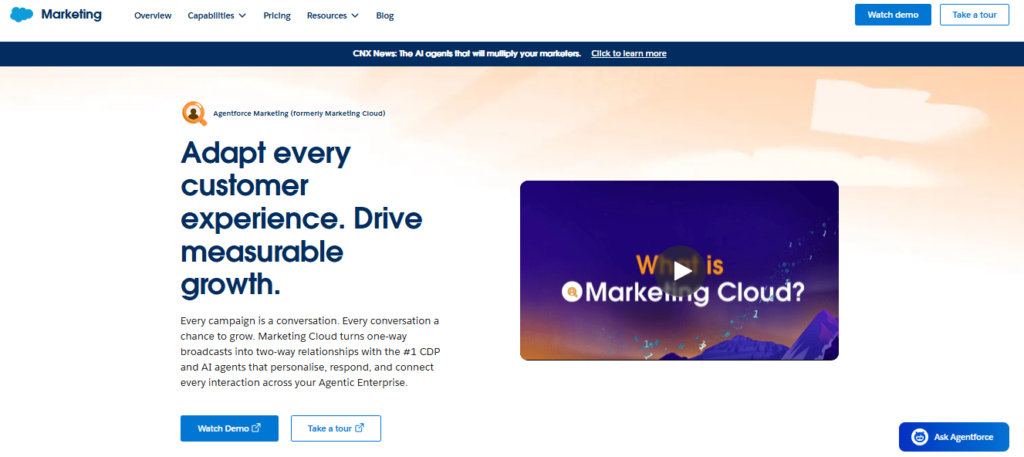
Salesforce Marketing Cloud is the go-to platform for large organizations that need deep CRM integration alongside their marketing execution. It connects email, mobile, social, advertising, and web into a single customer data hub, giving enterprise teams a 360-degree view of every interaction across the buyer journey. If you are already running Salesforce CRM, the native connection between the two systems alone makes this worth serious consideration.
What sets Salesforce apart is Journey Builder, its visual workflow engine that lets marketers design multi-step customer journeys triggered by real-time behaviors. You can set up a flow that sends an email, waits for a click, triggers an SMS if the link is not opened, and then routes the contact to a sales rep, all automatically. The Einstein AI layer adds predictive send-time optimization and content scoring on top of that.
It is not cheap and it is not simple to set up, but for enterprise teams with complex segmentation needs and large contact databases, Salesforce Marketing Cloud delivers a ceiling that most competitors cannot match. It earns the top spot on most best marketing software for financial advisors shortlists because of its compliance controls and deep CRM connectivity.
Key Features
- Journey Builder with drag-and-drop multi-channel workflow design and real-time trigger logic
- Einstein AI for send-time optimization, content scoring, and engagement prediction
- Cross-channel execution across email, SMS, push notifications, social ads, and web
- Data Studio for second-party data sharing and audience enrichment from partner networks
- Interaction Studio for real-time website personalization based on visitor behavior
- Pre-built Salesforce CRM connector for unified sales and marketing data flows
Pros
- Deepest CRM integration on the market for Salesforce-first organizations
- Scales to tens of millions of contacts without performance degradation
- Einstein AI adds genuine intelligence, not just feature-checkbox marketing
- Journey Builder is one of the most visual and powerful automation tools available
- Enterprise-grade compliance, audit trails, and data governance controls
Cons
- High cost, entry starts around $1,250 per month for basic features
- Steep learning curve requires dedicated admin or implementation partner
- Modules are sold separately, total cost climbs fast for full capability
- Overkill for small teams or businesses without an existing Salesforce ecosystem
Best For: Enterprise B2B and B2C teams already on Salesforce CRM that need scalable, multi-channel automation with AI and deep analytics.
Pricing: From approximately $1,250/month. Full enterprise packages typically range from $10,000 to $50,000+ per year depending on modules and contacts.
2. HubSpot Marketing Hub
The All-in-One Platform That Actually Lives Up to the Hype
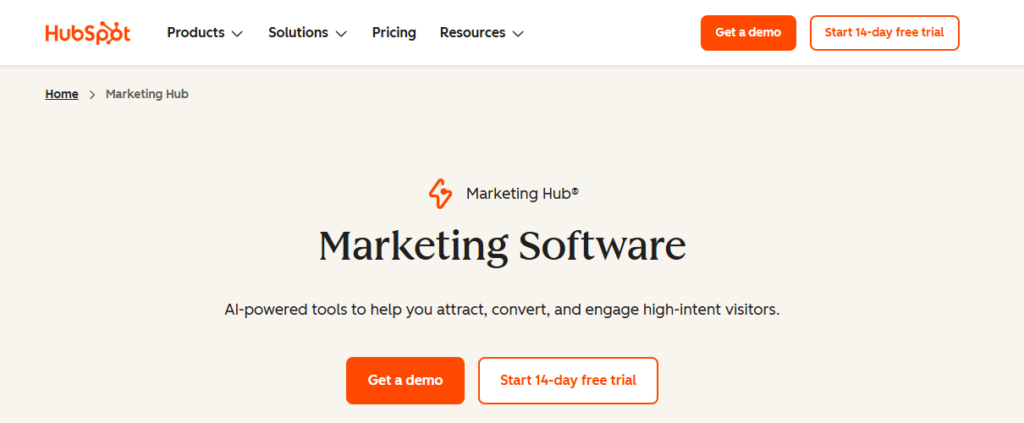
HubSpot Marketing Hub is the standard recommendation for growing companies that want a full marketing suite without the enterprise price tag or implementation headache. It covers email marketing, landing pages, lead capture forms, ad management, social scheduling, and marketing automation, all connected to HubSpot’s free CRM. The fact that you get so much functionality under one login is a genuine competitive advantage for smaller teams.
The real strength is how tightly every tool connects to contact records. When a lead fills out a form, downloads a PDF, opens an email, or clicks on an ad, that activity shows up in their CRM timeline. Marketers can segment and trigger workflows based on any of that data without exporting to a third tool. This makes HubSpot especially effective for inbound marketing strategies where nurturing is the primary growth lever.
It is often the first serious recommendation in any best marketing tools for small business guide, and for good reason. The free tier is genuinely useful, the paid plans scale in a way that makes sense, and the onboarding experience is far smoother than most enterprise alternatives. The main watch-out is that advanced features like custom reporting and predictive lead scoring require the higher-tier Professional or Enterprise plans.
Key Features
- Drag-and-drop email builder with A/B testing and smart personalization tokens
- Marketing automation workflows with multi-step branching logic and CRM triggers
- Landing page and form builder with native A/B testing and analytics
- Ads management for Google, Facebook, Instagram, and LinkedIn from one dashboard
- Attribution reporting with multi-touch models across email, ads, and organic channels
- Social media publishing, monitoring, and engagement tracking across major platforms
Pros
- Truly all-in-one with CRM, email, social, ads, and automation under one roof
- Free plan is genuinely useful for startups and early-stage businesses
- Intuitive UI requires minimal training even for non-technical marketers
- Excellent onboarding resources, academy, and active user community
- Marketing and sales alignment built-in through shared CRM data
Cons
- Advanced features like custom reporting require Professional plan ($800/month+)
- Contact-based pricing gets expensive fast as your list grows
- Email editor, while improved, still lacks flexibility of dedicated email tools
- HubSpot CRM lock-in can be a concern if you want to switch tools later
Best For: SMBs and mid-market companies running inbound marketing strategies who want email, CRM, automation, and reporting in one connected platform.
Pricing: Free plan available. Starter from $20/month. Professional from $800/month. Enterprise from $3,600/month.
3. Adobe Marketo Engage
The B2B Lead Nurturing Engine Built for Complex Sales Cycles
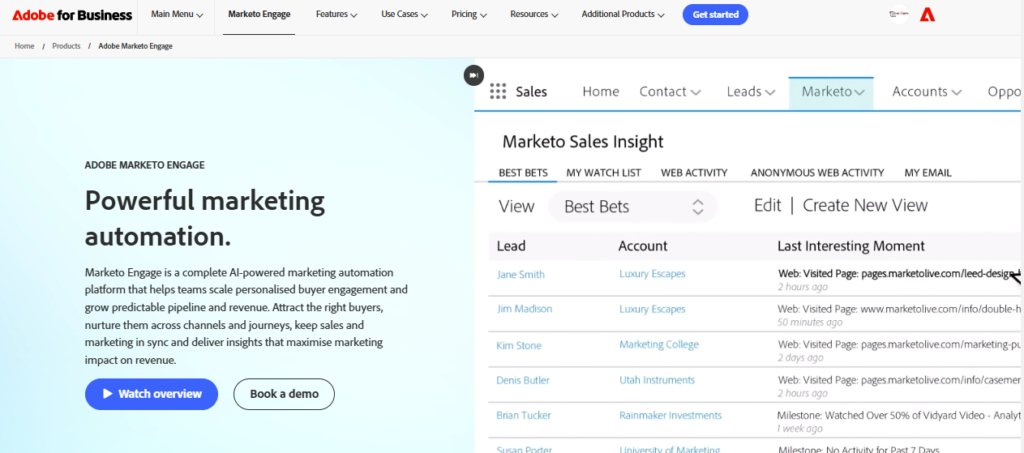
Adobe Marketo Engage is purpose-built for B2B marketing teams running long, complex sales cycles with multiple stakeholders involved in each deal. It has long been the industry standard for lead scoring, nurturing, and account-based marketing at scale. If your marketing team’s primary job is generating and qualifying pipeline for a sales team, Marketo is hard to beat.
The lead scoring engine is particularly mature. Marketo lets you define behavioral scores and demographic scores separately, then combine them into composite lead grades that tell sales exactly which contacts to prioritize. You can score based on web activity, email engagement, form submissions, event attendance, or CRM data. That level of precision is genuinely difficult to replicate in lighter-weight tools.
Since being acquired by Adobe, Marketo now integrates with Adobe Experience Cloud, including Adobe Analytics and Adobe Target, which expands its capabilities significantly for teams already in the Adobe ecosystem. It is a serious investment but a justified one for B2B organizations with dedicated marketing operations resources.
Key Features
- Advanced lead scoring with behavioral, demographic, and account-level scoring models
- Account-based marketing (ABM) workflows for targeting named accounts and buying committees
- Revenue attribution with multi-touch models tied to actual pipeline and closed revenue
- Engagement programs for long-form drip nurture across months or years
- Bi-directional Salesforce and Microsoft Dynamics CRM sync for full funnel visibility
- Smart Lists for dynamic segmentation based on any combination of behavioral or firmographic data
Pros
- Best-in-class lead scoring with granular behavioral and demographic weighting
- Handles complex, multi-stage B2B nurture programs at scale
- Deep CRM integration with Salesforce and Dynamics for pipeline attribution
- Robust reporting on funnel velocity, pipeline contribution, and revenue influence
- Adobe ecosystem integration adds content personalization and analytics depth
Cons
- High price point with limited transparency on exact monthly costs
- Steep learning curve, most organizations need a dedicated Marketo admin
- UI feels dated compared to newer marketing automation platforms
- Onboarding and setup are complex, typically requiring professional services
Best For: B2B organizations with complex sales cycles, marketing operations teams, and a dedicated budget for lead scoring, ABM, and pipeline attribution.
Pricing: Starts at approximately $895/month. Pricing scales significantly based on database size and features. Enterprise packages often exceed $5,000/month.
4. ActiveCampaign
Intelligent Automation That Punches Well Above Its Price Point
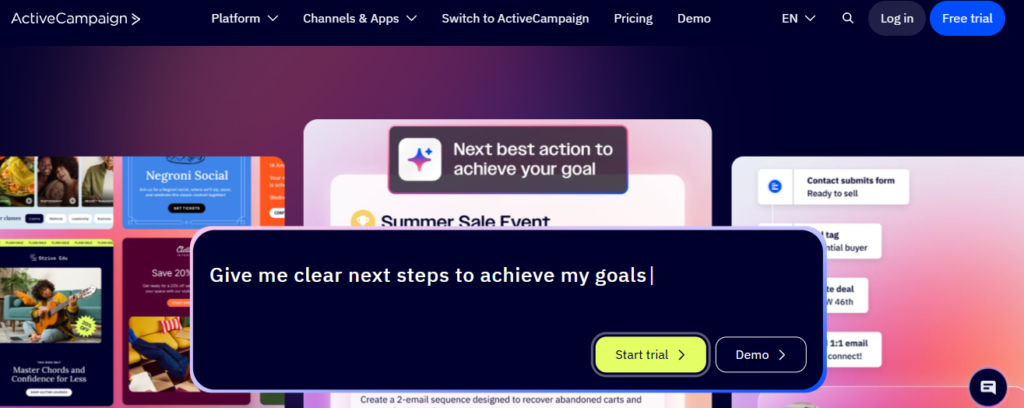
ActiveCampaign sits in a sweet spot that not many platforms can claim: it offers automation depth that rivals much more expensive tools, at a price point accessible to small and mid-size businesses. It combines email marketing, CRM, and marketing automation in a way that feels genuinely integrated rather than bolted together. The automation builder is one of the best in its class, with a visual canvas that handles conditional logic, goal-based branching, and multi-channel triggers with minimal effort.
What makes ActiveCampaign stand out is how well it personalizes at scale. The predictive sending feature uses machine learning to determine the best send time for each individual contact based on their past email engagement. Predictive content takes that further by showing different email blocks to different segments automatically. These are features you would expect to pay enterprise prices for, but they are included in mid-tier plans.
The integrated CRM is not quite as robust as Salesforce or HubSpot for complex sales processes, but for businesses where marketing automation drives most of the sales pipeline, it gets the job done. It is a consistent top recommendation alongside the best marketing tools for small business because of its generous feature-to-price ratio.
Key Features
- Visual automation builder with conditional logic, wait steps, goal-based branching, and split testing
- Predictive sending AI that optimizes individual send times based on engagement history
- Contact scoring and CRM pipeline management built into the same platform
- Site tracking that monitors visitor behavior and triggers automations based on page visits
- Dynamic email content that changes based on contact attributes and behavior segments
- SMS marketing and messaging alongside email campaigns for multi-channel sequences
Pros
- Automation builder is among the most powerful available outside enterprise tools
- Predictive AI features included in mid-tier plans at very competitive pricing
- Tight integration between email, CRM, and automation without multiple logins
- Site and event tracking data feeds directly into segmentation and automations
- Strong deliverability rates and responsive customer support
Cons
- CRM is functional but not as feature-rich as dedicated CRM platforms
- Interface can feel complex when managing large numbers of automations
- Landing page builder is limited compared to dedicated tools like Unbounce
- Reporting depth is solid but lags behind HubSpot for multi-touch attribution
Best For: SMBs and growing companies that need serious marketing automation depth, CRM integration, and AI personalization without paying enterprise-level prices.
Pricing: Starts at $15/month for 1,000 contacts. Scales based on contacts and features. Plus plan from $49/month, Professional from $79/month.
5. Klaviyo
The Revenue-Focused Cloud Marketing Platform Built for E-Commerce
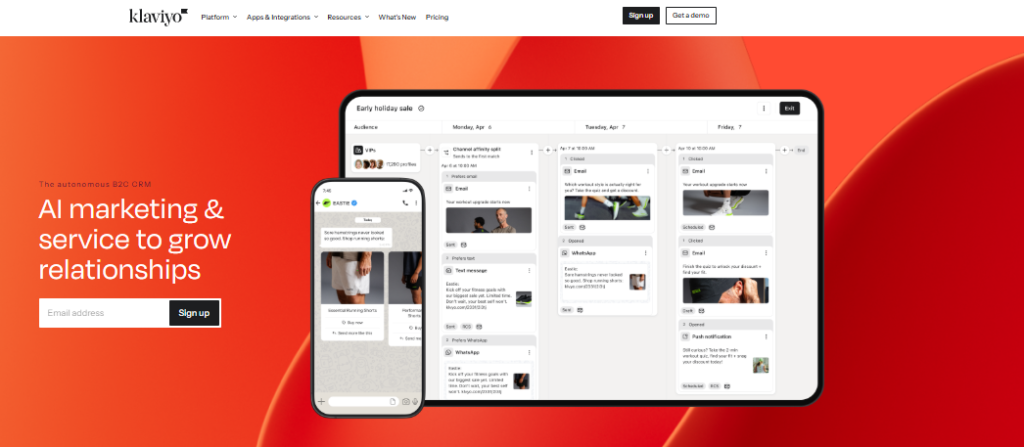
Klaviyo has become the dominant cloud marketing software for direct-to-consumer brands and e-commerce businesses. It was built from the ground up around product data, purchase history, and real-time shopping behavior, which means its segmentation and automation capabilities are uniquely suited to online retail in a way that general marketing platforms are not. If you sell physical or digital products online, Klaviyo understands your business model better than most alternatives.
Every contact in Klaviyo carries a revenue attribution record showing exactly how much money they have generated through email and SMS interactions. This Revenue Per Recipient metric changes how marketers think about campaign performance. Instead of optimizing for open rates, you are optimizing for actual sales outcomes. The predictive analytics engine also forecasts customer lifetime value, churn risk, and expected next purchase date, giving you segmentation logic based on future behavior rather than just past actions.
Klaviyo’s integration depth with platforms like Shopify, WooCommerce, Magento, and BigCommerce is best-in-class. Data flows in real-time so you can trigger a cart abandonment email within minutes of the event. This kind of speed and specificity is difficult to replicate in tools built for generic B2B marketing workflows.
Key Features
- Real-time Shopify and WooCommerce sync for product, order, and cart data at the contact level
- Predictive analytics for customer lifetime value, churn risk, and next purchase timing
- Revenue attribution at the campaign and flow level with per-email revenue tracking
- Advanced segmentation using purchase behavior, product categories, and RFM (recency, frequency, monetary) models
- SMS and mobile push notifications alongside email for full mobile marketing coverage
- Pre-built e-commerce automation flows including cart abandonment, post-purchase, win-back, and browse abandonment
Pros
- Best-in-class e-commerce integration with Shopify, WooCommerce, and BigCommerce
- Revenue attribution is more granular and actionable than most marketing platforms
- Predictive analytics included at no extra cost for segmentation and personalization
- Flows library provides ready-made automation templates for common e-commerce scenarios
- Free plan for up to 250 contacts makes it accessible for new online stores
Cons
- Primarily built for e-commerce, weaker for B2B or service-based businesses
- Pricing scales sharply with list size, can become expensive for large databases
- Limited native landing page builder compared to all-in-one marketing suites
- CRM functionality is basic, not designed for complex B2B sales processes
Best For: Direct-to-consumer brands, Shopify stores, and e-commerce businesses that want deep revenue attribution, predictive analytics, and real-time behavioral triggers.
Pricing: Free for up to 250 contacts and 500 emails/month. Paid plans start at $45/month for 1,001 to 1,500 contacts. Scales with list size.
6. Mailchimp
The Entry-Level Cloud Marketing Platform That Covers the Essentials
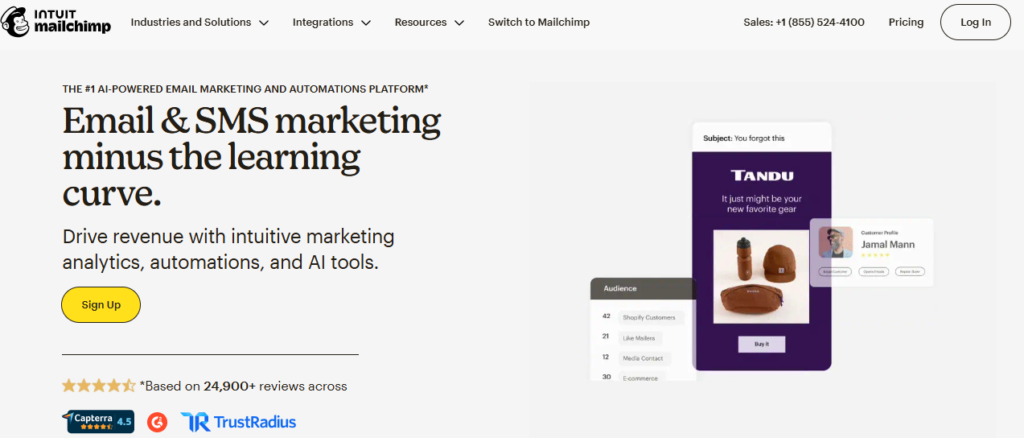
Mailchimp is where most businesses start their cloud marketing journey, and there is a reason for that. It is approachable, affordable, and covers the core marketing functions that most small businesses actually need: email campaigns, basic automation, landing pages, and simple audience segmentation. The interface is clean and intuitive enough that a non-technical business owner can launch a campaign without any training.
Over the past few years, Mailchimp has expanded well beyond email. It now includes social media posting, a basic website builder, digital ads, and an AI-powered creative assistant that helps generate email designs and content. The Customer Journey builder allows you to create simple automated sequences triggered by subscriber activity, though it is not as deep as ActiveCampaign or HubSpot for complex multi-branch logic.
Mailchimp makes the most sense for startups, content creators, local businesses, and anyone managing lists under 2,000 subscribers who wants a free and functional marketing tool to get started. Once you start needing advanced segmentation, robust reporting, or deep CRM integration, you will likely feel the ceiling and want to upgrade to a more capable platform.
Key Features
- Drag-and-drop email builder with pre-designed templates and AI content suggestions
- Customer Journey builder for visual automation with basic branching logic
- Landing page and signup form builder with built-in analytics and A/B testing
- Social media posting and scheduling across Facebook, Instagram, and Twitter
- Audience segmentation based on engagement level, purchase history, and tags
- AI-powered Creative Assistant that generates on-brand email designs automatically
Pros
- Generous free plan for up to 500 contacts and 1,000 emails per month
- Very easy to use, no technical experience required to launch campaigns
- All core marketing functions available in one place at low cost
- Strong template library and AI design assistant for polished campaigns
- Large ecosystem of integrations with e-commerce, CRM, and business tools
Cons
- Automation logic is basic compared to ActiveCampaign or HubSpot at similar price points
- Reporting and analytics are surface-level, limited attribution modeling
- List management can be confusing, contacts across multiple audiences count separately
- Customer support is limited on lower plans, chat and email only
Best For: Startups, solopreneurs, local businesses, and content creators who need an affordable, easy-to-use cloud marketing platform for email and basic automation.
Pricing: Free for up to 500 contacts. Essentials plan from $13/month. Standard from $20/month. Premium from $350/month.
7. Braze
Real-Time Customer Engagement for Mobile-First and High-Volume Brands
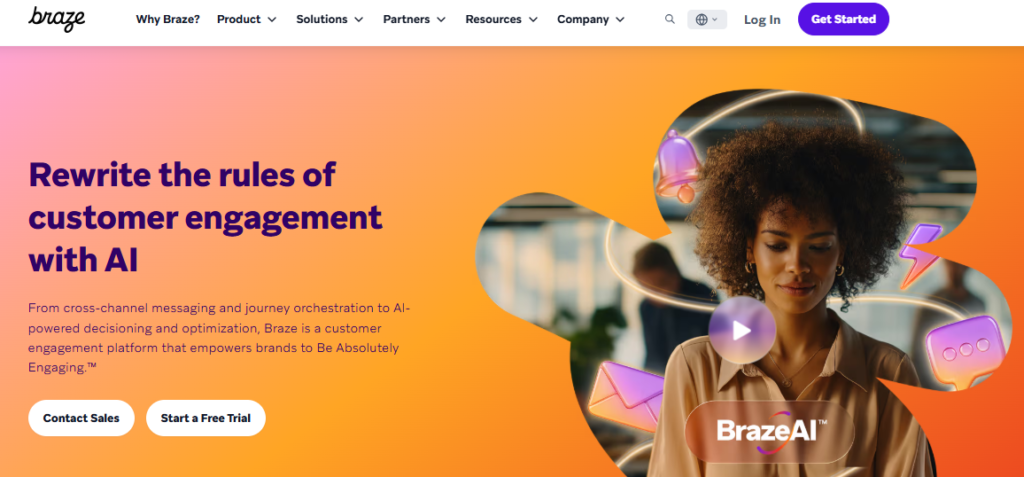
Braze is built for brands that need real-time, high-frequency customer engagement across mobile apps, email, SMS, web push, and in-app messaging. It is a category leader for consumer tech companies, media platforms, and retail apps where the speed of personalization matters as much as the message itself. Braze processes behavioral events as they happen, allowing marketers to trigger responses within seconds of a user action inside an app.
The Connected Content feature lets Braze pull in live data from external APIs at the moment an email or push notification is sent. That means you can send a notification that shows a user’s current loyalty point balance, today’s personalized product recommendations, or real-time pricing, all without pre-loading any of that data into Braze in advance. This kind of real-time data enrichment is genuinely difficult to replicate in traditional marketing automation platforms.
Braze is enterprise-oriented with custom pricing, so it is not the right fit for small teams or standard B2B marketing use cases. But for high-growth consumer brands with large, active user bases across mobile and web, Braze offers a level of real-time personalization and engagement speed that few platforms can match.
Key Features
- Real-time event streaming with sub-second trigger latency for immediate personalization
- Connected Content API integration for live data pull at send-time across email and push
- Canvas Flow visual automation with multi-channel journey orchestration across all channels
- In-app messaging and content cards for native mobile and web app engagement
- Intelligent Timing and Intelligent Channel AI for automated send-time and channel optimization
- Predictive Churn and Predictive Events AI for proactive customer retention campaigns
Pros
- Real-time event processing is among the fastest available in cloud marketing software
- Connected Content feature enables live data personalization unmatched by most platforms
- Handles massive scale with high message volume and complex segmentation simultaneously
- Full mobile marketing capability including push, in-app, and SMS in one platform
- Strong AI features for channel selection, send timing, and churn prediction
Cons
- Custom pricing with no transparent tiers, requires a sales conversation to get started
- Implementation is complex and typically requires dedicated technical resources
- Not suited for traditional B2B lead generation or email-primary marketing strategies
- Learning curve is significant even for experienced marketing operations teams
Best For: High-growth consumer apps, media platforms, retail brands, and mobile-first companies that need real-time personalization, mobile push, and high-volume engagement at scale.
Pricing: Custom pricing based on monthly active users and message volume. Generally ranges from $5,000 to $50,000+ per month for enterprise contracts.
8. Zoho Marketing Plus
The Budget-Friendly Cloud Marketing Suite for Teams That Need Everything
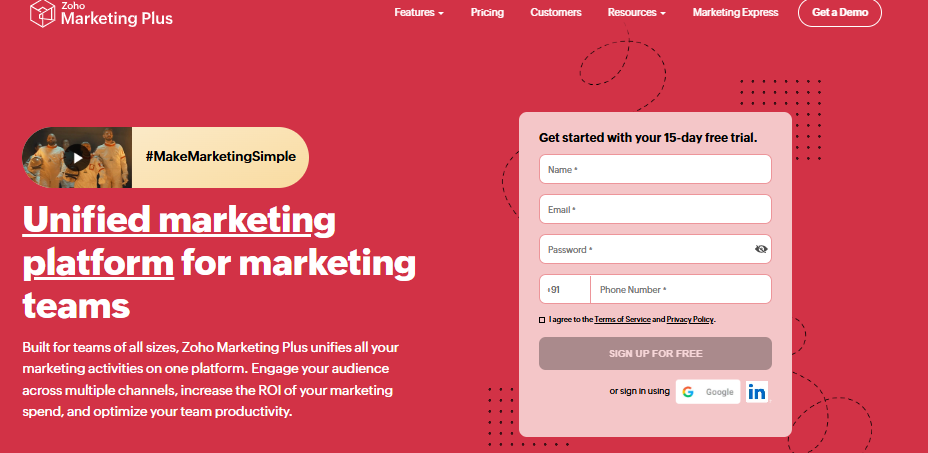
Zoho Marketing Plus is the best value cloud-based marketing software for budget-conscious teams that still need a comprehensive suite of tools. It bundles email marketing, social media management, event marketing, SMS campaigns, webinar hosting, and analytics into a single platform at a price point that undercuts most comparable alternatives by a significant margin. If you are already using other Zoho products like Zoho CRM or Zoho Books, the native integration makes this an obvious choice.
The platform covers a surprisingly wide range of cloud marketing automation software functions for its price. The email builder is solid, the social scheduling tools handle all major platforms, and the audience segmentation engine lets you create targeted lists based on behavioral and demographic data. The unified dashboard gives you a consolidated view of campaign performance across every channel, which removes the need to jump between multiple tools to understand what is working.
Zoho Marketing Plus is not the most powerful tool on this list in any single category. It does not match Braze for real-time mobile personalization, Klaviyo for e-commerce depth, or Marketo for B2B lead scoring sophistication. But if your budget is limited and you need a real cloud marketing automation software platform that handles multiple channels without requiring separate subscriptions for each, Zoho delivers exceptional value.
Key Features
- Unified marketing command center covering email, social, SMS, events, and webinars
- Email campaign builder with personalization, A/B testing, and scheduling
- Social media management across Facebook, Instagram, Twitter, LinkedIn, and YouTube
- Audience segmentation based on behavior, demographics, and CRM data via Zoho CRM sync
- Marketing analytics dashboard with cross-channel attribution and ROI tracking
- Webinar and virtual event hosting built into the platform without third-party tools
Pros
- Outstanding value at $25/month for a full omnichannel marketing suite
- Covers more marketing channels in one plan than most alternatives at 2x the price
- Native integration with Zoho CRM, Zoho Books, and the full Zoho ecosystem
- Easy to use with minimal technical setup required for most features
- Webinar and event marketing built-in saves significant additional software spend
Cons
- Individual tools are less powerful than dedicated best-in-class alternatives
- AI and predictive features are less mature than HubSpot, ActiveCampaign, or Klaviyo
- Limited integration options outside the Zoho ecosystem
- Customer support quality varies across plans and regions
Best For: Budget-conscious teams, small businesses, and Zoho ecosystem users that want omnichannel cloud marketing software without paying for multiple separate subscriptions.
Pricing: From $25/month for up to 3 users and 1,000 contacts. Business plan available for larger teams. Free trial available.
Marketing Cloud Software Comparison Table: All 8 Tools Side by Side
| Tool Name | Best For | Key Strength | Integrations | Ease of Use | Platform | Pricing | Verdict |
|---|---|---|---|---|---|---|---|
| Salesforce Marketing Cloud | Enterprise Multi-Channel | Journey Builder + AI | 1,000+ | Moderate | Cloud SaaS | From $1,250/mo | Best Overall |
| HubSpot Marketing Hub | SMB to Mid-Market | All-in-One CRM Hub | 1,500+ | Very Easy | Cloud SaaS | Free; Paid from $20/mo | Best Value |
| Adobe Marketo Engage | B2B Enterprise | Advanced Lead Scoring | 500+ | Moderate | Cloud SaaS | From ~$895/mo | Best for B2B |
| ActiveCampaign | SMB + Mid-Market | AI Automation + CRM | 870+ | Easy | Cloud SaaS | From $15/mo | Best for Automation |
| Klaviyo | E-Commerce Brands | Revenue Attribution | 350+ | Easy | Cloud SaaS | Free up to 250 contacts | Best for E-Commerce |
| Mailchimp | Startups + Solopreneurs | Content + Email Combo | 300+ | Very Easy | Cloud SaaS | Free; Paid from $13/mo | Best Free Option |
| Braze | Mobile-First Companies | Real-Time Personalization | 150+ | Moderate | Cloud SaaS | Custom Pricing | Best for Mobile |
| Zoho Marketing Plus | Budget-Conscious Teams | Omnichannel on a Budget | 800+ | Easy | Cloud SaaS | From $25/mo | Best Budget Pick |
Final Verdict
Salesforce Marketing Cloud leads for enterprise organizations with existing Salesforce infrastructure and complex multi-channel needs. HubSpot Marketing Hub remains the smartest choice for growing businesses that want an all-in-one platform without the enterprise complexity. ActiveCampaign is the automation depth leader at accessible pricing for SMBs. Klaviyo is the clear winner for e-commerce brands. Marketo dominates B2B lead scoring. Mailchimp is the lowest-friction entry point. Braze is the specialist for mobile-first consumer brands. Zoho Marketing Plus delivers the best dollar-for-dollar value for omnichannel needs on a tight budget.
How to Choose the Right Cloud Marketing Software: 4 Key Criteria
1. Match the Platform to Your Business Model
B2B and B2C marketing have very different requirements. B2B teams generally need lead scoring, CRM sync, long-form nurture sequences, and account-level reporting. B2C and e-commerce teams need real-time behavioral triggers, purchase data integration, and revenue attribution at the campaign level. Using a B2B-focused tool like Marketo for an e-commerce brand, or Klaviyo for a complex B2B sales process, will leave you frustrated with missing capabilities.
2. Factor in Total Cost of Ownership
The monthly subscription is only part of the cost. Factor in setup costs, integration fees, training time, and whether you need a dedicated admin or consultant to run the platform. A $50/month tool that takes three months to configure properly is not cheaper than a $200/month platform with a one-day onboarding. Also check contact-based pricing tiers, since costs can jump significantly as your audience grows.
3. Prioritize Integration With Your Existing Stack
Cloud marketing automation software only works well if it connects cleanly to your CRM, e-commerce platform, analytics tools, and ad accounts. Check the native integration library before committing to any platform. HubSpot and Salesforce have the broadest integration ecosystems with 1,000+ connectors. Klaviyo’s Shopify integration is notably tighter than any competitor’s. Zoho Marketing Plus works best within the Zoho stack.
4. Test Automation Depth Before You Buy
Most platforms offer a free trial or demo account. Use it specifically to build one of your real automation sequences and see how far you get. Limitations in automation logic, branching depth, or trigger options become obvious fast when you are trying to replicate an actual workflow. Mailchimp’s Customer Journey builder and ActiveCampaign’s automation canvas feel very different in practice, even if they look similar on a features comparison page.
To explore more in-depth comparisons like this, visit TheListify, where we regularly publish expert-curated lists of the best tools and software for businesses across various industries. Whether you’re searching for Best CRM Tools, Best Accounting Software, Best Recruiting Software, Best Project Management Software, Best marketing tools, or productivity solutions, our detailed guides help you make informed decisions faster.