Paying per seat for project management software is starting to feel like renting furniture. The more your team grows, the more your tool vendor benefits. And if you want to own your data, customize your workflows, or operate inside a strict compliance environment, most SaaS platforms leave you with limited options.
That is why open source project management software is no longer just a budget choice. It is a strategic one. Whether you are a startup avoiding vendor lock-in, an enterprise navigating GDPR requirements, or a developer team that simply wants to self-host and move fast, the right open source tool can outperform paid alternatives on every dimension that matters.
This guide covers the 5 best open source project management software available in 2026. Each one has been evaluated on features, community health, ease of self-hosting, and real-world fit for different team types. No filler. Just the tools worth your time.
What Is Open Source Project Management Software?
Open source project management software is any project management platform whose source code is publicly available, typically hosted on GitHub or GitLab, and licensed under terms that allow users to freely use, modify, and distribute the software. Unlike proprietary SaaS tools that lock features behind subscription tiers, open source tools give teams complete access to the codebase.
This matters for several practical reasons. You can self-host the software on your own infrastructure, which means your project data never leaves your environment. You can modify the tool to fit your workflows rather than adapting your workflows to fit the tool. And you eliminate recurring per-seat costs, which adds up quickly at scale.
The key distinction to understand is between open source (code is public and licensed openly) and open core (core features are open, but advanced features require a commercial license). Both models exist in this list, and the differences matter when you are choosing a tool for the long term.
Top 5 Best Open Source Project Management Software in 2026
1. Plane – Modern Open Source Alternative to Jira and Linear

Plane is hands down the most polished open source project management software available in 2026. Built as a direct alternative to Jira and Linear, it delivers a clean interface, fast performance, and a genuinely complete feature set without requiring a paid plan to unlock the essentials. With over 50,000 GitHub stars, its community adoption speaks for itself.
What sets Plane apart from everything else on this list is its open-core model. The Community Edition is fully functional, supports unlimited users and projects, and comes with features like Gantt charts, Kanban boards, sprint cycles, and built-in AI assistance. Most open source tools make you sacrifice UX for freedom. Plane refuses that trade-off.
It is best suited for product and engineering teams that want Jira-level power without Jira-level complexity or cost. If you have compared the Best Project Management Tools on the market and landed here, Plane is the one most likely to replace a paid tool permanently. Self-hosted deployment via Docker Compose or Helm charts is clean and well-documented.
Key Features
- Issue Tracking with rich text, labels, attachments, and configurable custom statuses
- Sprint Cycles with burndown charts, velocity tracking, and sprint planning views
- Modules and Initiatives for grouping related work across sub-projects or entire teams
- Multiple Views including Kanban, List, Gantt, Calendar, and Spreadsheet layouts
- Built-in AI (Plane AI) with Ask and Build modes, MCP connectors, and BYOK self-hosted support
- Custom Workflows and Approval flows with gating logic on state transitions
Pros
- Most visually polished open source PM tool available today
- Unlimited users and projects in the free Community Edition
- Active development with frequent public releases and transparent roadmap
- Native AI features available even on self-hosted deployments
- Strong GitHub community and responsive Discord support
Cons
- Advanced enterprise SSO (SAML, OIDC) requires the paid Pro tier
- Newer platform so some edge-case integrations are still maturing
- Self-hosting still requires some DevOps comfort for initial setup
- Analytics and reporting depth is lighter compared to OpenProject
Best For: Product teams, engineering squads, and startups that want a Jira replacement with a modern UI and zero per-user licensing costs.
2. OpenProject – Enterprise-Grade Open Source PM for Complex Organizations
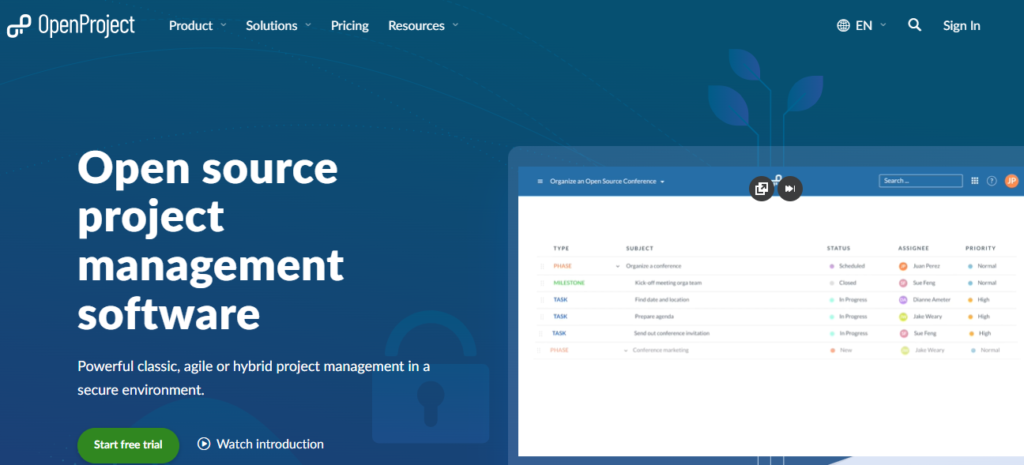
OpenProject is the go-to choice when your team needs serious project management depth. It has been around since 2011, is written in Ruby on Rails, and is trusted by enterprises in highly regulated industries including government agencies, healthcare organizations, and financial institutions. This is not a startup experiment. It is battle-tested infrastructure.
The feature set is genuinely comprehensive. OpenProject handles classic waterfall-style project management (Gantt charts, milestones, timelines) alongside agile workflows (scrum boards, backlogs, sprints). It also includes time tracking, budgeting, cost reporting, and meeting management out of the box. Very few open source project management tools offer this breadth in a single platform.
If you are evaluating the Best Agile Project Management Software Tools alongside traditional PM tools, OpenProject is one of the only open source options that genuinely covers both worlds. It is ideal for organizations that run mixed-methodology projects or need to satisfy compliance and audit requirements.
Key Features
- Full Gantt chart with dependencies, milestones, and critical path visualization
- Scrum and Kanban boards for agile teams with backlog management and sprint planning
- Integrated time tracking and project budgeting with cost reporting dashboards
- Work package system supporting custom fields, workflows, and status transitions
- Meeting management module with agendas, minutes, and action item tracking
- LDAP/AD integration and fine-grained role-based permissions across projects
Pros
- Most complete feature set of any open source PM tool
- Strong compliance-ready infrastructure for regulated industries
- Excellent Gantt and timeline capabilities rivaling paid enterprise tools
- Long track record and stable, well-maintained codebase
- Detailed audit logs and permission structures for enterprise needs
Cons
- UI feels dated compared to newer tools like Plane or Taiga
- Steeper learning curve for new users unfamiliar with enterprise PM software
- Some advanced modules (like enterprise SSO) require the paid Enterprise edition
- Ruby on Rails stack can feel heavyweight to smaller self-hosting teams
Best For: Mid-size to large organizations and government agencies that need enterprise-grade project tracking, compliance, and mixed agile/waterfall workflows.
3. Taiga – Agile-First Open Source Tool Built for Developer Teams
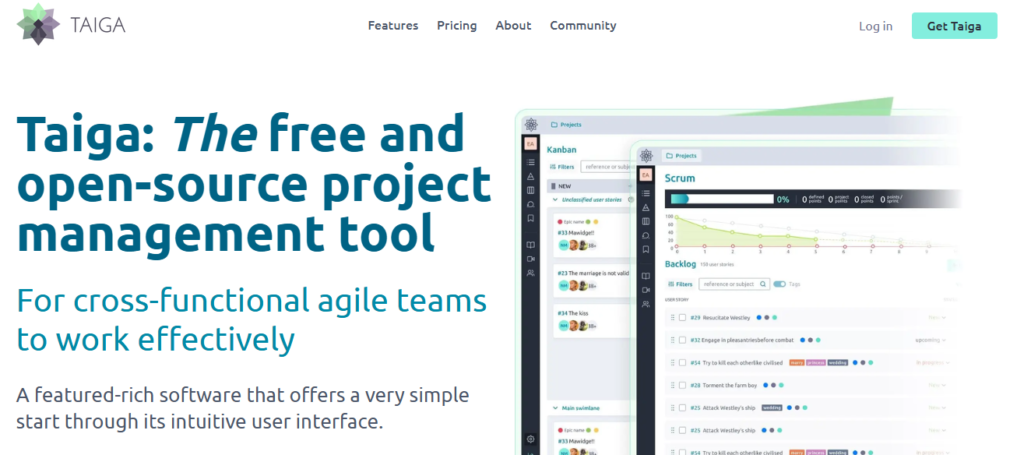
Taiga was built specifically for agile teams, and it shows. The interface is clean, the workflow is intuitive, and the tool never buries you in configuration. It supports Scrum, Kanban, and a hybrid mode out of the box, making it one of the most accessible options for teams transitioning from spreadsheets or basic task boards into real agile workflows.
What makes Taiga particularly interesting is its GitHub and GitLab integration. You can link commits and pull requests directly to user stories and issues, which gives developers a genuine feedback loop between their code and their project board. This is something most open source PM tools treat as an afterthought. Taiga treats it as a feature.
For teams specifically hunting for the Best Agile Project Management Software Tools that they can self-host without a complicated setup process, Taiga is one of the easiest options to get running. The Docker-based deployment is well-documented, and the community around it is active and helpful.
Key Features
- Native Scrum support with user stories, sprints, backlog, and burndown charts
- Kanban boards with swim lanes, WIP limits, and customizable workflows
- GitHub and GitLab integration for linking commits and PRs to project issues
- Epic and user story hierarchy for structured product roadmap planning
- Issues module for tracking bugs, questions, and improvements separately from stories
- Multi-project workspace with cross-project member and role management
Pros
- Purpose-built for agile so workflows feel natural from day one
- Git integration makes it highly relevant for software development teams
- Easy Docker-based self-hosting with clear official documentation
- Supports both Scrum and Kanban in the same workspace
- Clean, uncluttered UI that does not require extensive training
Cons
- Lacks the breadth of Gantt and timeline features found in OpenProject
- Not well-suited for non-technical or business-side project management
- Limited built-in reporting compared to enterprise tools
- Cloud-hosted version has usage limits that push you toward paid plans
Best For: Software development teams and technical product managers who want a self-hosted agile board with native Git integrations and clean sprint workflows.
4. Redmine – The Battle-Hardened Classic That Still Delivers
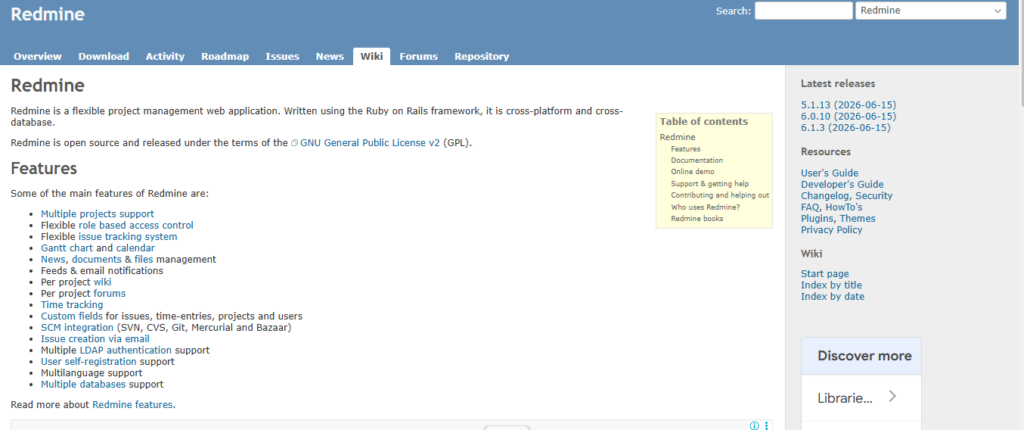
Redmine has been around since 2006, which in software terms makes it ancient. But longevity has a way of building something valuable: a massive plugin ecosystem, deep documentation, and an installation base that spans thousands of organizations worldwide. If a feature exists in project management, there is probably a Redmine plugin for it.
The core feature set includes issue tracking, Gantt charts, time logging, wiki pages, and repository browsing for Git, SVN, and Mercurial. It is not pretty. The interface has the aesthetic charm of early 2010s enterprise software. But it works, it is stable, and it is genuinely free and open source under the GPL v2 license with no vendor strings attached.
Redmine is a particularly strong choice as the Best Project Management Software for Small Business teams with technical staff who want total control over their data and are comfortable managing a Ruby on Rails application. If you can tolerate the UI and handle the setup, the long-term cost is essentially zero.
Key Features
- Flexible issue tracking with custom fields, workflows, priorities, and categories
- Gantt charts and calendar view for timeline and deadline management
- Built-in time tracking with reporting and export capabilities
- Wiki system for documentation and knowledge base per project
- Repository browsing for Git, SVN, Mercurial, and CVS integrations
- Massive plugin ecosystem with 1,000+ community-built extensions
Pros
- One of the most mature and stable open source PM tools available
- Enormous plugin library covering nearly every workflow need
- Completely free with no licensing tiers or feature paywalls
- Supports multiple version control systems natively
- Highly customizable through plugins, themes, and configuration
Cons
- Outdated UI that requires significant effort to modernize
- Plugin compatibility can break between versions during upgrades
- No native mobile app; mobile experience is poor without third-party tools
- Setup and maintenance require Ruby on Rails server expertise
Best For: Technical teams and IT departments that value stability, a massive plugin ecosystem, and zero licensing cost over modern UX or easy onboarding.
5. Leantime – ADHD-Friendly PM Tool Designed for Focused, Neurodivergent Teams
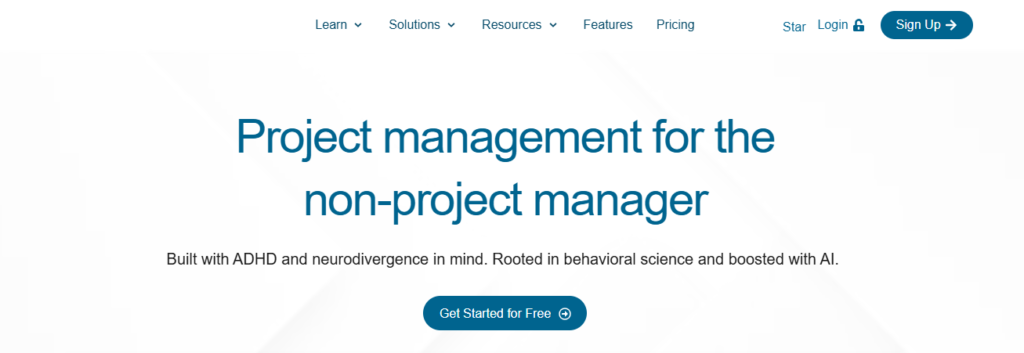
Leantime is unlike anything else on this list. It was explicitly designed with neurodivergent users in mind, particularly people with ADHD, and focuses on reducing cognitive overload while helping teams stay focused on outcomes rather than just task lists. This is a genuinely differentiated design philosophy, not a marketing angle.
Practically speaking, this translates to a tool that surfaces the right information at the right time, reduces visual noise, and helps teams connect daily work to strategic goals. It includes features like a daily check-in, a personal task view (My Work), and goal-setting frameworks that help individuals and teams build productive habits rather than just tracking tickets.
Beyond its unique positioning, Leantime is a capable project management platform. It supports Kanban boards, timelines, time tracking, retrospectives, and idea boards. For teams that care about the Best Project Management Software for Small Business and want something that actually helps people focus rather than just filing tasks into lists, Leantime is worth serious consideration.
Key Features
- ADHD-friendly interface designed to reduce cognitive load and decision fatigue
- Daily and weekly personal check-ins to keep individuals grounded in priorities
- My Work view for each team member showing their personal task queue in context
- Goal and OKR tracking to connect project work to strategic outcomes
- Kanban boards, timelines, and idea boards for visual workflow management
- Retrospective module with built-in formats to support continuous improvement
Pros
- Uniquely designed for neurodivergent users, reducing overwhelm and burnout
- Strong personal productivity layer alongside team collaboration features
- Actively developed with a genuine community-driven product philosophy
- Docker-based self-hosting that is straightforward to configure
- OKR and goal tracking built natively into the project workflow
Cons
- Smaller community and plugin ecosystem than Redmine or OpenProject
- Less suited for large enterprise teams or complex multi-project portfolios
- Gantt chart functionality is more basic than dedicated Gantt tools
- Brand recognition is low, which can affect team adoption and buy-in
Best For: Small to mid-size teams, creative agencies, and organizations prioritizing team wellbeing and focus. Especially valuable when neurodivergent team members are part of the mix.
Open Source Project Management Software: Comparison Table 2026
Use this table to compare the top tools side by side before making your decision. Each column targets a specific evaluation criterion that matters in real-world team environments.
| Tool | Best For | Key Strength | Integrations | Ease of Use | Agile Support |
|---|---|---|---|---|---|
| Plane | Dev & Product Teams | Modern UI + AI | GitHub, Slack, APIs | Very Easy | Excellent |
| OpenProject | Enterprise / Gov | Full Feature Depth | LDAP, Git, APIs | Moderate | Strong |
| Taiga | Agile Dev Teams | Agile + Git Integration | GitHub, GitLab | Easy | Excellent |
| Redmine | Technical Teams | Plugin Ecosystem | Git, SVN, Hg | Moderate | Good |
| Leantime | Small Teams / Focus | ADHD-Friendly UX | Slack, OAuth | Easy | Good |
Final Verdict
Plane wins for most modern teams looking for an immediate Jira replacement with no per-user cost and an active development roadmap. OpenProject is the right call for enterprise environments needing compliance, audit trails, and deep Gantt capabilities. Taiga is the top pick for pure agile and software development workflows with Git at the center. Redmine remains unbeatable for teams that want maximum plugin flexibility and do not mind a dated interface. Leantime is the most thoughtful choice for smaller teams prioritizing human-centered design and focus over feature density.
To explore more in-depth comparisons like this, visit TheListify, where we regularly publish expert-curated lists of the best tools and software for businesses across various industries. Whether you’re searching for Best CRM Tools, Best Accounting Software, Best Recruiting Software, Best Project Management Software, Best marketing tools, or productivity solutions, our detailed guides help you make informed decisions faster.